-
05-27 2026
Top Mistakes To Avoid When Choosing Hardness Testing Equipment
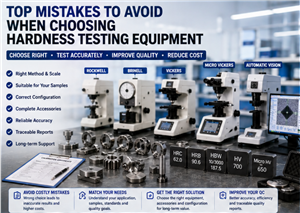
The biggest mistake when choosing hardness testing equipment is treating the purchase as a simple machine comparison. In reality, reliable hardness testing depends on method selection, sample compatibility, test force, calibration blocks, indenters, fixtures, sample preparation, automation, software, and operator workflow. Buyers should avoid choosing only by price or catalogue appearance. A suitable solution should match the factory’s real materials, samples, standards, testing volume, reporting needs, and long-term quality control process. If you are not sure which hardness tester is right for your application, share your sample details and testing requirements before ordering. A complete technical recommendation can help you avoid wrong equipment selection and improve testing reliability from the beginning.
-
05-25 2026
Calibration Blocks For Hardness Testers: What Buyers Must Know
Calibration blocks are essential for reliable hardness testing. They help verify machine performance, detect abnormal readings, support daily quality checks, and strengthen customer confidence in test reports. The right block should match the hardness method, scale, value range, and certificate requirement. Buyers should avoid ordering generic “hardness blocks” without confirming the testing method and scale. Rockwell, Brinell, Vickers, Micro Vickers, Barcol, and Shore testing all require suitable references. Using the wrong block can lead to unreliable verification and quality disputes. For a complete QC system, calibration blocks should be purchased together with proper indenters, fixtures, maintenance procedures, operator training, and verification records. This creates a more stable and traceable hardness testing process.
-
05-22 2026
3 Key Considerations Before Buying Rockwell Hardness Testing Equipment
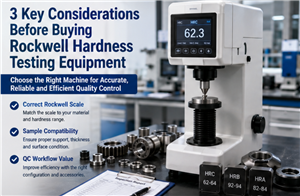
Before buying Rockwell hardness testing equipment, buyers should focus on three key points: the required Rockwell scale, the real sample condition, and the machine configuration needed for daily quality control. These factors affect not only the machine price, but also testing accuracy, operator efficiency, and long-term reliability. A suitable Rockwell hardness tester should support your material range, sample geometry, required scale, calibration process, and reporting workflow. For a factory that tests heat-treated parts, automotive components, bearings, tools, or metal products every day, choosing the correct configuration can reduce testing errors and improve production control. If you are unsure which Rockwell tester is suitable, provide your sample details and testing requirements before requesting a quote. A technical recommendation can help avoid wrong model selection and unnecessary cost.
-
05-20 2026
How To Reduce Measurement Error In Vickers, Rockwell And Brinell Hardness Testing
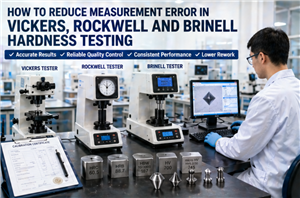
Reducing measurement error in Vickers, Rockwell, and Brinell hardness testing requires more than adjusting one machine setting. Buyers and operators should control sample preparation, scale selection, test force, indenter condition, calibration block verification, optical measurement, indentation spacing, and operator procedure together. For Vickers testing, polished surfaces and accurate indentation measurement are critical. For Rockwell testing, scale selection, sample support, thickness, and indenter condition are key. For Brinell testing, correct force and ball combination, surface condition, and diameter measurement accuracy are essential. A well-controlled hardness testing process improves repeatability, reduces quality disputes, supports customer audits, and makes industrial QC reports more reliable.
-
05-19 2026
Hardness Tester Calibration Blocks: What Buyers Should Know Before Ordering
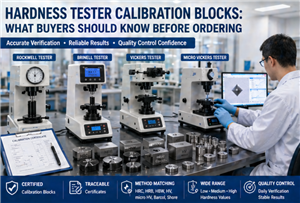
Hardness tester calibration blocks are small accessories, but they play a major role in measurement reliability. The right block helps verify tester performance, detect abnormal readings, support daily QC checks, and strengthen customer confidence in test reports. Buyers should confirm the hardness method, scale, value range, certificate, traceability requirement, surface condition, and block quantity before ordering. For laboratories using multiple hardness testers, each method should have suitable reference blocks. A complete hardness testing setup should include not only the machine, but also proper calibration blocks, indenters, fixtures, maintenance tools, software records, and operator procedures. This helps create a more stable and trustworthy quality control system.
-
05-15 2026
How To Choose Hardness Testing Equipment For Automotive Parts Inspection
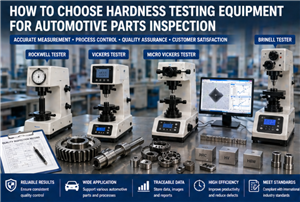
Choosing hardness testing equipment for automotive parts inspection should start from the part type, material, heat treatment process, hardness scale, and testing location. Rockwell testers are suitable for fast production checks. Brinell testers are useful for larger castings and forgings. Vickers and Micro Vickers testers are important for precision testing, case depth analysis, coatings, and small samples. Buyers should also consider sample fixtures, calibration blocks, indenters, sample preparation equipment, automation level, and report functions. For automotive quality control, repeatability and traceability are just as important as the hardness value itself. A well-selected hardness testing solution helps improve process control, reduce rejected parts, support customer audits, and provide reliable documentation for production and quality teams.
-
05-14 2026
How To Select A Hardness Tester For Heat Treatment Quality Control
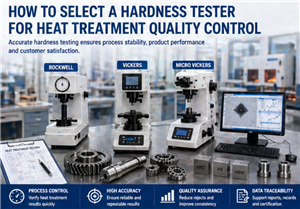
Selecting a hardness tester for heat treatment quality control should start from the actual process and inspection purpose. Rockwell testers are highly practical for fast batch inspection after quenching and tempering. Vickers and Micro Vickers testers are better for precision testing, case depth analysis, carburized layers, nitrided layers, and hardness profiles. Brinell testers may be suitable for large heat-treated castings and forgings. Buyers should not compare only price. They should evaluate hardness method, scale, load range, sample size, fixtures, calibration blocks, automation level, sample preparation needs, and data reporting functions. A well-selected tester helps improve production control, reduce quality disputes, and provide reliable documentation for customers. If your heat treatment process involves multiple materials and hardness requirements, a complete solution may include Rockwell testing for fast production checks and Micro Vickers testing for detailed layer analysis.
-
05-06 2026
How To Choose A Rockwell Hardness Tester For Metal And Plastic Materials
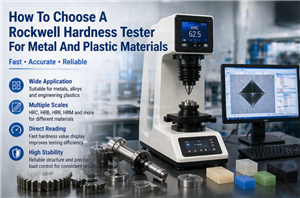
Choosing a Rockwell hardness tester for metal and plastic materials requires more than comparing price. Buyers should first confirm the material type, required Rockwell scale, indenter, test force, sample thickness, and testing purpose. Hardened metals, softer metals, engineering plastics, and thin samples may all require different configurations. For routine metal quality control, a digital Rockwell tester is often a practical choice. For higher-volume production inspection, an automatic Rockwell tester can improve repeatability and efficiency. For laboratories testing both metals and plastics, scale flexibility and accessory support become especially important. The best Rockwell hardness tester is the one that matches your real samples, testing standard, daily workload, and documentation needs. Before purchasing, provide detailed material and sample information so the tester configuration can be recommended correctly.
-
05-04 2026
What Load Range Matters Most When Choosing A Hardness Tester
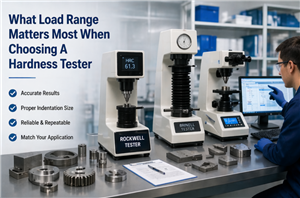
Load range matters because it directly affects indentation size, measurement accuracy, sample damage, and result repeatability. A suitable hardness tester should not be selected only by maximum force. It should be selected according to the material, thickness, surface condition, test method, accuracy requirement, and quality control workflow. For thin coatings and small parts, low-load Micro Vickers or Vickers testing is often more suitable. For routine production inspection, Rockwell testing may provide faster results. For large castings and forgings, Brinell testing can provide a more representative value. For laboratories with multiple testing needs, a wider load range or multi-method configuration may be more practical. Before purchasing, provide detailed sample information and testing requirements. This will help identify the correct load range and avoid choosing a hardness tester that is either under-configured, over-configured, or unsuitable for the real application.
-
05-02 2026
Rockwell vs Brinell vs Vickers Hardness Testing: Which Method Should You Choose?
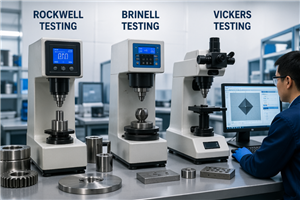
Rockwell, Brinell, and Vickers hardness testing each have clear strengths. Rockwell is fast and practical for routine production inspection. Brinell is reliable for large parts, castings, forgings, and materials with uneven structures. Vickers is precise and flexible for thin layers, coatings, small samples, and laboratory analysis. The best choice is not simply the most advanced machine. It is the method that matches your material, sample condition, accuracy requirement, testing speed, and quality control workflow. For many industrial laboratories, a combination of different hardness testing methods may be necessary to cover both production inspection and detailed material analysis. If you are unsure which hardness testing method is suitable for your application, provide your material information, sample size, expected hardness range, and inspection purpose before requesting a quote. This will help identify the most practical and cost-effective testing solution.