


What Load Range Matters Most When Choosing A Hardness Tester
What Load Range Matters Most When Choosing A Hardness Tester
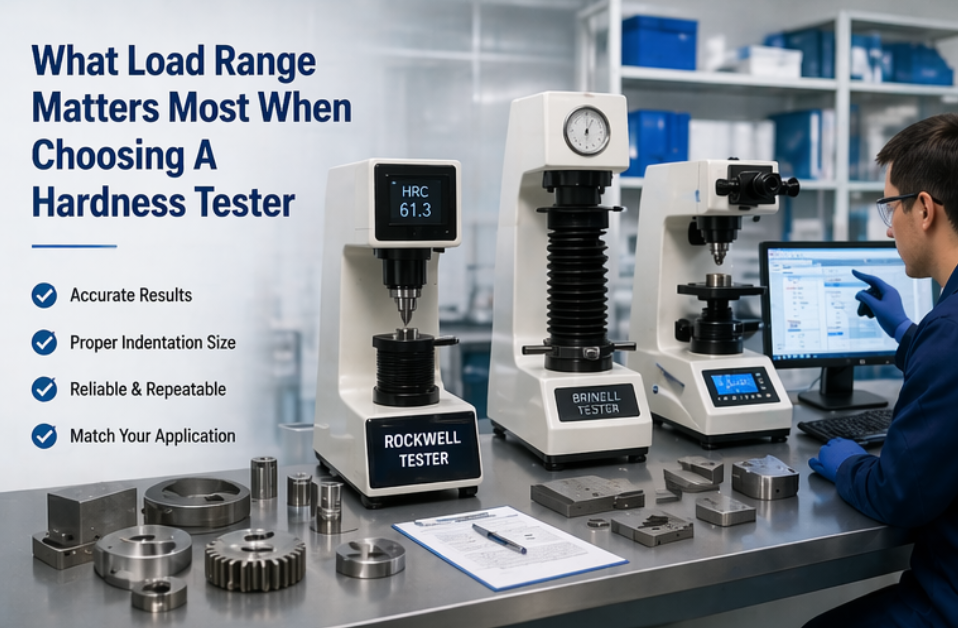
Load range is one of the most important factors when selecting a hardness tester. The correct load affects indentation size, measurement accuracy, repeatability, sample damage, and whether the result truly represents the material. For industrial quality control, buyers should match the load range to the material, thickness, hardness level, surface condition, and testing standard.
Material Thickness
Thin layers and small parts need lower loads, while large metal parts usually require higher loads for stable results.
Indentation Size
The load must create a measurable indentation without damaging the sample or being affected by the base material.
Testing Standard
Different Rockwell, Brinell, Vickers, and Micro Vickers methods require different load configurations.
When choosing a hardness tester, many buyers first compare price, machine appearance, display type, or brand. However, load range is often more important than these surface-level factors. The load determines how much force is applied to the sample during testing. If the load is not suitable, the indentation may be too large, too small, too shallow, or too deep, resulting in unreliable hardness values. A hardness tester does not simply “press and read.” Each test method is designed around a specific relationship between force, indenter type, material response, and indentation measurement. Rockwell testing depends on indentation depth. Brinell testing depends on the diameter of a larger round indentation. Vickers testing depends on the diagonal length of a diamond-shaped indentation. Micro Vickers testing uses lower forces to measure small areas, thin layers, coatings, and delicate samples. For industrial quality control, the load range must match the material hardness, sample thickness, surface preparation, required test standard, and inspection purpose. A wrong load may make the result look accurate on the screen, but the value may not represent the real material condition. Sample thickness is one of the first details buyers should confirm. A thin coating, a hardened surface layer, a small precision part, and a thick casting cannot be tested with the same load. If the load is too high for a thin sample, the indentation may penetrate through the tested layer and be affected by the substrate. If the load is too low for a large or rough metal part, the indentation may be unclear or not representative. For thin layers and coatings, low-load Vickers or Micro Vickers testing is usually preferred because it can create small, controlled indentations. For larger castings and forgings, Brinell testing often uses higher loads and larger indentations to obtain a more representative average value. For routine production inspection of metal parts, Rockwell testing is often selected because it is fast and practical.1. Why Load Range Is Critical In Hardness Testing
2. Start With The Sample Type And Thickness
Sample Type Load Range Focus Recommended Method Thin coatings and surface layers Low load, small indentation, high magnification Micro Vickers / Vickers Small precision metal parts Controlled load and stable sample positioning Vickers / Micro Vickers Routine machined metal parts Standard production inspection load Rockwell Castings and forgings Higher load and larger indentation Brinell
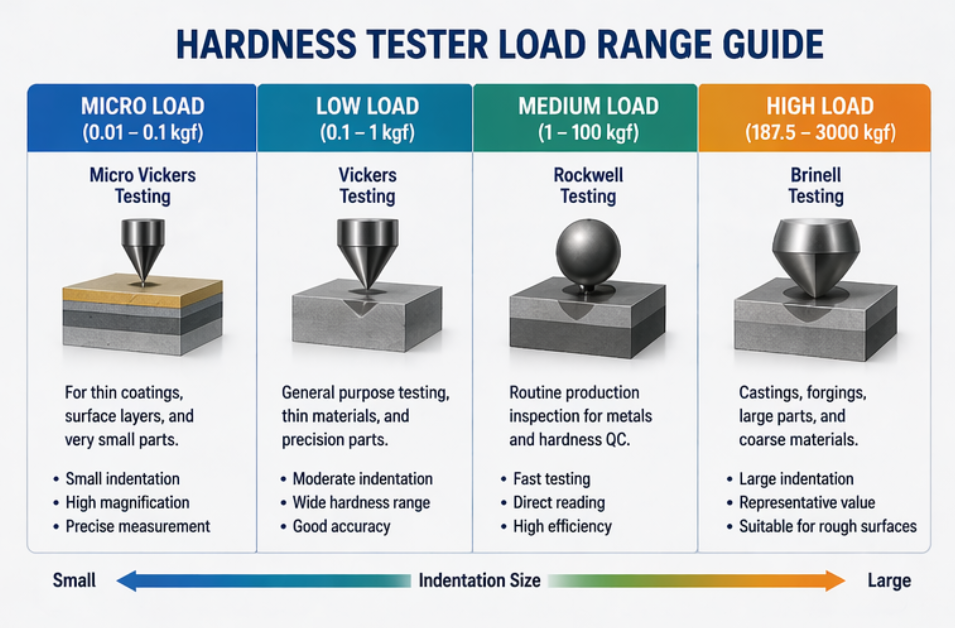
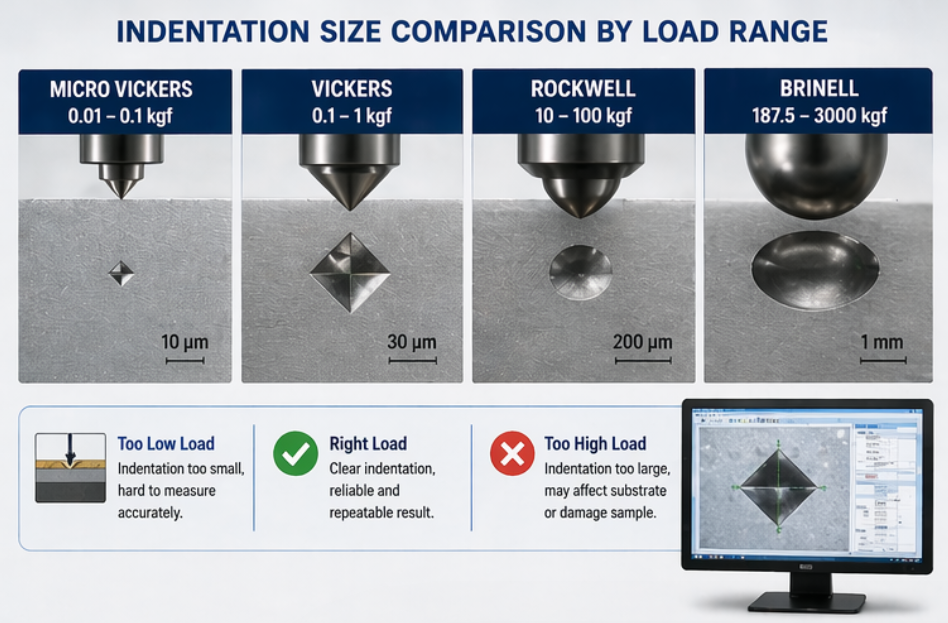
Different hardness testing methods use different force ranges because they are designed for different sample conditions and measurement principles. A buyer should not ask only for “a hardness tester.” It is better to define the hardness method first, then confirm whether the machine supports the required load range. A common purchasing mistake is assuming that a higher load range means a better hardness tester. In reality, the best load is not the highest load. The best load is the one that creates a clear, measurable, and appropriate indentation for the sample being tested. For thin layers, a high load may penetrate beyond the coating and measure the base material instead of the surface layer. For small components, a high load may deform the part or make the test area unusable. For very hard materials, an unsuitable low load may create an indentation that is too small to measure accurately. For rough or coarse materials, a very small indentation may not represent the overall material structure. Buyers should therefore focus on the useful load range, not only the maximum load. A machine with the right low-load accuracy, stable force application, suitable dwell time, and good measurement system may be more valuable than a machine that simply lists a high maximum force. Load range and indentation measurement must be considered together. A hardness tester may apply the required force, but if the indentation cannot be measured clearly, the result will still be unreliable. This is especially important for Vickers and Micro Vickers testing, where the hardness value depends on precise diagonal measurement. For optical measurement methods, buyers should check magnification, image clarity, camera resolution, illumination, automatic measurement software, and data export. For depth-based methods like Rockwell, buyers should pay attention to loading control, scale selection, sample support, and machine repeatability. For Brinell testing, the machine should support proper ball diameter and indentation diameter measurement. Large enough to measure clearly. Small enough to avoid damaging the sample. Not affected by the substrate or nearby edges. Representative of the material being tested. Compatible with the required testing standard.3. Understand Load Range By Testing Method
Testing Method Load Range Concern Best Application Buyer Checkpoint Rockwell Correct scale and major load selection Fast production QC for metals and plastics Check supported Rockwell scales and sample thickness Brinell Higher load and ball diameter matching Castings, forgings, coarse materials Check force capacity and indentation measurement system Vickers Wide load range and clear optical measurement General precision testing and metallographic samples Check objective lenses, load accuracy, and software Micro Vickers Very low load and small indentation control Thin layers, coatings, case depth, small parts Check micro-load stability and image measurement resolution 4. Do Not Select The Highest Load Just Because It Looks Stronger
5. Match Load Range With Indentation Measurement
A suitable load should create an indentation that is:
When purchasing a hardness tester, buyers should not only consider the current sample. Many factories start with one type of product but later need to test different materials, coatings, heat-treated layers, or customer-specific standards. A machine with a wider useful load range can offer more flexibility. For example, a laboratory that mainly tests metal parts today may later need to test thin surface-treated layers. A heat treatment workshop may need both fast Rockwell testing and more detailed Vickers analysis. A research or third-party testing lab may need wider method coverage, more load options, and stronger data reporting. If your testing needs are likely to expand, consider whether a universal hardness tester, automatic Vickers tester, or a combination of different machines would be more practical. The goal is not to buy the most complex machine, but to avoid purchasing a tester that becomes too limited after a few months. To choose the right load range, buyers should prepare clear testing information before asking for a quotation. This helps the manufacturer recommend the proper hardness tester, indenter, test blocks, fixture, and software configuration. What material will be tested? Is the sample metal, plastic, coating, casting, forging, or heat-treated part? What is the sample thickness? Is the surface polished, machined, rough, curved, or coated? What hardness method or standard is required? What hardness range is expected? How large can the indentation be? Will the test affect the final product surface? How many samples need to be tested per day? Do you need data export, image storage, or test reports?6. Consider Current And Future Testing Needs
7. Key Questions Before Requesting A Quote
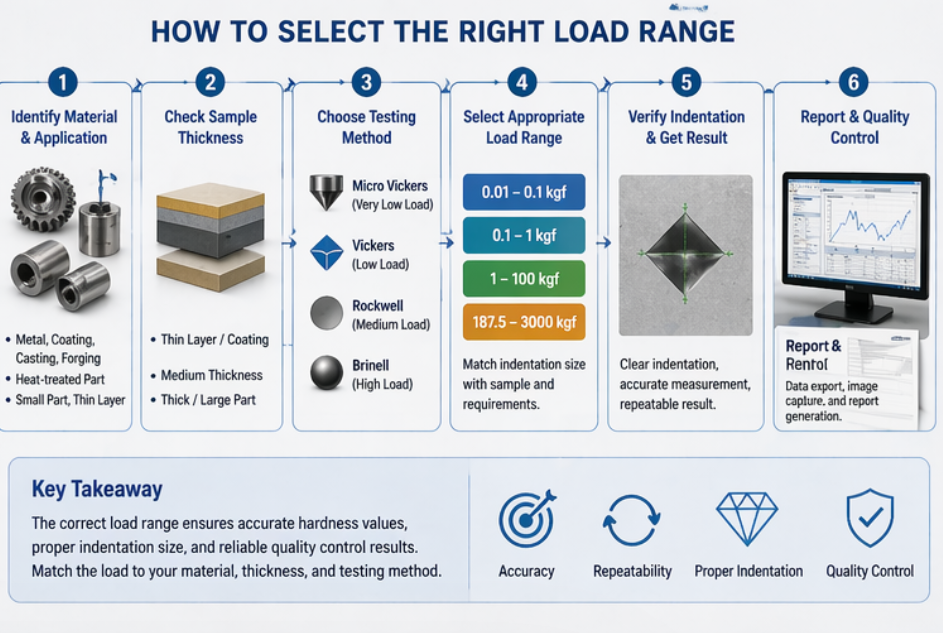
Load range matters because it directly affects indentation size, measurement accuracy, sample damage, and result repeatability. A suitable hardness tester should not be selected only by maximum force. It should be selected according to the material, thickness, surface condition, test method, accuracy requirement, and quality control workflow. For thin coatings and small parts, low-load Micro Vickers or Vickers testing is often more suitable. For routine production inspection, Rockwell testing may provide faster results. For large castings and forgings, Brinell testing can provide a more representative value. For laboratories with multiple testing needs, a wider load range or multi-method configuration may be more practical. Before purchasing, provide detailed sample information and testing requirements. This will help identify the correct load range and avoid choosing a hardness tester that is either under-configured, over-configured, or unsuitable for the real application. No. The correct load should match the sample thickness, material, testing method, and required indentation size. A higher load can damage thin samples or measure the wrong layer. Micro Vickers or low-load Vickers testing is usually better for thin layers, coatings, and small precision parts because it creates smaller controlled indentations. Brinell testing is often preferred for large castings and forgings because the larger indentation can better represent coarse or uneven material structures. You should provide material type, sample thickness, surface condition, expected hardness, testing standard, daily testing volume, and whether the sample can be marked or damaged by indentation.Conclusion: The Right Load Range Depends On The Real Testing Job
FAQ
Does a higher test load always mean better hardness testing?
Which hardness tester is better for thin layers?
Which method is better for large castings?
What information should I provide before choosing a load range?
Need Help Choosing The Right Hardness Tester Load Range?
Share your material type, sample thickness, hardness range, testing standard, and daily inspection needs. We can help recommend a suitable hardness tester configuration for your industrial quality control process.