
Top Mistakes To Avoid When Choosing Hardness Testing Equipment
Top Mistakes To Avoid When Choosing Hardness Testing Equipment
Choosing hardness testing equipment is not only about selecting a machine with the right price. Buyers must consider material type, hardness method, sample size, test force, calibration blocks, indenters, fixtures, sample preparation, automation level, software reports, and long-term quality control needs. Avoiding common purchasing mistakes can help factories reduce testing errors, save cost, and improve inspection reliability.
Wrong Method
Rockwell, Brinell, Vickers, Micro Vickers, Barcol, Shore, and Leeb testing are not interchangeable.
Wrong Configuration
Sample size, thickness, fixture, test force, optical system, and automation level must match real applications.
Missing Accessories
Calibration blocks, indenters, anvils, software, and sample preparation equipment are essential for reliable results.
Hardness testing equipment is often purchased for quality control, incoming inspection, heat treatment verification, coating evaluation, automotive parts inspection, casting and forging inspection, and laboratory testing. If the equipment does not match the real sample or testing method, the factory may get unstable results, repeated tests, customer complaints, or even wrong production decisions. Many buyers compare machine prices first, but hardness testing is a complete process. The correct method, proper sample support, suitable test force, calibration blocks, indenters, fixtures, software, and operator workflow all affect the final result. A cheaper machine may become expensive if it cannot test the required samples or produce reliable reports. Before ordering, buyers should understand the most common mistakes and prepare clear sample information. This helps suppliers recommend equipment that fits real factory quality control instead of only quoting a generic model. One of the biggest mistakes is assuming that one hardness tester can solve every testing problem. Rockwell testing is fast and suitable for routine metal inspection. Brinell testing is useful for castings, forgings, and large metal parts. Vickers and Micro Vickers testing are better for precision testing, coatings, thin layers, case depth, and small parts. Barcol, Shore, and Leeb testing also have their own application ranges. If the method does not match the material and sample, the result may be inaccurate or not accepted by customers. Buyers should first confirm what materials they test, what standard is required, and what hardness scale is used in drawings or specifications.Why Hardness Tester Selection Mistakes Are Costly
Mistake 1: Choosing The Wrong Hardness Testing Method
Testing Method Suitable Application Common Buying Mistake Rockwell Fast QC for metals, heat-treated parts, tools, bearings Ignoring required scale such as HRC, HRB, HRA, or superficial Rockwell Brinell Castings, forgings, large components, coarse structures Choosing a machine without enough force or sample space Vickers Precision metal testing, weld sections, polished samples Ignoring optical measurement and sample preparation needs Micro Vickers Thin layers, coatings, case depth, small parts Using too high a load or skipping polishing preparation
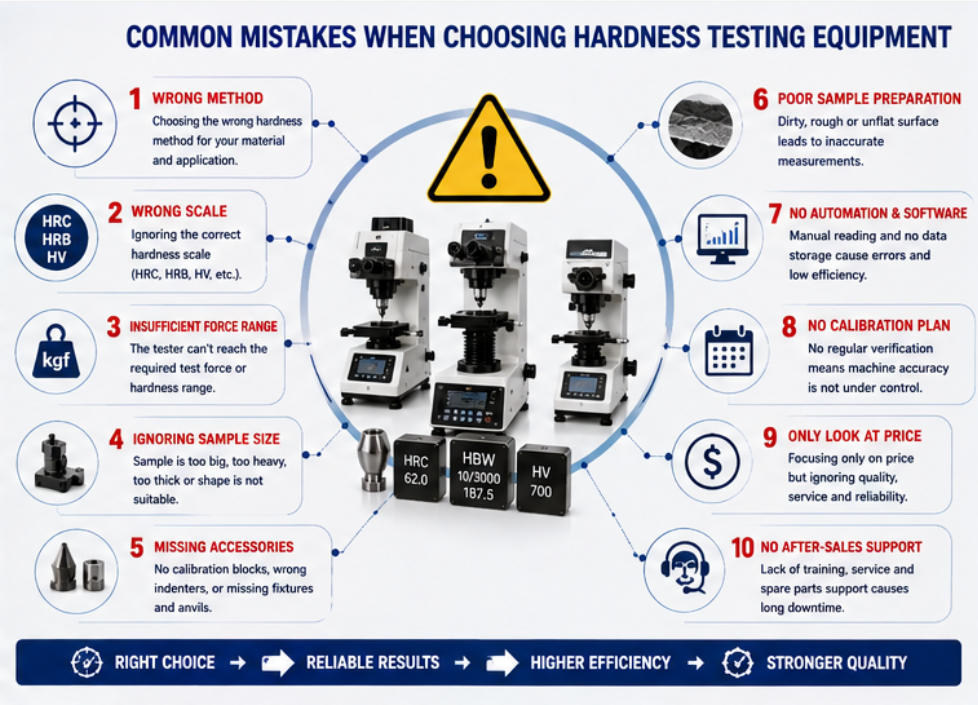
A hardness tester must physically fit the sample and support it correctly. Some buyers only check the hardness method and forget sample height, throat depth, worktable size, sample weight, thickness, and fixture requirements. This can cause major problems after the machine arrives. Round shafts, gears, bearings, fasteners, castings, forgings, thin sheets, coatings, weld sections, and small precision parts may all require different supports or fixtures. If the sample is unstable during testing, the result may shift. If the sample is too thin for the selected test force, the reading may be affected by the backing surface. Maximum sample height, width, diameter, thickness, and weight. Whether the sample is flat, round, curved, thin, coated, or irregular. Whether the test location is easy to reach. Whether special anvils, V fixtures, clamps, or custom supports are required. Whether the sample surface needs cutting, mounting, grinding, or polishing. Whether portable testing is needed for large or immovable parts. Price is important, but choosing only the lowest price can lead to hidden costs. A low-cost machine may not include necessary calibration blocks, indenters, fixtures, software, report functions, or after-sales support. It may also have limited test force range, poor optical clarity, or low automation level. Buyers should compare total value instead of only initial price. For a factory that tests many samples every day, better automation, digital measurement, and report export can save labor and reduce mistakes. For a laboratory that needs customer reports, image storage and data traceability may be more important than saving a small amount on the machine purchase.Mistake 2: Ignoring Sample Size, Shape And Thickness
Before ordering, buyers should confirm:
Mistake 3: Comparing Only The Machine Price
Price-Only Decision Possible Problem Better Buying Approach Choose the cheapest model May not support required samples or testing standards Compare method, scale, force range, and sample capacity Ignore accessories Extra cost for blocks, indenters, anvils, and fixtures later Request a complete configuration list before ordering Ignore software Manual records and weak traceability Check data storage, image capture, statistics, and report export Ignore service support Hard to solve setup, training, or maintenance problems Confirm manuals, training, spare parts, and technical support
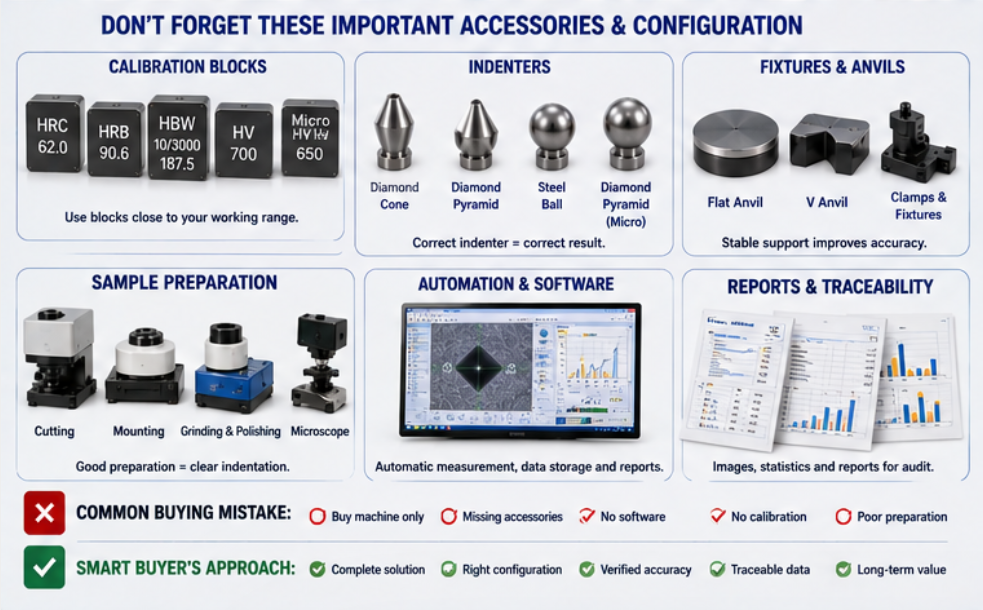
Calibration blocks and indenters are essential for reliable hardness testing. Without suitable calibration blocks, the operator cannot verify whether the machine is reading correctly. Without the correct indenter, the test may not match the required method or scale. Rockwell testing may require diamond cone or ball indenters and HRC, HRB, or other test blocks. Brinell testing requires suitable ball indenters and HBW blocks. Vickers and Micro Vickers testing require diamond indenters, HV blocks, and clear optical measurement. Buyers should confirm which accessories are included and which must be purchased separately. Some hardness testing methods require careful sample preparation. Vickers and Micro Vickers testing usually need a flat, polished surface so the indentation can be measured clearly. Coatings, weld sections, and case depth samples may require cutting, mounting, grinding, and polishing before testing. If buyers purchase only the hardness tester but do not prepare the sample properly, the results may still be unstable. For a complete laboratory, sample preparation equipment should be considered together with hardness testing equipment. Metallographic cutting machine for low-damage sectioning. Hot or cold mounting equipment for small or irregular samples. Grinding and polishing machine for flat and clean surfaces. Polishing consumables such as grinding papers, polishing cloths, and diamond suspension. Cleaning station or ultrasonic cleaning equipment. Microscope for checking surface quality before hardness testing. Manual machines can be suitable for low-volume inspection, but they may not be enough for busy laboratories or factories with strict documentation requirements. If multiple operators use the same tester, manual measurement and manual records may create variation. Digital and automatic systems can improve efficiency, reduce reading errors, save images, store test data, calculate statistics, and export reports. For Vickers, Micro Vickers, and Brinell testing, automatic vision measurement can reduce operator variation and improve traceability.Mistake 4: Forgetting Calibration Blocks And Indenters
Mistake 5: Ignoring Sample Preparation Requirements
Sample preparation equipment may include:
Mistake 6: Not Considering Automation And Reports
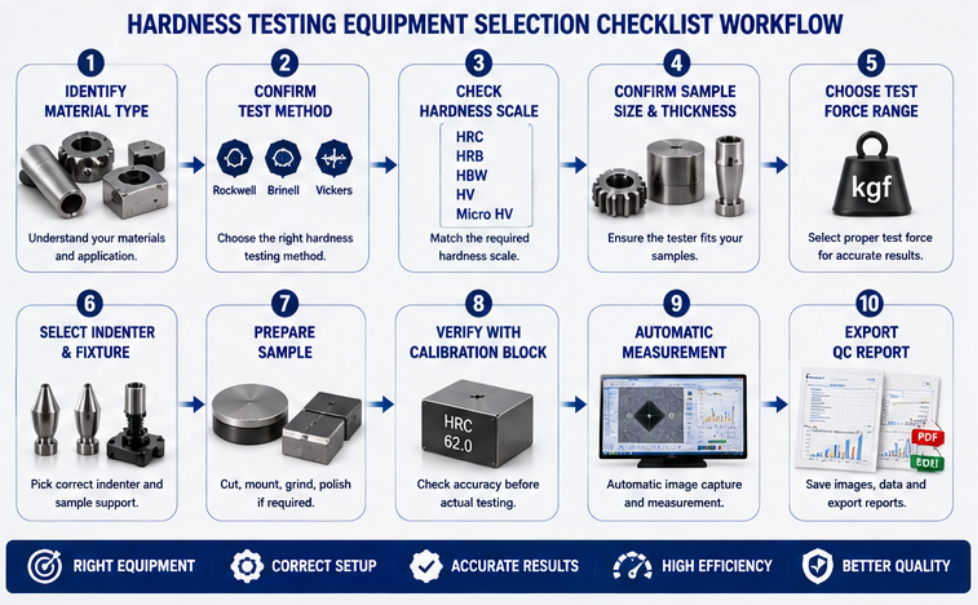
To avoid wrong model selection, buyers should prepare detailed application information before requesting a quotation. This allows the supplier to recommend a suitable hardness testing solution instead of a generic machine. What materials will be tested? Which hardness method is required: Rockwell, Brinell, Vickers, Micro Vickers, Barcol, Shore, or Leeb? What hardness scale and value range are needed? What are the sample size, shape, thickness, weight, and surface condition? How many samples and test points are measured per day? Do you need manual, digital, automatic, or automatic vision measurement? Do you need calibration blocks, indenters, anvils, fixtures, or custom supports? Do samples require cutting, mounting, grinding, and polishing before testing? Do you need image storage, statistics, Excel export, or PDF reports? Do you need installation support, training, spare parts, and long-term technical service? The biggest mistake when choosing hardness testing equipment is treating the purchase as a simple machine comparison. In reality, reliable hardness testing depends on method selection, sample compatibility, test force, calibration blocks, indenters, fixtures, sample preparation, automation, software, and operator workflow. Buyers should avoid choosing only by price or catalogue appearance. A suitable solution should match the factory’s real materials, samples, standards, testing volume, reporting needs, and long-term quality control process. If you are not sure which hardness tester is right for your application, share your sample details and testing requirements before ordering. A complete technical recommendation can help you avoid wrong equipment selection and improve testing reliability from the beginning. The most common mistake is choosing equipment only by price without confirming the hardness method, sample size, test force, accessories, and reporting needs. Not always. Different materials and applications may require Rockwell, Brinell, Vickers, Micro Vickers, Barcol, Shore, Leeb, or universal hardness testing methods. Calibration blocks help verify tester accuracy and detect problems such as machine drift, worn indenters, wrong setup, or operator error. It is useful for Vickers, Micro Vickers, Brinell, case depth testing, coating inspection, batch testing, and laboratories that require saved images and traceable reports.Key Questions Before Requesting A Quote
Conclusion: Buy Based On Real Testing Needs, Not Only Equipment Price
FAQ
What is the most common mistake when buying hardness testing equipment?
Can one hardness tester test all materials?
Why are calibration blocks important?
When is automatic vision measurement useful?
Need Help Choosing The Right Hardness Testing Equipment?
Share your material type, sample size, hardness method, testing volume, accuracy requirement, and report needs. We can help recommend suitable hardness testing equipment, calibration blocks, accessories, and complete laboratory solutions.