
Hardness Tester Selection Guide For Automotive & Metal Parts QC
Hardness Tester Selection Guide For Automotive & Metal Parts QC
Automotive and metal parts quality control requires reliable hardness testing for material verification, heat treatment inspection, surface hardening, coating evaluation, casting and forging control, and batch consistency. To choose the right hardness tester, buyers should consider part type, material, hardness method, sample size, test location, automation level, calibration blocks, fixtures, and reporting needs.
Automotive Parts QC
Gears, shafts, bearings, fasteners, springs, brake parts, and transmission components need stable hardness verification.
Metal Parts Inspection
Castings, forgings, machined parts, tool steel, welds, and coatings require different hardness testing methods.
Traceable Reports
Digital and automatic systems help save test data, images, batch records, and customer-ready QC reports.
Automotive and metal parts often work under pressure, friction, impact, vibration, heat, and long service cycles. Parts such as gears, shafts, bearings, bolts, springs, brake components, molds, castings, forgings, and machined components must meet specific hardness requirements to ensure strength, wear resistance, fatigue performance, and dimensional stability. Hardness testing helps factories verify raw materials, heat treatment results, surface hardening quality, coating performance, weld zones, and production batch consistency. If hardness is too low, the part may wear quickly or fail under load. If hardness is too high, the part may become brittle, crack during assembly, or fail in service. Choosing the right hardness tester is therefore not only a purchasing decision. It directly affects quality control reliability, customer approval, production efficiency, and long-term product performance. Different automotive and metal parts require different hardness testing methods. A hardened gear may need Rockwell testing for fast surface hardness inspection and Micro Vickers testing for case depth analysis. A large casting may need Brinell testing because the larger indentation can better represent coarse structures. A thin coating or small precision part may require Vickers or Micro Vickers testing. Buyers should avoid assuming that one testing method can cover every application. The correct method depends on material, size, surface condition, expected hardness range, required standard, and test location.Why Hardness Testing Matters For Automotive And Metal Parts
1. Match The Hardness Method To The Part Type
Part / Material Type Common Testing Need Recommended Method Gears, shafts, bearings Heat treatment and surface hardening verification Rockwell / Vickers / Micro Vickers Fasteners and small metal parts Batch hardness consistency Rockwell / Vickers Castings and forgings Representative hardness of large metal structures Brinell / Rockwell Coatings and surface layers Thin layer hardness and substrate influence control Micro Vickers Weld sections and case depth samples Hardness profile and zone comparison Vickers / Micro Vickers
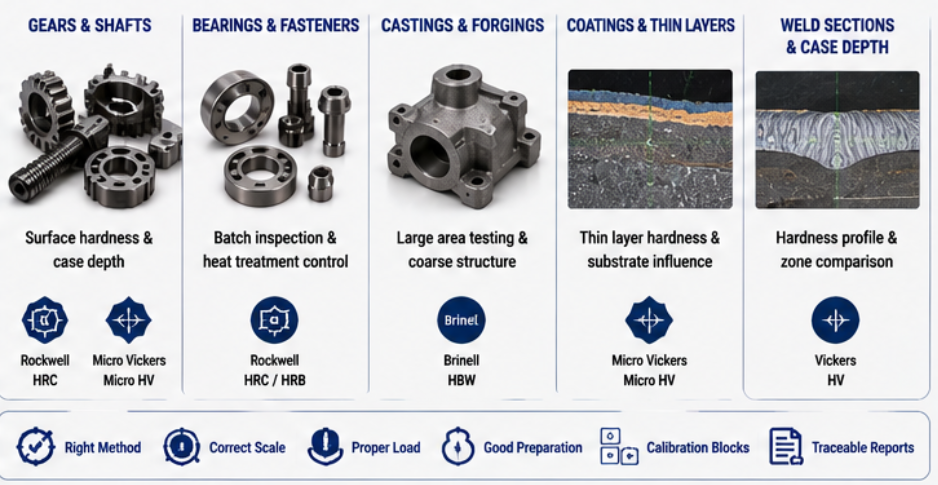
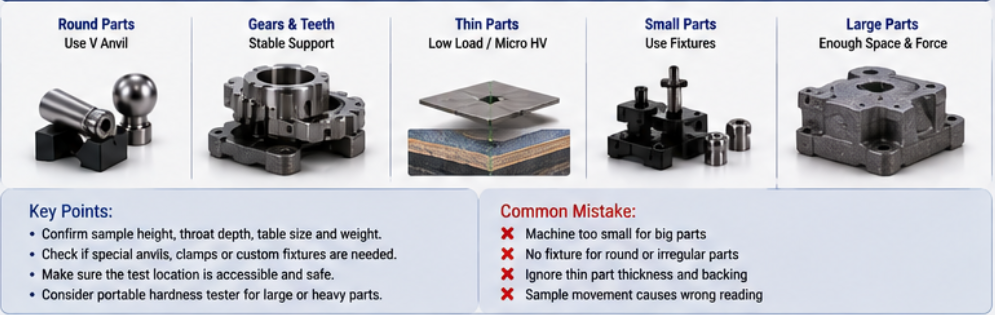
Many automotive and metal parts are heat-treated to improve strength, wear resistance, and fatigue performance. Quenching, tempering, carburizing, nitriding, and induction hardening all require reliable hardness verification. For fast production checks, Rockwell testing is often practical. For hardened layer depth or hardness profile analysis, Micro Vickers testing is usually required. If the factory only needs a quick HRC check after heat treatment, a digital Rockwell hardness tester may be suitable. If the factory needs to verify surface-to-core hardness changes, a Micro Vickers tester with proper sample preparation, optical measurement, and software reporting may be a better choice. Required hardness scale, such as HRC, HV, Micro HV, or HBW. Whether the test is for surface hardness, core hardness, or case depth. Sample size, shape, thickness, and test location. Whether cutting, mounting, grinding, and polishing are required. Whether the lab needs hardness profile and report export functions. Required calibration blocks and indenters for daily verification. Automotive and metal parts are rarely simple flat samples. They can be round, curved, toothed, threaded, heavy, thin, coated, welded, or irregular. A tester that looks suitable in a catalogue may not actually support the part correctly in daily inspection. Shafts may require V-shaped anvils. Gears may need careful test location control. Small fasteners may need stable fixtures. Large castings and forgings may require enough machine space or portable testing options. Thin parts may need lower loads or superficial testing methods.2. Choose The Right Tester For Heat Treatment Quality Control
For heat-treated parts, confirm:
3. Check Sample Size, Shape, And Fixture Requirements
Sample Condition Risk If Ignored Buyer Checkpoint Round shafts and bearings Sample movement or unstable contact Check V anvil or special fixture compatibility Large castings and forgings Machine space or force may not be enough Check test height, throat depth, force range, and sample support Small precision parts Difficult positioning and repeatability Check small-part fixtures and optical measurement options Thin layers and coatings Indentation may penetrate into the substrate Check low-load Micro Vickers capability and sample preparation
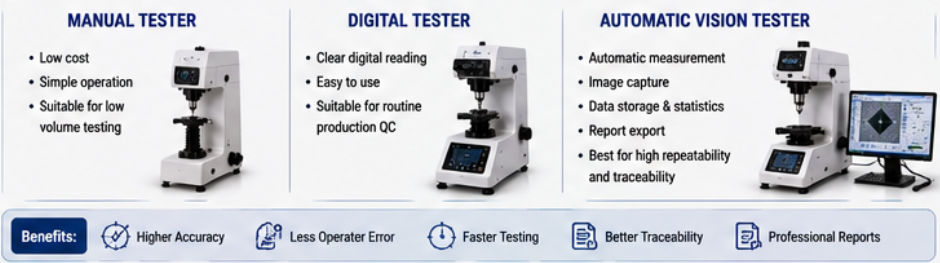
Manual hardness testers can be suitable for basic inspection and low-volume testing. Digital testers are more practical for routine factory QC because they provide clearer readings and easier operation. Automatic vision systems are especially useful for Vickers, Micro Vickers, and Brinell testing because they can reduce manual measurement variation. If your factory tests many parts every day, the automation level can directly affect efficiency and repeatability. Automatic systems may support image capture, indentation measurement, data storage, statistics, hardness profiles, and report export. These functions are valuable for automotive suppliers and industrial factories that need traceable quality documentation. A hardness tester is not complete without the correct accessories. Calibration blocks help verify machine accuracy. Indenters must match the method and scale. Fixtures and anvils help position real parts correctly. Software and reports help keep data traceable. For Vickers and Micro Vickers testing, sample preparation equipment may also be required. Automotive and metal parts QC often involves different sample types, so buyers should ask for a complete configuration list before ordering. This prevents hidden costs and ensures the equipment can be used immediately after installation. Rockwell, Brinell, Vickers, or Micro Vickers hardness tester. Calibration blocks for the required scales and value ranges. Diamond cone, ball, or Vickers diamond indenters. Flat anvils, V anvils, sample stages, and custom fixtures. Metallographic cutting, mounting, grinding, and polishing equipment. Software for image storage, statistics, hardness profiles, and report export.4. Decide Between Manual, Digital, And Automatic Systems
System Type Best For Main QC Benefit Manual hardness tester Low-volume or basic inspection Lower investment and simple operation Digital hardness tester Routine production QC Clear readings, easier operation, and better daily control Automatic vision hardness tester High-repeatability lab testing Automatic measurement, saved images, and traceable reports 5. Include Calibration Blocks, Indenters, And Sample Preparation
A complete QC configuration may include:
To choose the right hardness tester for automotive and metal parts QC, buyers should provide detailed sample and testing information before requesting a quote. This helps the supplier recommend a practical system instead of a generic machine. What automotive or metal parts will be tested? What materials and grades are involved? What heat treatment or surface treatment process is used? Which hardness method and scale are required: HRC, HRB, HBW, HV, Micro HV, or others? What are the sample size, thickness, shape, weight, and test location? Do you need surface hardness, core hardness, or case depth analysis? How many samples and test points are measured per day? Do you need manual, digital, or automatic vision measurement? Do you need sample preparation equipment? Do you need image storage, statistics, Excel export, or PDF reports? Selecting a hardness tester for automotive and metal parts QC should start from real samples, not only machine specifications. The part type, material, heat treatment process, sample geometry, hardness scale, test location, and reporting requirements all affect the best equipment choice. Rockwell testers are practical for fast production inspection. Brinell testers are useful for castings, forgings, and large metal parts. Vickers and Micro Vickers testers are better for coatings, case depth, weld sections, thin layers, and small precision parts. Automatic vision systems can further improve repeatability and documentation. If your factory needs stable hardness inspection for automotive or metal parts, share your sample information before ordering. A complete recommendation can help avoid wrong model selection and improve long-term quality control reliability. It depends on the part and testing purpose. Rockwell is common for fast heat-treated part inspection, while Micro Vickers is better for case depth, coatings, and thin layers. Brinell testing is often suitable for castings, forgings, and large metal parts because its larger indentation can better represent coarse material structures. Some methods, such as Rockwell and Brinell, may need only a clean stable surface. Vickers, Micro Vickers, coatings, welds, and case depth testing usually require cutting, mounting, grinding, and polishing. Calibration blocks help verify machine accuracy, detect abnormal readings, and support traceable quality control records.Key Questions Before Requesting A Quote
Conclusion: Select The Tester Around Real Parts And QC Workflow
FAQ
Which hardness tester is best for automotive parts?
Which hardness tester is suitable for castings and forgings?
Do metal parts need sample preparation before hardness testing?
Why are calibration blocks important?
Need Help Selecting A Hardness Tester For Automotive Or Metal Parts QC?
Share your part type, material grade, hardness method, sample size, heat treatment process, testing volume, and report needs. We can help recommend suitable hardness testing equipment, calibration blocks, fixtures, and complete QC laboratory solutions.