
Complete Metallographic & Hardness Testing Lab Setup For Industrial QC
Complete Metallographic & Hardness Testing Lab Setup For Industrial QC
A complete metallographic and hardness testing laboratory helps factories verify material quality, heat treatment results, coating performance, weld reliability, case depth, microstructure, and production batch consistency. To build an effective industrial QC lab, buyers should plan sample preparation, hardness testing, microscopy, calibration, consumables, software reports, laboratory layout, and operator training as one connected workflow.
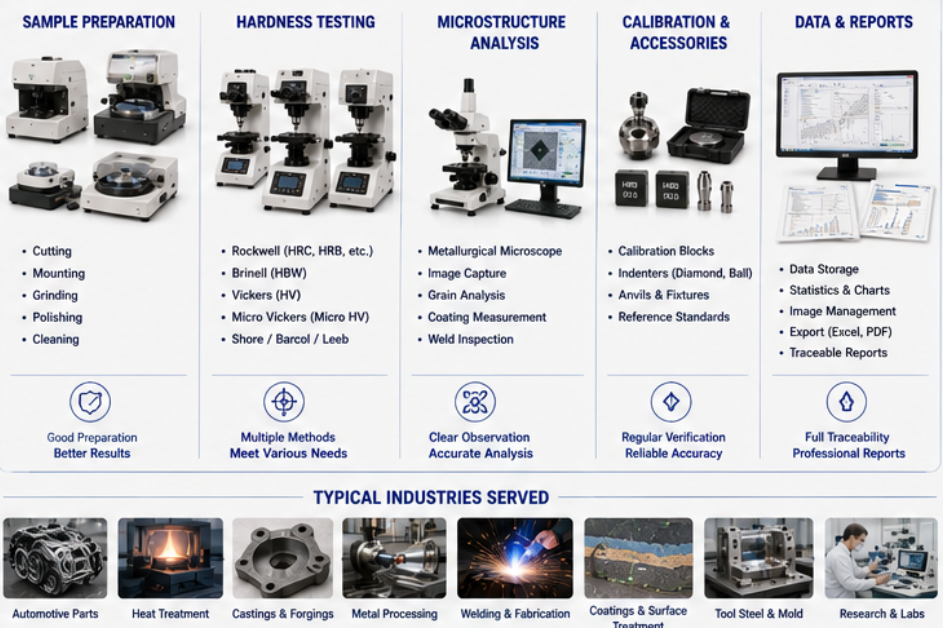
Sample Preparation
Cutting, mounting, grinding, polishing, and cleaning prepare reliable samples for testing.
Hardness Testing
Rockwell, Brinell, Vickers, Micro Vickers, Barcol, Shore, or universal testers match different QC needs.
Microscope Analysis
Metallurgical microscopes help inspect grain structure, coatings, welds, cracks, and case depth.
QC Reports
Software, image capture, statistics, and export functions support traceable quality documentation.
Industrial quality control is no longer limited to checking whether a part looks acceptable. Factories often need to verify material structure, hardness distribution, heat treatment quality, coating thickness, weld performance, case depth, defects, and batch stability. A complete metallographic and hardness testing laboratory gives the QC team the tools to convert these quality questions into measurable results. A single hardness tester may solve simple inspection needs, but many industrial applications require a full workflow. Samples may need to be cut, mounted, ground, polished, cleaned, observed under a microscope, and then tested by Rockwell, Brinell, Vickers, or Micro Vickers methods. If one step is weak, the final report may be unreliable. For automotive parts, heat treatment plants, casting and forging factories, welding workshops, coating companies, metal processing factories, tool steel suppliers, and third-party testing labs, a complete lab setup can reduce quality disputes, improve process control, and support customer audits. Before choosing equipment, buyers should define what the laboratory needs to test. A heat treatment factory may focus on HRC testing and case depth profiles. A foundry may need Brinell testing and microstructure inspection. A coating company may need cross-section preparation, microscope measurement, and Micro Vickers testing. A general industrial QC lab may need several methods to cover different parts. The best lab setup should be built around real samples, not around a standard equipment list. Material type, hardness range, sample size, production volume, testing standard, report format, and future expansion all affect the final configuration.Why Build A Complete Metallographic And Hardness Testing Lab?
1. Start With Your Materials And QC Purpose
Industry / Application Common QC Need Recommended Lab Focus Heat treatment plants Surface hardness, core hardness, case depth Rockwell tester, Micro Vickers tester, cutting and polishing line Casting and forging factories Representative hardness and microstructure Brinell tester, cutting machine, microscope, polishing equipment Coating and surface treatment Coating cross-section, layer hardness, thickness inspection Precision cutting, cold mounting, polishing, Micro Vickers, microscope Automotive parts QC Gears, shafts, bearings, fasteners, heat-treated parts Rockwell, Vickers, Micro Vickers, fixtures, report software
Sample preparation is the foundation of reliable metallographic and hardness testing. Poor cutting may create heat damage. Poor mounting may lose edge retention. Poor grinding and polishing may leave scratches, deformation, or unclear indentation edges. Even an advanced hardness tester cannot produce accurate results from a poorly prepared sample. A complete sample preparation workflow usually includes cutting, mounting, grinding, polishing, cleaning, and surface inspection. For Vickers, Micro Vickers, coating cross-sections, case depth, and weld analysis, preparation quality is especially important. A complete industrial QC lab may need one or several hardness testing methods. Rockwell is efficient for routine production inspection. Brinell is suitable for castings, forgings, and large metal parts. Vickers and Micro Vickers are used for precision testing, coatings, thin layers, weld zones, and case depth analysis. Barcol, Shore, and Leeb testers can support specific materials or portable inspection needs. Buyers should not choose a hardness tester only by popularity. The correct tester depends on material type, sample geometry, required standard, test force, hardness range, and reporting needs.2. Plan The Sample Preparation Workflow First
Equipment Main Function Buyer Checkpoint Metallographic cutting machine Cuts representative samples with low damage Check cutting capacity, coolant system, wheel type, and clamping fixtures Mounting press or cold mounting system Supports small, irregular, coating, or cross-section samples Choose hot mounting, cold mounting, or both according to sample type Grinding and polishing machine Creates flat, clean, scratch-controlled sample surfaces Check manual/automatic mode, disc size, pressure control, and speed control Cleaning station Removes abrasive particles, polishing residue, and contamination Check ultrasonic cleaning, drying method, and contamination control 3. Choose Hardness Testing Equipment By Method
Hardness Tester Best For Lab Setup Focus Rockwell hardness tester Fast QC for metals and heat-treated parts HRC/HRB scales, indenters, anvils, calibration blocks Brinell hardness tester Castings, forgings, large components High force, ball indenters, sample space, diameter measurement Vickers / Micro Vickers tester Coatings, case depth, welds, small parts, precision testing Optics, low load, XY stage, automatic vision, software reports Universal hardness tester Labs with multiple materials and standards Wide load range, multiple methods, advanced software
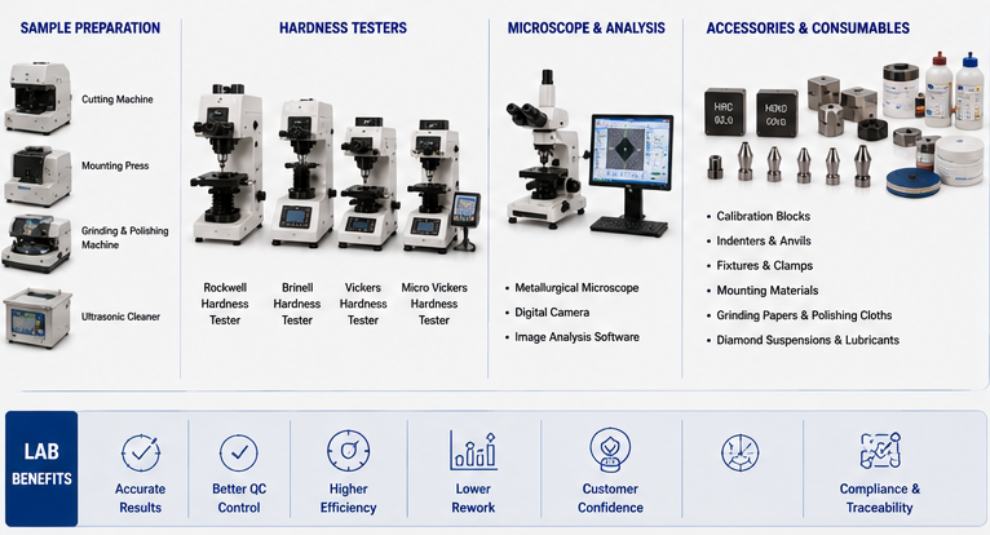
Metallographic inspection often requires microscope analysis after sample preparation. A metallurgical microscope can help inspect grain structure, coating layers, weld zones, cracks, inclusions, defects, and case depth. For many QC labs, microscopy and hardness testing should be planned together. Buyers should decide whether they need basic observation, digital image capture, measurement software, coating thickness measurement, grain size analysis, or report export. If the lab needs formal customer reports, microscope software and image storage become important. Many lab setup problems happen because buyers only purchase main machines and forget accessories. A complete lab needs calibration blocks, indenters, anvils, sample fixtures, objective lenses, cutting wheels, mounting materials, grinding papers, polishing cloths, diamond suspension, cleaning supplies, and spare parts. These items directly affect daily operation. Without the right test blocks, the hardness tester cannot be verified properly. Without suitable fixtures, irregular samples may not be positioned correctly. Without matched consumables, sample preparation quality may be unstable. Rockwell, Brinell, Vickers, and Micro Vickers calibration blocks. Diamond cone, Vickers diamond, Brinell ball, Barcol, or Shore indenters. Flat anvils, V anvils, small-part fixtures, sample holders, and custom supports. Cutting wheels, coolant, hot mounting resin, cold mounting resin, and molds. Grinding papers, polishing cloths, diamond suspension, alumina, and colloidal silica. Microscope camera, software, objective lenses, and report tools. Laboratory layout affects safety, cleanliness, and efficiency. A practical workflow usually starts from sample receiving, cutting, mounting, grinding and polishing, cleaning, microscope inspection, hardness testing, data analysis, and report export. Wet preparation equipment such as cutting and grinding machines should be placed in areas with water supply, drainage, cleaning access, and splash control. Precision equipment such as hardness testers and microscopes should be placed in a cleaner, more stable area. The lab should also consider power supply, ventilation, lighting, vibration control, bench strength, storage, and operator movement.4. Add Metallurgical Microscope And Image Analysis
5. Prepare Calibration Blocks, Indenters, Fixtures And Consumables
A complete lab package may include:
6. Plan Lab Layout Around Workflow
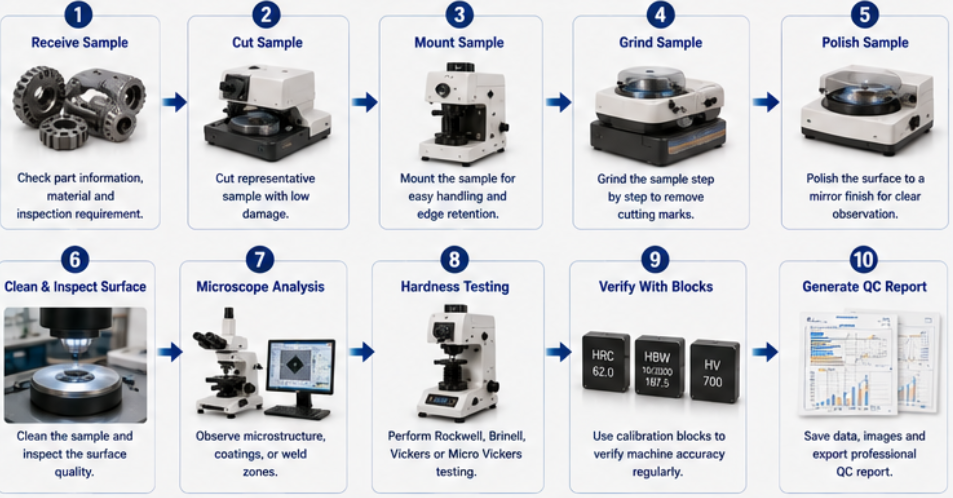
Modern industrial QC labs need more than test values. They often need sample IDs, batch numbers, operator names, test images, hardness profiles, microscope images, calibration records, statistics, and customer-ready reports. Digital systems and software can improve traceability and reduce manual record errors. Buyers should confirm whether the hardness testing software and microscope software can export Excel, PDF, images, or customized reports. For case depth testing and coating analysis, image capture and data storage are especially useful. Before requesting a complete metallographic and hardness testing lab proposal, buyers should prepare clear technical and workflow information. This helps the supplier recommend a practical configuration instead of quoting unrelated individual machines. What industries and materials will the lab support? What samples will be tested: steel, cast iron, aluminum, copper alloy, coatings, welds, plastics, composites, or ceramics? What testing purpose is required: hardness testing, microstructure analysis, case depth, coating inspection, weld inspection, or failure analysis? Which hardness methods are required: Rockwell, Brinell, Vickers, Micro Vickers, Barcol, Shore, Leeb, or universal testing? What sample sizes, shapes, thicknesses, and hardness ranges are expected? How many samples need to be prepared and tested per day? Do you need manual, digital, automatic, or automatic vision testing equipment? Do you need cutting, mounting, grinding, polishing, microscope, hardness tester, and report software together? What calibration blocks, indenters, fixtures, sample holders, and consumables are required? What is the available lab space, power supply, water supply, drainage, and installation condition? A metallographic and hardness testing laboratory should be planned as one connected quality control workflow. The goal is not only to buy several machines, but to create a reliable process from sample cutting to final report. For industrial buyers, the best lab setup depends on material type, testing purpose, daily workload, required standards, report needs, and future expansion plans. A simple lab may only need basic cutting, polishing, and hardness testing. A more advanced lab may need automatic sample preparation, Micro Vickers case depth analysis, metallurgical microscopy, image software, and full report traceability. Before building or upgrading a QC lab, provide your material details, sample information, testing standards, and workflow requirements. This allows the supplier to recommend a practical, scalable, and cost-effective laboratory solution. A complete lab may include a cutting machine, mounting press, grinding and polishing machine, cleaning station, metallurgical microscope, hardness tester, calibration blocks, fixtures, consumables, and report software. Not every factory needs a full setup. However, Vickers, Micro Vickers, coatings, case depth, weld sections, and microstructure analysis usually require sample preparation and microscope equipment. It depends on materials and testing purpose. Rockwell is common for fast production QC, Brinell for large castings and forgings, and Vickers or Micro Vickers for precision testing and case depth analysis. Poor cutting, grinding, or polishing can cause heat damage, scratches, deformation, unclear indentation edges, and unreliable hardness results.7. Build Data Management And QC Report Capability
Key Questions Before Requesting A Complete Lab Proposal
Conclusion: Build The Lab As One Complete QC Workflow
FAQ
What equipment is needed for a complete metallographic and hardness testing lab?
Does every factory need a full metallographic lab?
Which hardness tester is best for industrial QC labs?
Why is sample preparation important before hardness testing?
Need A Complete Metallographic & Hardness Testing Lab Solution?
Share your material type, sample size, testing purpose, daily workload, required standards, laboratory space, and report needs. We can help recommend a complete metallographic sample preparation and hardness testing solution for your industrial QC laboratory.