
Which Hardness Testing Method Is Best For Your Materials: Rockwell, Brinell, Or Vickers
Which Hardness Testing Method Is Best For Your Materials: Rockwell, Brinell, Or Vickers
Rockwell, Brinell, and Vickers hardness testing methods are widely used in industrial quality control, but they are not interchangeable. The best method depends on your material type, sample size, surface condition, hardness range, test standard, accuracy requirement, testing speed, and reporting needs.
Rockwell
Best for fast production QC of metals, heat-treated parts, tools, bearings, shafts, and fasteners.
Brinell
Best for castings, forgings, large metal parts, aluminum alloys, copper alloys, and coarse structures.
Vickers
Best for precision testing, thin sections, coatings, weld zones, case depth, and small samples.
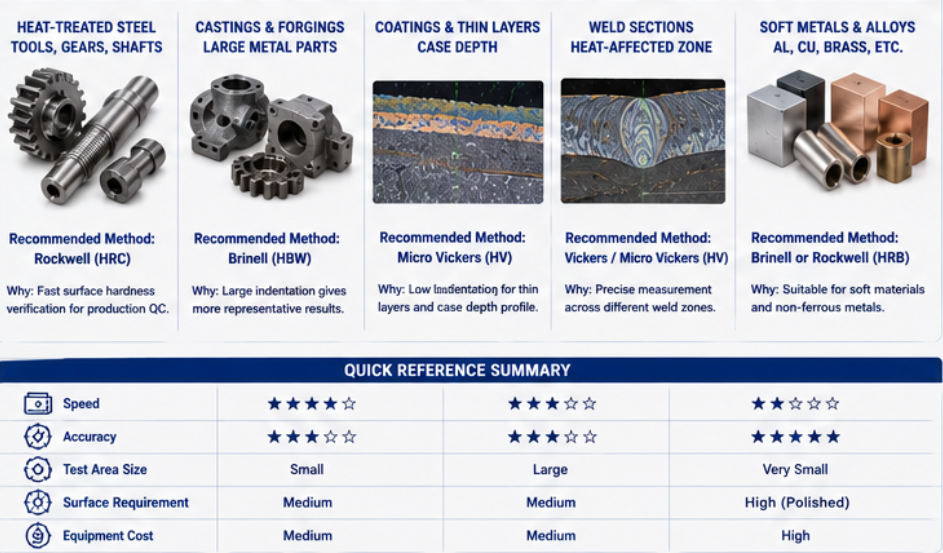
Many hardness testing problems begin with choosing the wrong method. A buyer may request a hardness tester only by price or by a familiar name, but Rockwell, Brinell, and Vickers testing are designed for different materials and inspection purposes. If the testing method does not match the sample, the result may be inaccurate, unstable, or not accepted by the customer. Rockwell testing is fast and practical for routine production inspection. Brinell testing is useful for large parts and materials with uneven or coarse structures. Vickers testing provides high precision and is suitable for small test areas, polished samples, coatings, weld sections, and hardness profiles. For factories, the right method can improve inspection efficiency, reduce measurement disputes, and support stronger quality control records. For laboratories, correct method selection also affects sample preparation, calibration blocks, indenters, software, and reporting workflow. Rockwell hardness testing is often the best choice when a factory needs fast, direct-reading results for production quality control. It is commonly used for hardened steel, heat-treated parts, tools, molds, bearings, shafts, gears, fasteners, and some plastic materials. Because the result is based on indentation depth, no optical indentation measurement is required in standard Rockwell testing. Rockwell is suitable when the sample has enough thickness, stable support, and a surface condition that allows proper indentation. Buyers should choose the correct Rockwell scale, such as HRC for hardened steel or HRB for softer metals. For thin parts or shallow hardened layers, superficial Rockwell may be required. Fast hardness inspection in production QC. Direct digital or dial reading without optical measurement. Testing for hardened steel, tools, shafts, bearings, gears, or fasteners. Routine HRC, HRB, HRA, or superficial Rockwell testing. Simple operation for repeated batch checks. Brinell hardness testing is a good choice for castings, forgings, large metal parts, aluminum alloys, copper alloys, and materials with coarse or uneven microstructures. Because Brinell testing creates a larger indentation, it can provide a more representative average hardness value for materials that may vary locally. Brinell testing requires the correct ball diameter, test force, surface preparation, and indentation diameter measurement. It is often used in foundries, forging plants, metal processing factories, and heavy industrial QC labs. For large parts, buyers should check machine force capacity, sample space, stable support, and digital diameter measurement options. Testing for castings, forgings, and large components. More representative results for coarse or uneven structures. Hardness testing for aluminum, copper alloys, steel castings, or forged parts. Large indentation measurement for industrial QC. Digital image measurement and HBW report records.Why Method Selection Matters
1. When To Choose Rockwell Hardness Testing
Choose Rockwell when you need:
2. When To Choose Brinell Hardness Testing
Choose Brinell when you need:
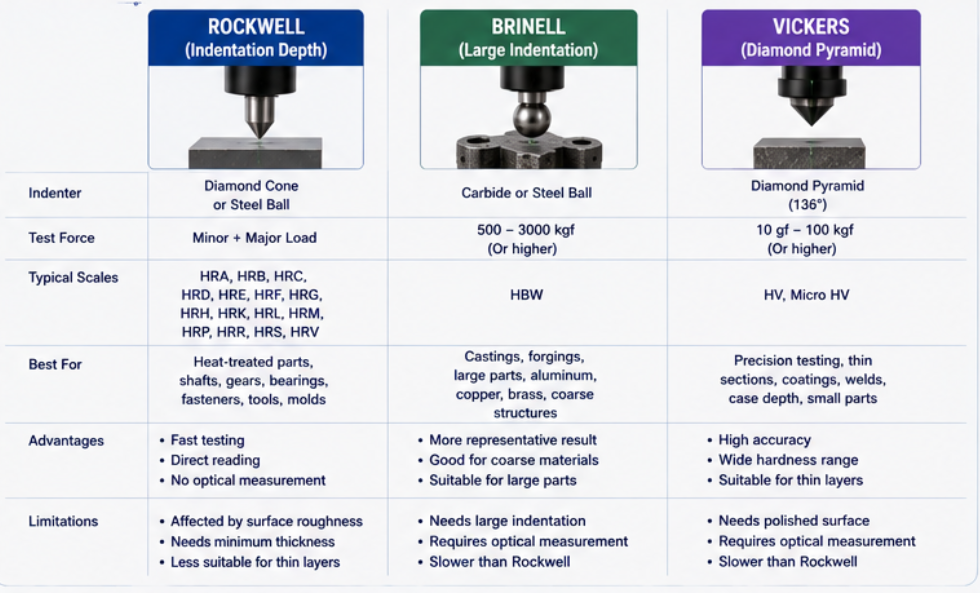
Vickers hardness testing is useful when buyers need precision measurement over a wide hardness range. It is commonly used for polished metal samples, small parts, thin sections, weld zones, coatings, heat-treated layers, and laboratory analysis. Vickers testing measures the diagonal of a diamond-shaped indentation, so the optical system and sample preparation quality are very important. Standard Vickers testing is suitable for many metal materials. Micro Vickers testing is better for thin layers, coatings, case depth analysis, carburized layers, nitrided layers, and small precision parts. If the laboratory needs hardness profiles or many test points, automatic vision measurement and a motorized XY stage can improve efficiency. Precision hardness testing with optical indentation measurement. Testing for small parts, thin sections, coatings, and weld zones. Micro Vickers testing for case depth or hardened layer analysis. Hardness profiles from surface to core. Image storage, automatic diagonal measurement, and report export. The best hardness testing method depends on the sample and inspection goal. Rockwell is usually preferred for speed, Brinell for large or coarse materials, and Vickers for precision and small test areas. The table below gives a practical comparison for buyers.3. When To Choose Vickers Hardness Testing
Choose Vickers when you need:
4. Quick Comparison: Rockwell vs Brinell vs Vickers
Method Best For Main Advantage Buyer Should Check Rockwell Heat-treated parts, tools, bearings, shafts, fasteners Fast direct reading for production QC Scale, sample thickness, support, indenter, calibration blocks Brinell Castings, forgings, aluminum alloys, copper alloys, large parts Representative result for coarse structures Force, ball diameter, sample size, surface, diameter measurement Vickers Precision samples, coatings, welds, thin layers, case depth High precision and wide application range Test force, optics, sample preparation, stage, software reports
Sample preparation requirements vary by method. Rockwell testing usually needs a clean, stable surface and enough sample thickness. Brinell testing needs a surface clear enough for indentation diameter measurement. Vickers and Micro Vickers testing often require cutting, mounting, grinding, and polishing because the indentation edges must be measured optically. If your application involves coatings, weld sections, thin layers, or case depth testing, sample preparation equipment should be considered together with the hardness tester. A complete solution may include a metallographic cutting machine, mounting press, grinding and polishing machine, microscope, and hardness testing system. Manual systems can be suitable for low-volume testing or simple inspection. Digital systems improve operation and data handling. Automatic vision systems are especially valuable for Vickers, Micro Vickers, and Brinell testing because they reduce manual measurement variation and support image storage. If the laboratory tests many samples every day or needs customer-ready reports, automation can improve efficiency and traceability. For case depth testing, hardness profiles, and repeated test points, software and stage control become more important. Before requesting a quotation, buyers should provide clear information about materials, samples, testing standards, and reporting needs. This allows the supplier to recommend the right method and configuration instead of a generic machine. What materials will be tested? Are the samples hardened steel, soft metals, castings, forgings, coatings, welds, or small parts? What hardness scale or standard is required? What is the expected hardness range? What are the sample size, thickness, shape, weight, and surface condition? Do you need fast production QC or precision laboratory analysis? Do you need surface hardness, core hardness, case depth, or coating hardness? How many samples and test points are measured per day? Do you need sample preparation equipment? Do you need digital reports, image storage, statistics, or automatic measurement?5. Consider Sample Preparation And Surface Condition
6. Do You Need Manual, Digital, Or Automatic Testing?
System Type Suitable For Main Benefit Manual Tester Low-volume inspection and basic QC Lower cost and simple operation Digital Tester Routine factory quality control Clear display, easier reading, better data handling Automatic Vision Tester Vickers, Micro Vickers, Brinell, case depth, high-volume labs Automatic measurement, saved images, traceable reports Key Questions Before Choosing A Hardness Testing Method
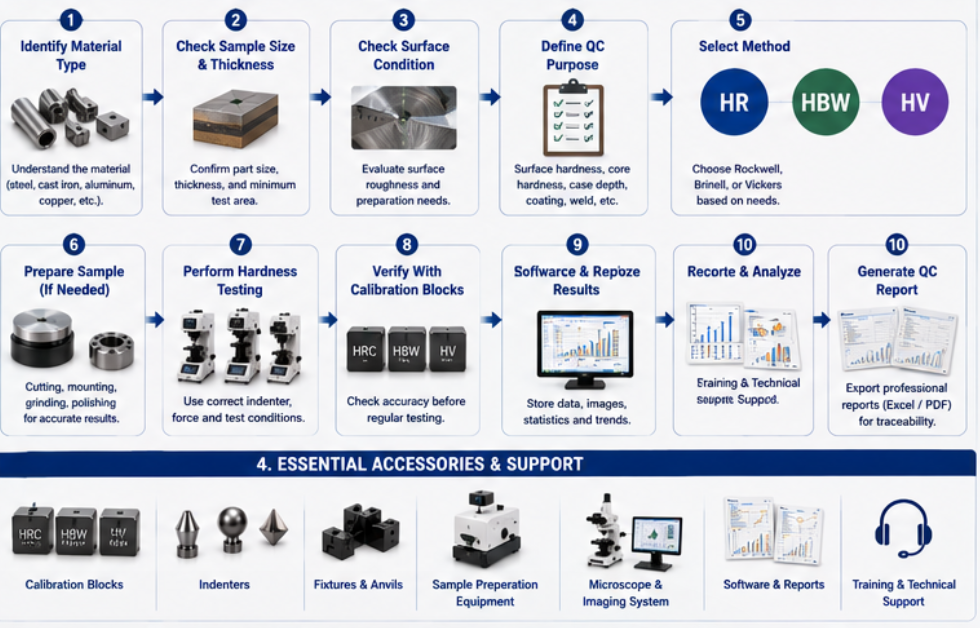
Rockwell, Brinell, and Vickers hardness testing methods each have clear advantages. Rockwell is best for fast production inspection, Brinell is best for large or coarse materials, and Vickers is best for precision testing, thin layers, coatings, welds, and small samples. The right choice depends on material type, sample size, surface condition, required scale, testing speed, accuracy needs, and report requirements. In many industrial QC labs, more than one method may be needed to cover different materials and parts. If you are not sure which method is suitable, share your sample details before ordering. A complete recommendation can help you choose the right hardness tester, accessories, calibration blocks, and sample preparation equipment. Rockwell testing is usually the fastest because it provides direct readings and does not require optical indentation measurement in standard testing. Brinell testing is often preferred for castings and forgings because the larger indentation can better represent coarse or uneven material structures. Micro Vickers testing is usually best for coatings, thin layers, case depth analysis, and small test areas because it uses lower loads and smaller indentations. Yes. Many industrial QC labs use Rockwell for fast production checks, Brinell for large parts, and Vickers or Micro Vickers for precision analysis.Conclusion: Choose The Method Around Your Material And QC Goal
FAQ
Which hardness testing method is fastest?
Which method is best for castings and forgings?
Which method is best for coatings and thin layers?
Can one lab use multiple hardness testing methods?
Need Help Choosing Rockwell, Brinell Or Vickers Testing?
Share your material type, sample size, hardness range, testing purpose, daily workload, and report needs. We can help recommend the right hardness testing method, equipment configuration, calibration blocks, and sample preparation solution.