
Automatic Vision Hardness Testers: Improve Accuracy & Lab Efficiency
Automatic Vision Hardness Testers: Improve Accuracy & Lab Efficiency
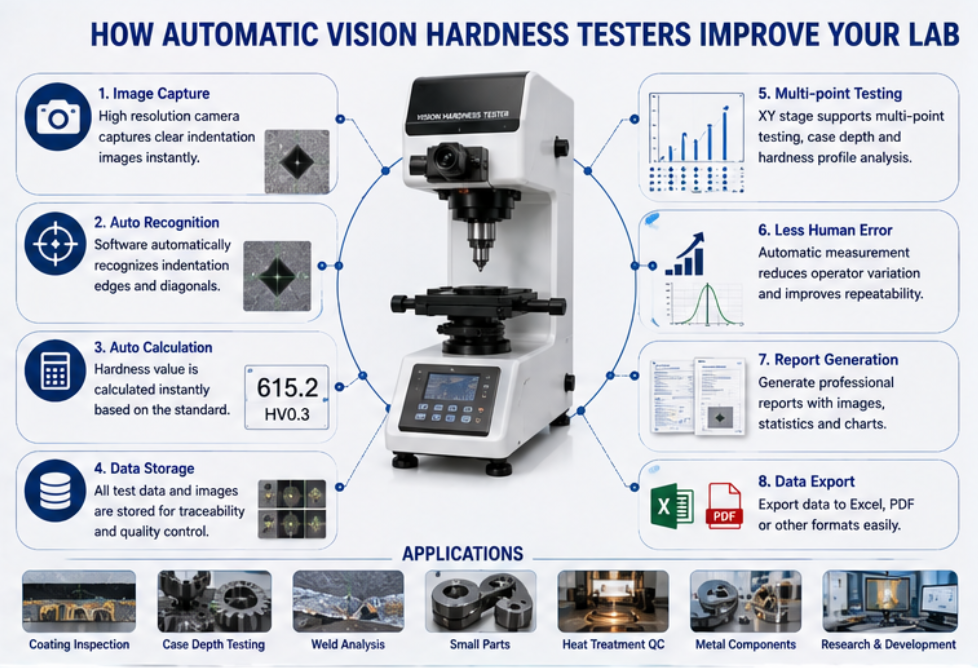
Automatic vision hardness testers help laboratories reduce operator error, improve indentation measurement accuracy, speed up batch testing, and generate traceable QC reports. They are especially useful for Vickers, Micro Vickers, Brinell, case depth testing, coating inspection, weld analysis, and high-volume industrial quality control.
Less Operator Error
Automatic indentation recognition reduces manual reading differences and improves repeatability between operators.
Faster Lab Workflow
Image capture, automatic measurement, batch data storage, and report export help laboratories complete more tests faster.
Traceable QC Reports
Saved images, test values, sample IDs, statistics, and PDF or Excel reports support customer audits and quality records.
Many hardness testing errors come from manual operation. In Vickers and Micro Vickers testing, operators must measure indentation diagonals accurately. In Brinell testing, operators must measure indentation diameter clearly. If the indentation edge is unclear, the lighting is poor, or operators judge the boundary differently, the final hardness value may vary. Automatic vision hardness testers use an optical camera and software to capture the indentation image, recognize edges, calculate hardness values, store data, and export reports. This helps reduce manual reading variation and improves consistency in daily laboratory work. For factories that need stable quality control, automatic vision is not only a convenience feature. It can directly improve testing repeatability, reduce rework, support customer documentation, and make laboratory workflow more efficient. In traditional hardness testing, the operator often plays a major role in final measurement. Manual reading may be acceptable for occasional testing, but it can create variation when multiple operators, shifts, or production batches are involved. Automatic vision systems help standardize the measurement process. The system can detect indentation edges, measure diagonals or diameters, calculate hardness values, and save the image for later review. This is especially helpful for small Vickers indentations, Micro Vickers testing, Brinell diameter measurement, and hardness profile analysis.Why Automatic Vision Matters In Hardness Testing
1. Improve Accuracy By Reducing Manual Measurement Error
Manual Challenge Automatic Vision Solution QC Benefit Different operators read indentation edges differently Software identifies and measures the indentation image Better repeatability and less human variation Small Micro Vickers indentation is difficult to measure High-resolution image capture and diagonal measurement More reliable thin layer and small part testing Brinell indentation diameter is unclear Digital diameter measurement with saved image Reduced reading error and stronger traceability Manual records are easy to lose or miswrite Automatic data storage and report export Cleaner QC documentation and easier audits
In a busy quality control laboratory, testing speed matters. If every indentation needs to be manually focused, measured, calculated, written down, and transferred into a report, the process can be slow and inconsistent. Automatic vision hardness testers help shorten this workflow. The operator can capture images, measure automatically, save results, compare samples, and generate reports more quickly. For laboratories testing many batches every day, this can reduce waiting time and improve inspection throughput. The lab tests many samples or test points every day. Multiple operators use the same hardness tester. Customer-ready reports are required. Indentation images need to be saved for traceability. Case depth or hardness profile testing is performed regularly. Manual measurement variation has caused quality disputes. Automatic vision is especially valuable for hardness testing methods that require optical measurement. For Vickers and Micro Vickers testing, the system measures diamond-shaped indentation diagonals. For Brinell testing, the system measures the diameter of the round indentation. In both cases, image clarity and software recognition are important. Buyers should confirm which testing methods the system supports before ordering. Some systems are designed mainly for Vickers and Micro Vickers testing. Others may support Brinell image measurement. A complete laboratory may need different automatic vision modules for different hardness testing methods.2. Increase Efficiency For High-Volume Laboratory Testing
Automatic vision systems are useful when:
3. Support Vickers, Micro Vickers And Brinell Testing
Testing Method What Vision System Measures Typical Application Vickers Indentation diagonal length Precision metal testing, weld sections, polished samples Micro Vickers Small indentation diagonal under low load Thin layers, coatings, case depth, small parts Brinell Round indentation diameter Castings, forgings, large metal parts, coarse materials
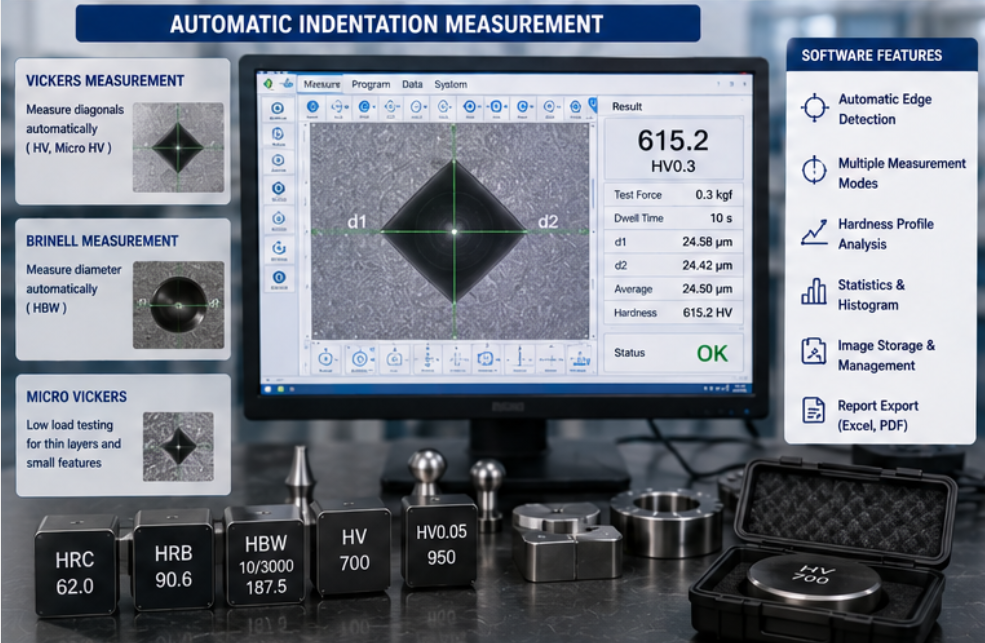
Automatic vision hardness testers are very useful for applications that require multiple test points. In case depth testing, operators may need to measure hardness from the surface toward the core. In weld inspection, hardness may need to be checked across the base metal, heat-affected zone, and weld metal. In coating analysis, the test point must stay within a small layer. A motorized or precise XY stage, combined with automatic image measurement, can improve test point positioning and data consistency. Software can also help generate hardness profile curves and store test point images, making the report more professional and easier to review. Not all automatic vision hardness testers are equal. The quality of the camera, optical system, lighting, measurement algorithm, stage stability, and software functions can affect the final performance. Buyers should check these details before ordering. A good system should provide clear indentation images, stable focusing, reliable edge recognition, easy sample management, report export, and convenient operation. For high-volume laboratories, software usability is just as important as machine accuracy. Automatic vision measurement can improve accuracy, but it cannot fully fix poor sample preparation. If the sample surface is scratched, dirty, tilted, oxidized, or poorly polished, the indentation edge may still be hard to identify. This is especially important for Vickers, Micro Vickers, coatings, case depth samples, and weld sections. A complete laboratory solution may include metallographic cutting, mounting, grinding, polishing, cleaning, microscope inspection, and hardness testing. Buyers should review the full preparation process before expecting automatic software to solve every measurement problem.4. Improve Case Depth, Coating And Weld Inspection
5. Check Camera, Optics, Software And Stage Configuration
Configuration Why It Matters Buyer Checkpoint Camera resolution Affects image clarity and edge recognition Check if small indentations can be captured clearly Optical system Determines magnification and measurement visibility Confirm lens options and illumination quality Measurement software Controls data storage, calculation, and report output Check image storage, statistics, Excel/PDF export XY stage Improves test point positioning and repeatability Confirm manual, precise, or motorized stage requirement 6. Do Not Ignore Sample Preparation
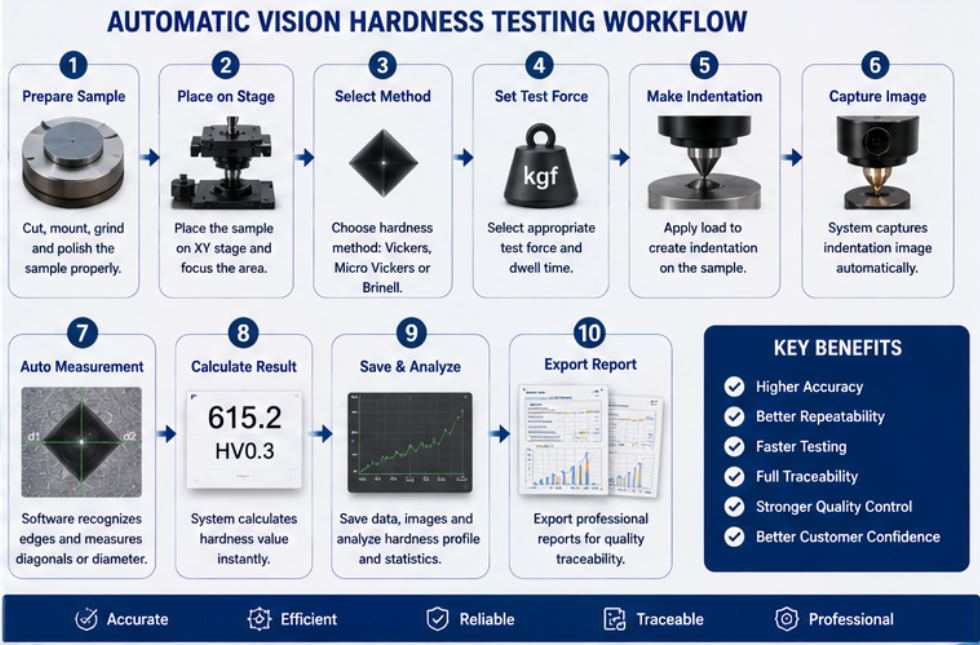
Before choosing an automatic vision hardness tester, buyers should provide clear testing and workflow information. This helps the supplier recommend the right system instead of only quoting a basic machine. Which hardness method do you need: Vickers, Micro Vickers, Brinell, or multiple methods? What materials and sample types will be tested? Are you testing thin layers, coatings, weld sections, case depth, or large parts? What is the expected hardness range and test force range? How many samples and test points are measured per day? Do you need manual, semi-automatic, or fully automatic measurement? Do you need a manual or motorized XY stage? Do you need image storage, statistics, hardness profiles, Excel export, or PDF reports? Do you already have proper cutting, mounting, grinding, and polishing equipment? Do you need calibration blocks, indenters, fixtures, and operator training? Automatic vision hardness testers help laboratories improve measurement accuracy, reduce operator variation, speed up routine testing, and generate more professional quality reports. They are especially valuable for Vickers, Micro Vickers, Brinell, coating inspection, case depth analysis, weld testing, and high-volume industrial QC. Buyers should compare more than the machine price. Camera quality, optics, software, stage control, report functions, calibration accessories, and sample preparation workflow all affect the final testing performance. If your laboratory needs stable results, saved images, batch data, and customer-ready reports, an automatic vision hardness testing solution can provide stronger long-term value than a basic manual system. It is a hardness testing system that uses a camera and software to capture indentation images, measure them automatically, calculate hardness values, and save test data. Vickers, Micro Vickers, and Brinell testing benefit greatly because they require optical indentation measurement. No. It reduces measurement variation, but sample preparation, calibration blocks, indenters, test force, and operator procedure still need proper control. It is recommended when the lab has high testing volume, multiple operators, small indentations, case depth testing, customer reports, or strict traceability requirements.Key Questions Before Requesting A Quote
Conclusion: Automatic Vision Is Best For Labs That Need Accuracy, Speed And Traceability
FAQ
What is an automatic vision hardness tester?
Which hardness methods benefit most from automatic vision?
Does automatic vision eliminate all testing errors?
When should a lab choose automatic vision instead of manual measurement?
Need An Automatic Vision Hardness Testing Solution?
Share your hardness method, sample type, test force range, daily testing volume, automation needs, and report requirements. We can help recommend suitable automatic vision hardness testers, software, calibration blocks, and complete sample preparation solutions.