


How To Choose A Rockwell Hardness Tester For Metal And Plastic Materials
How To Choose A Rockwell Hardness Tester For Metal And Plastic Materials
A Rockwell hardness tester is widely used for fast hardness inspection of metals, engineering plastics, heat-treated parts, machined components, and production quality control samples. To choose the right model, buyers need to confirm the material type, Rockwell scale, test force, indenter, sample thickness, accuracy requirement, and daily testing volume.
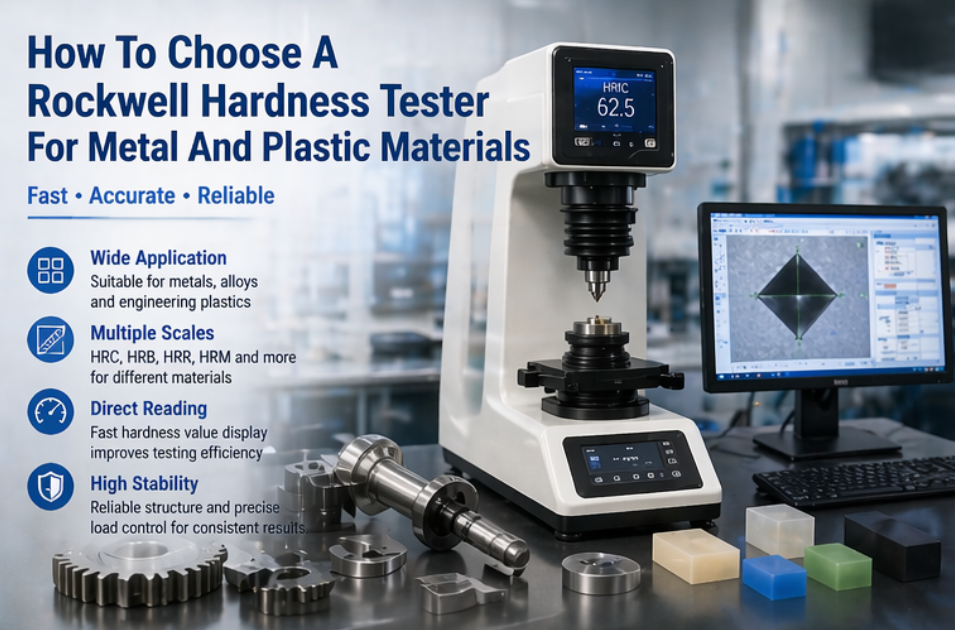
Fast QC Testing
Rockwell testing provides direct hardness readings, making it suitable for routine production inspection.
Multiple Scales
Different Rockwell scales are used for hardened steel, softer metals, plastics, and thin materials.
Metal & Plastic Use
With the right indenter and force configuration, Rockwell testing can support both metal and plastic materials.
Rockwell hardness testing is one of the most widely used hardness testing methods in manufacturing and quality control. Compared with optical indentation methods such as Vickers or Brinell, Rockwell testing measures indentation depth and gives a direct hardness value. This makes the process faster, simpler, and easier to use for routine inspection. For metal parts, Rockwell testing is commonly used to check heat treatment quality, material consistency, production batches, incoming raw materials, machined components, bearings, shafts, fasteners, tools, molds, and structural parts. For plastic materials, Rockwell testing can also be used when the selected scale, indenter, and test force match the material properties. However, not every Rockwell hardness tester is suitable for every material. A tester used for hardened steel may not be suitable for soft plastics or thin samples unless it supports the required scale and load range. Buyers should therefore select the tester based on real testing needs instead of only comparing machine price or appearance. The first question is simple: what material will be tested? Metal and plastic materials respond differently under load. Metals are usually harder and more stable under indentation, while plastics may deform, recover, or respond differently depending on material formulation, temperature, thickness, and surface condition. For hardened steel, tool steel, carburized parts, and heat-treated metal components, the tester must support the proper Rockwell scale and diamond cone indenter. For softer metals such as copper alloys, aluminum alloys, brass, and mild steel, ball indenters and different scales may be more suitable. For plastics, the tester should support appropriate Rockwell scales for polymer materials and ensure that the test force does not cause excessive deformation or unreliable results.1. Why Rockwell Hardness Testing Is Popular In Industrial QC
2. Start With The Material Type: Metal Or Plastic
Material Type Common Testing Need Selection Focus Hardened steel Heat treatment verification Diamond cone indenter, HRC scale, stable force application Softer metals Material consistency inspection Ball indenter, suitable Rockwell scale, sample support Engineering plastics Plastic hardness comparison and QC Plastic-compatible scale, proper test force, enough sample thickness Thin or small parts Limited test area or thickness Superficial Rockwell or alternative Vickers testing may be needed
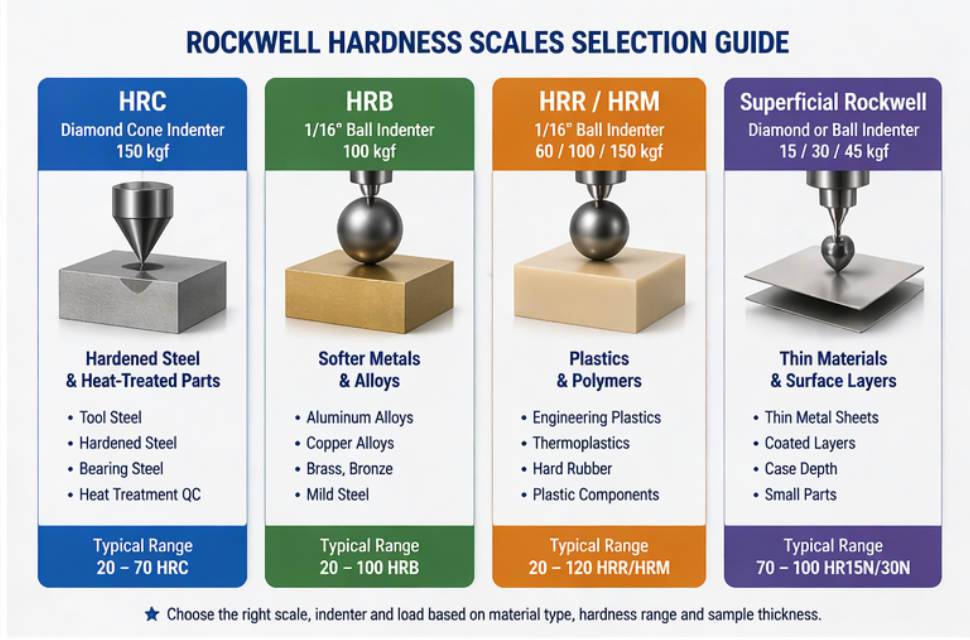
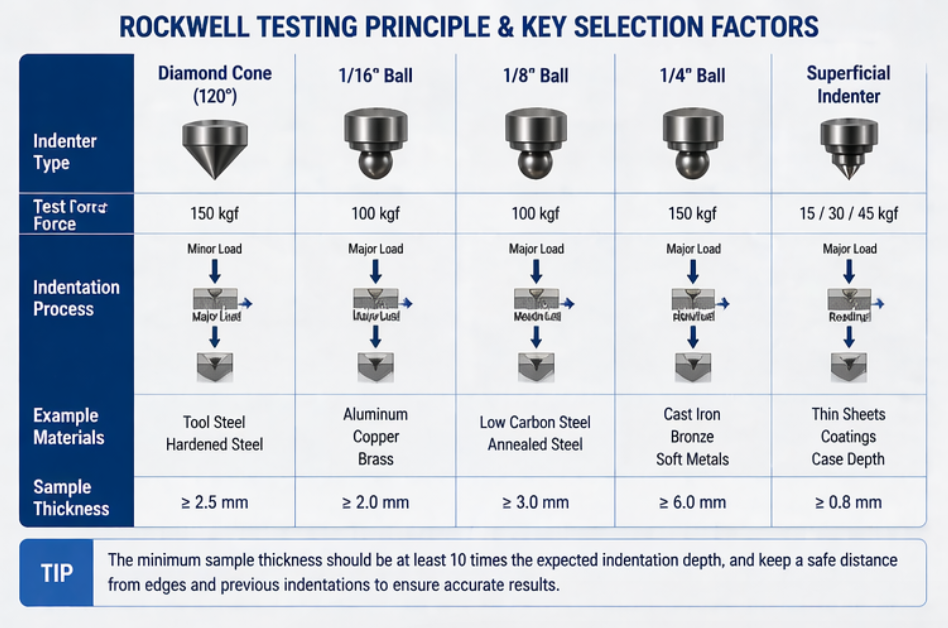
Rockwell hardness testing includes multiple scales. Each scale uses a specific combination of indenter and test force. Choosing the correct scale is essential because the wrong scale may create an indentation that is too shallow, too deep, or unsuitable for the material. For example, HRC is commonly used for hardened steel and harder metal components. HRB is often used for softer metals such as copper alloys, aluminum alloys, brass, and mild steel. For plastics, scales such as HRR, HRM, or other plastic-related Rockwell scales may be considered depending on material type and test standard. Buyers should not simply ask for “a Rockwell hardness tester.” They should ask whether the tester supports the required Rockwell scales for their materials. If one factory tests both hardened metal parts and plastic components, the tester must support the correct force range, indenters, and accessories for both applications. Rockwell testing uses a minor load and a major load. The tester measures the indentation depth difference and calculates the hardness value. This means the test force and indenter must match the material and scale. If the force is too high for a thin sample, the indentation may be affected by the support surface or damage the sample. If the force is too low for the material, the result may not be stable. The indenter is also important. Harder materials often require a diamond cone indenter, while softer metals and plastics may require ball indenters of different sizes. Buyers should confirm which indenters are supplied with the machine and whether additional indenters are needed for different scales. Sample thickness should be checked before purchase. A Rockwell indentation must not be too close to the back side of the sample, edge, or another indentation. If the sample is too thin, superficial Rockwell testing or Vickers testing may be more suitable.3. Choose The Correct Rockwell Scale
Rockwell Scale Typical Material Buyer Checkpoint HRC Hardened steel, tool steel, heat-treated metal parts Confirm diamond cone indenter and proper major load HRB Softer metals, copper alloy, aluminum alloy, brass, mild steel Confirm ball indenter and sample surface condition HRR / HRM Plastics and polymer materials Confirm plastic testing standard and sample thickness Superficial Rockwell Thin materials, small parts, surface-treated parts Confirm lighter loads and suitable scale support 4. Check Test Force, Indenter, And Sample Thickness
Rockwell hardness testers are available in manual, digital, and automatic configurations. A manual model can be suitable for basic inspection with limited testing volume. A digital model is easier to operate, reduces reading mistakes, and improves data visibility. An automatic model is better for laboratories that need higher repeatability, faster workflow, and test records. For production quality control, digital and automatic Rockwell testers are often more practical because they reduce operator dependency. They can display hardness values clearly, store data, support report output, and make daily inspection more consistent. If the tester will be used by multiple operators or across different shifts, ease of operation becomes very important. Plastic hardness testing requires special attention because plastic materials may deform differently from metals. The test result can be affected by material formulation, sample thickness, surface flatness, temperature, conditioning, and recovery behavior after loading. This is why buyers should confirm the test standard and required Rockwell scale before choosing a machine. For plastic materials, the machine should support the required scale, suitable ball indenter, proper test force, stable loading time, and reliable sample support. The sample should be flat, thick enough, and properly conditioned according to the testing requirement. If the plastic is too soft, too thin, curved, or unstable under load, another hardness method may be needed. If your laboratory tests both metal and plastic materials, tell the manufacturer clearly. The tester may need additional indenters, scale support, fixtures, or software settings to handle both types of materials reliably. A good Rockwell hardness tester should provide stable loading, reliable measurement, simple operation, scale flexibility, and long-term accuracy. For industrial buyers, the machine should also be easy to calibrate, maintain, and use by different operators. Supported Rockwell scales for metal and plastic materials. Major load and minor load accuracy. Diamond cone and ball indenter options. Sample stage size and fixture compatibility. Maximum sample height and throat depth. Digital display, data storage, and report output. Calibration blocks and standard accessories. Repeatability across different operators and shifts. Operation training, maintenance guidance, and spare parts support.5. Manual, Digital, Or Automatic Rockwell Hardness Tester?
Tester Type Best For Main Advantage Buyer Consideration Manual Rockwell Tester Basic QC and low-volume testing Lower investment cost More operator-dependent Digital Rockwell Tester Routine production inspection Clear display and easier operation Check scale support and data output Automatic Rockwell Tester High-volume QC and repeatable testing Better consistency and efficiency Higher budget but stronger long-term value 6. What Matters For Plastic Rockwell Hardness Testing?
7. Key Features Buyers Should Compare
Important features to check:
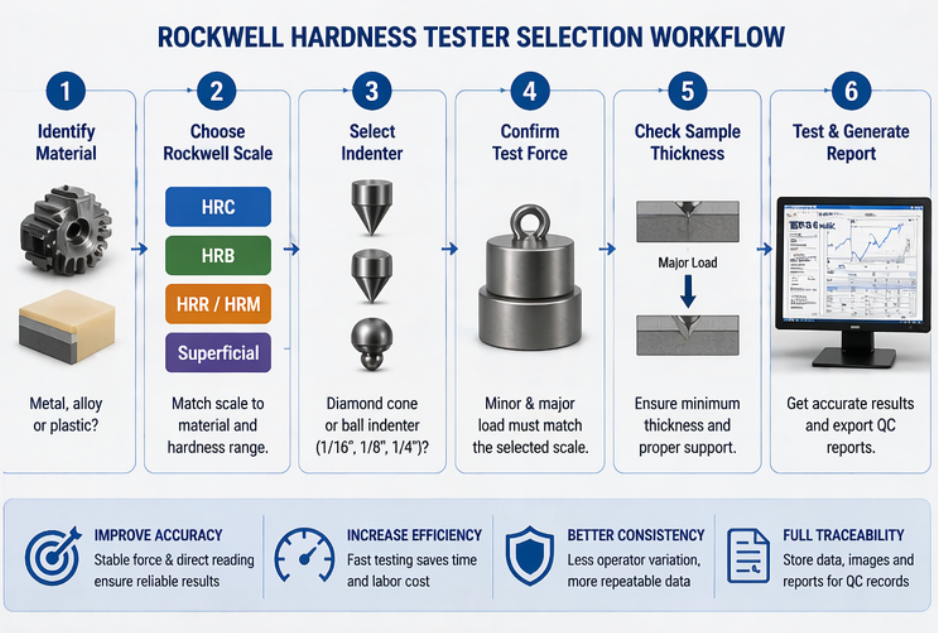
Before requesting a Rockwell hardness tester quotation, buyers should prepare clear technical information. This helps avoid choosing a machine that cannot support the required scales, materials, or sample dimensions. Will the tester be used for metal, plastic, or both? What material grades will be tested? What Rockwell scale is required, such as HRC, HRB, HRR, or HRM? What is the expected hardness range? What is the sample size and thickness? Is the sample flat, curved, rough, polished, or finished? How many samples need to be tested per day? Do you need manual, digital, or automatic operation? Do you need data storage, report export, or printer connection? Do you need calibration blocks, indenters, fixtures, or special accessories? Choosing a Rockwell hardness tester for metal and plastic materials requires more than comparing price. Buyers should first confirm the material type, required Rockwell scale, indenter, test force, sample thickness, and testing purpose. Hardened metals, softer metals, engineering plastics, and thin samples may all require different configurations. For routine metal quality control, a digital Rockwell tester is often a practical choice. For higher-volume production inspection, an automatic Rockwell tester can improve repeatability and efficiency. For laboratories testing both metals and plastics, scale flexibility and accessory support become especially important. The best Rockwell hardness tester is the one that matches your real samples, testing standard, daily workload, and documentation needs. Before purchasing, provide detailed material and sample information so the tester configuration can be recommended correctly. Yes, if the machine supports the required Rockwell scales, test forces, indenters, and sample fixtures for both metal and plastic materials. HRC is commonly used for hardened steel, tool steel, and many heat-treated metal parts, but the exact scale should follow the required testing standard. For plastics, check the required scale, sample thickness, surface flatness, test force, indenter type, temperature condition, and applicable testing standard. Superficial Rockwell testing may be suitable for thinner materials, smaller parts, or surface-treated samples where standard Rockwell loads are too high.8. Key Questions Before Requesting A Quote
Conclusion: Select The Tester By Material, Scale, And Workflow
FAQ
Can one Rockwell hardness tester test both metal and plastic?
Which Rockwell scale is commonly used for hardened steel?
What should be checked before testing plastics?
When should I consider superficial Rockwell testing?
Need Help Choosing A Rockwell Hardness Tester?
Share your material type, Rockwell scale, sample thickness, expected hardness range, and daily testing volume. We can help recommend a suitable Rockwell hardness testing solution for metal and plastic quality control.