-
06-12 2026
Hardness Testing Equipment For Fastener Manufacturers: Bolts, Screws And Precision Pins
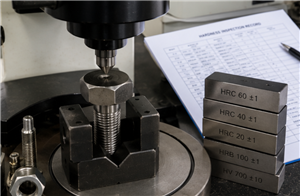
Fastener manufacturers need reliable hardness testing equipment to verify bolts, screws, studs, nuts, washers, rivets, precision pins, and heat-treated small metal parts. A complete fastener hardness testing solution should consider material grade, heat treatment process, test scale, sample size, surface condition, small-part fixture, calibration blocks, and batch inspection reports.
-
06-09 2026
What Information Should Buyers Send Before Quoting A Hardness Testing Solution
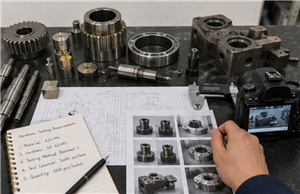
A reliable hardness testing solution quotation requires more than a simple machine request. Buyers should provide material details, sample photos, part dimensions, hardness method, scale, expected range, testing workload, report needs, and laboratory conditions. With complete information, the supplier can recommend the right Rockwell, Brinell, Vickers, Micro Vickers, Shore, Barcol, Leeb, or universal hardness testing equipment. The quotation can also include the right calibration blocks, indenters, fixtures, sample preparation equipment, software, and service support. If you are not sure which hardness tester is suitable, send your sample details first. A complete technical review can help avoid wrong equipment selection and build a more reliable quality control process from the beginning.
-
06-05 2026
How To Choose Hardness Testing Equipment For Casting And Forging Factories
Hardness testing equipment for casting and forging factories should be selected according to real production conditions. Brinell testing is often the first choice for large, coarse, or uneven metal structures because its larger indentation provides more representative results. Rockwell testing can be useful for faster checks on machined or prepared surfaces. The correct setup should include proper test force, ball diameter, machine capacity, sample support, calibration blocks, indenters, digital measurement options, and traceable reporting tools. For large or irregular parts, fixture and support design can be just as important as the machine itself. If your factory produces castings, forgings, heavy metal parts, or heat-treated components, share your sample size, material, hardness range, and report requirements before ordering. A complete recommendation can help prevent wrong model selection and improve long-term QC stability.
-
06-02 2026
Hardness Testing Solution For Gear, Shaft And Bearing Manufacturers
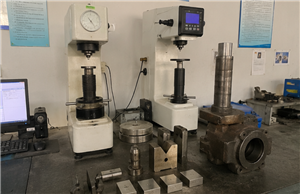
Gear, shaft, and bearing manufacturers should choose hardness testing equipment based on real production parts, not only equipment catalogue specifications. Rockwell testing is efficient for fast HRC inspection, while Micro Vickers testing is important for case depth, hardened layer profiles, and small test areas. A complete solution may include Rockwell hardness tester, Micro Vickers hardness tester, metallographic sample preparation equipment, microscope, calibration blocks, indenters, fixtures, and report software. This gives the factory a more reliable workflow from production inspection to shipment approval. If your factory manufactures gears, shafts, bearings, or precision transmission parts, share your samples, heat treatment process, hardness standard, and reporting requirements before ordering. A complete recommendation can help avoid wrong equipment selection and improve long-term QC reliability.
-
05-31 2026
Hardness Testing Equipment For Heat Treatment Shops: What Should Be Included
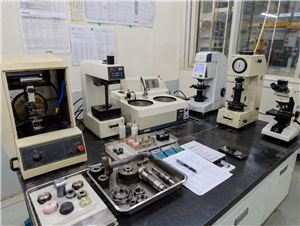
Hardness testing equipment for heat treatment shops should be selected according to real production needs. A Rockwell hardness tester is useful for fast HRC checks after quenching and tempering. A Micro Vickers hardness tester is important for case depth, carburized layers, nitrided layers, and induction-hardened zones. For shops that need customer-ready reports, the setup should also include calibration blocks, correct indenters, fixtures, sample preparation equipment, microscope inspection, and software export functions. This makes the testing process more stable, traceable, and professional. If you are planning to build or upgrade a heat treatment QC lab, share your parts, materials, processes, hardness standards, and reporting requirements before ordering. A complete recommendation can help you avoid missing key equipment and improve long-term inspection reliability.
-
05-28 2026
Hardness Tester Selection Guide For Automotive & Metal Parts QC
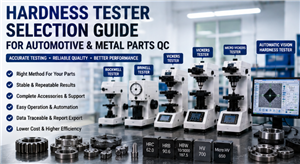
Selecting a hardness tester for automotive and metal parts QC should start from real samples, not only machine specifications. The part type, material, heat treatment process, sample geometry, hardness scale, test location, and reporting requirements all affect the best equipment choice. Rockwell testers are practical for fast production inspection. Brinell testers are useful for castings, forgings, and large metal parts. Vickers and Micro Vickers testers are better for coatings, case depth, weld sections, thin layers, and small precision parts. Automatic vision systems can further improve repeatability and documentation. If your factory needs stable hardness inspection for automotive or metal parts, share your sample information before ordering. A complete recommendation can help avoid wrong model selection and improve long-term quality control reliability.
-
05-27 2026
Top Mistakes To Avoid When Choosing Hardness Testing Equipment
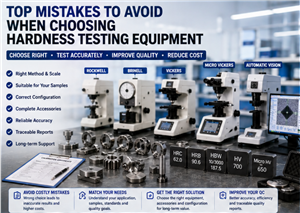
The biggest mistake when choosing hardness testing equipment is treating the purchase as a simple machine comparison. In reality, reliable hardness testing depends on method selection, sample compatibility, test force, calibration blocks, indenters, fixtures, sample preparation, automation, software, and operator workflow. Buyers should avoid choosing only by price or catalogue appearance. A suitable solution should match the factory’s real materials, samples, standards, testing volume, reporting needs, and long-term quality control process. If you are not sure which hardness tester is right for your application, share your sample details and testing requirements before ordering. A complete technical recommendation can help you avoid wrong equipment selection and improve testing reliability from the beginning.
-
05-22 2026
3 Key Considerations Before Buying Rockwell Hardness Testing Equipment
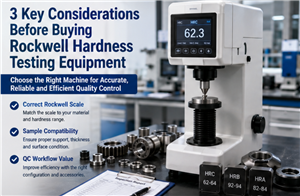
Before buying Rockwell hardness testing equipment, buyers should focus on three key points: the required Rockwell scale, the real sample condition, and the machine configuration needed for daily quality control. These factors affect not only the machine price, but also testing accuracy, operator efficiency, and long-term reliability. A suitable Rockwell hardness tester should support your material range, sample geometry, required scale, calibration process, and reporting workflow. For a factory that tests heat-treated parts, automotive components, bearings, tools, or metal products every day, choosing the correct configuration can reduce testing errors and improve production control. If you are unsure which Rockwell tester is suitable, provide your sample details and testing requirements before requesting a quote. A technical recommendation can help avoid wrong model selection and unnecessary cost.
-
05-15 2026
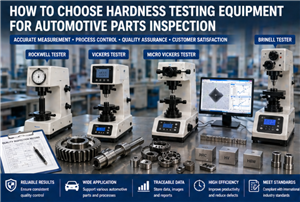
How To Choose Hardness Testing Equipment For Automotive Parts Inspection
Choosing hardness testing equipment for automotive parts inspection should start from the part type, material, heat treatment process, hardness scale, and testing location. Rockwell testers are suitable for fast production checks. Brinell testers are useful for larger castings and forgings. Vickers and Micro Vickers testers are important for precision testing, case depth analysis, coatings, and small samples. Buyers should also consider sample fixtures, calibration blocks, indenters, sample preparation equipment, automation level, and report functions. For automotive quality control, repeatability and traceability are just as important as the hardness value itself. A well-selected hardness testing solution helps improve process control, reduce rejected parts, support customer audits, and provide reliable documentation for production and quality teams.
-
04-21 2026
How To Choose A Hardness Tester Without Overpaying For Features You Do Not Need
In hardness tester procurement, the safest path is to define the real inspection requirement first and then buy only the capability that improves actual testing reliability, efficiency, and control. Buyers who follow this logic usually get better results than those who compare machines mainly by screen size or feature count. The right machine is not the one with the longest specification list. It is the one that supports daily quality decisions with less waste and fewer surprises.