


Hardness Testing Equipment For Fastener Manufacturers: Bolts, Screws And Precision Pins
Hardness Testing Equipment For Fastener Manufacturers: Bolts, Screws And Precision Pins
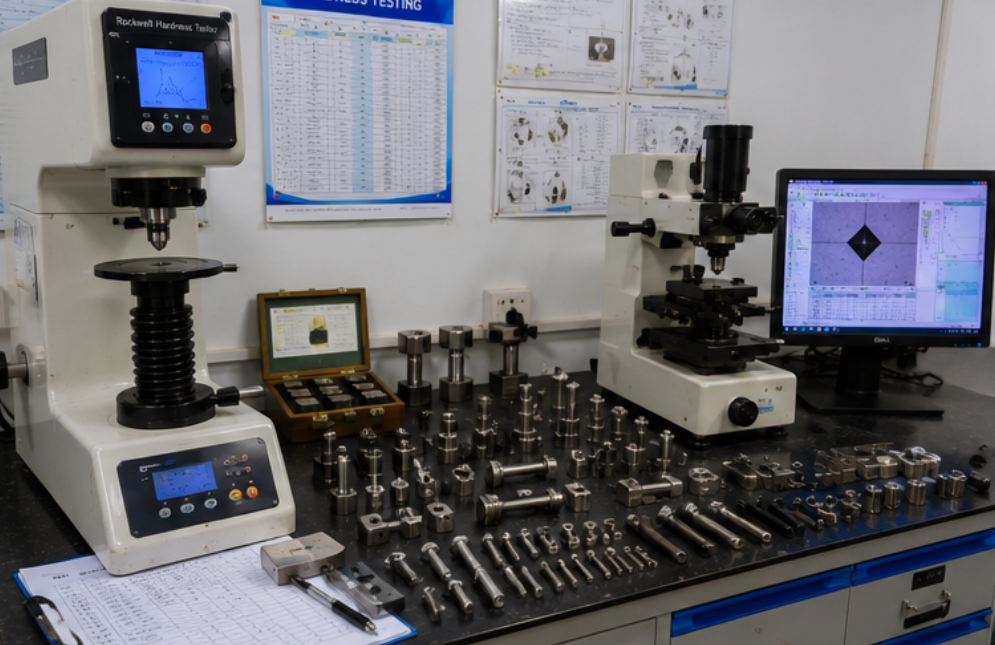
Fastener manufacturers need reliable hardness testing equipment to verify bolts, screws, studs, nuts, washers, rivets, precision pins, and heat-treated small metal parts. A complete fastener hardness testing solution should consider material grade, heat treatment process, test scale, sample size, surface condition, small-part fixture, calibration blocks, and batch inspection reports.
Bolt Hardness
Verify strength grade, heat treatment result, and surface hardness consistency.
Screw Testing
Check small screws, threaded parts, self-tapping screws, and precision components.
Small-Part Fixtures
Stable holders, V anvils, and custom fixtures reduce movement during testing.
Batch Reports
Digital records help track batch number, hardness value, calibration status, and shipment approval.
Why Fastener Hardness Testing Matters
Bolts, screws, studs, nuts, washers, rivets, and precision pins are small components, but they often carry important mechanical loads. In automotive, construction machinery, electronics, rail, energy, tooling, furniture, and industrial assembly applications, fastener hardness can affect tensile strength, wear resistance, thread performance, fatigue life, and assembly reliability.
If fasteners are too soft, threads may deform, heads may strip, or parts may fail under load. If fasteners are too hard, they may become brittle, crack during installation, or fail under impact. Heat treatment, surface hardening, carburizing, plating, and material grade all affect the final hardness result.
For fastener manufacturers, hardness testing should not be treated as a simple random check. The correct solution should match fastener size, grade, surface condition, test method, production volume, and customer reporting requirements.
1. Choose The Right Hardness Method For Fasteners
Fasteners can be tested by Rockwell, Vickers, Micro Vickers, Brinell, or other hardness methods depending on material, size, grade, and standard. Rockwell testing is often used for faster production inspection when the fastener has enough test area and stable support. Vickers or Micro Vickers testing is useful for smaller parts, thin surfaces, case depth, and precision inspection.
Some fasteners require testing on the head, shank, thread area, or prepared cross-section. Buyers should confirm the required test method before choosing equipment. If the test location is small or curved, fixture and sample preparation requirements become more important.
| Fastener Type | Common Testing Need | Recommended Method |
|---|---|---|
| Bolts and studs | Strength grade and heat treatment verification | Rockwell / Vickers |
| Small screws | Small-area hardness and thread performance | Vickers / Micro Vickers |
| Precision pins | Surface hardness and dimensional reliability | Rockwell / Vickers / Micro Vickers |
| Surface-hardened fasteners | Case depth and hardened layer profile | Micro Vickers with sample preparation |
2. Check Sample Size, Shape And Holding Method
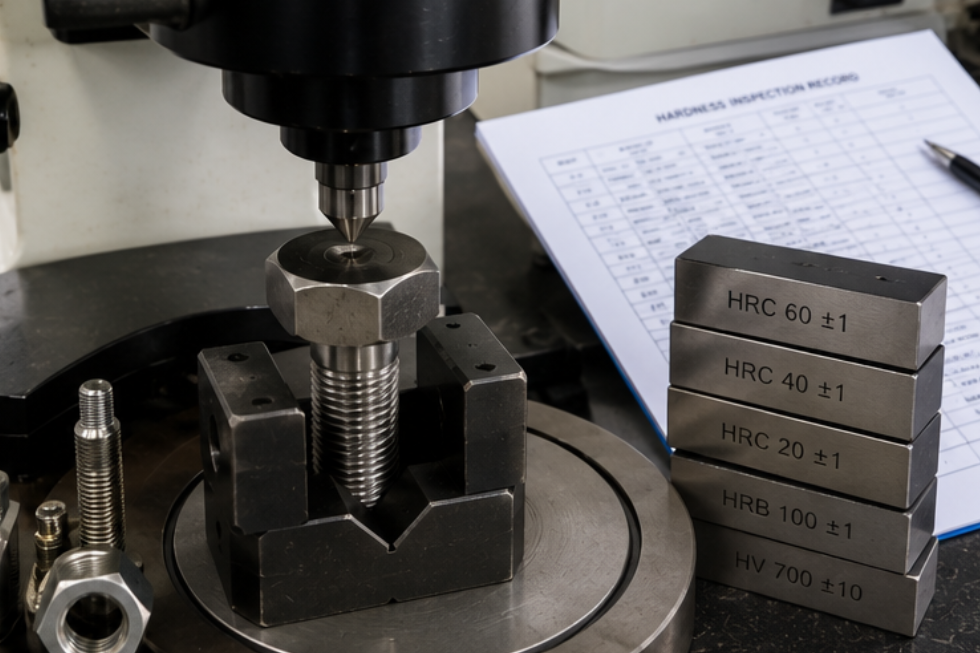
Fasteners are small, round, threaded, and sometimes difficult to hold during testing. If the part moves, tilts, or rolls during loading, the hardness result may become unstable. This is why sample support is a key part of fastener hardness testing.
Bolts may be tested on the head, shank, or cross-section. Screws and pins may require small-part holders. Round parts may require V anvils. Thin or very small fasteners may need mounting and polishing before Micro Vickers testing. The fixture should be selected according to real production samples, not only the machine catalog.
Before selecting equipment, confirm:
Fastener type, diameter, length, head shape, and thread condition.
Whether the test area is flat, curved, threaded, coated, or heat-treated.
Whether the part can be tested directly or needs sectioning.
Whether a flat anvil, V anvil, small-part fixture, or custom holder is needed.
Whether the sample has enough thickness for the selected hardness method.
Whether testing should be done on surface, core, head, shank, or cross-section.
3. Use Rockwell Testing For Fast Production QC When Suitable
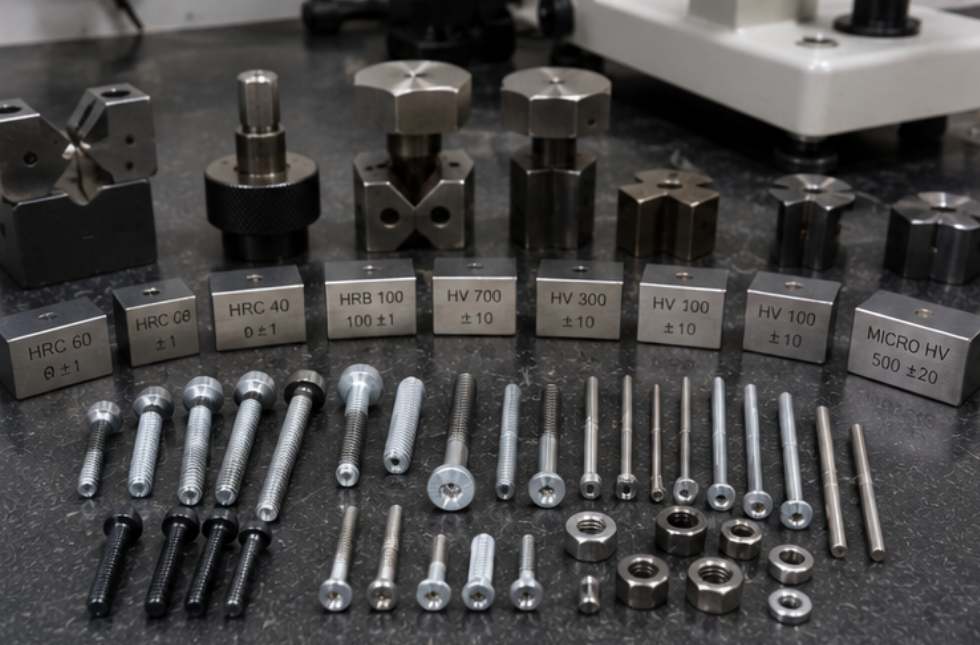
Rockwell hardness testing is useful for many fastener manufacturers because it is fast and easy to use for batch inspection. It is commonly applied to larger bolts, studs, nuts, washers, and heat-treated fasteners when the test surface and support are suitable.
However, Rockwell testing is not always suitable for every fastener. Very small screws, thin sections, curved surfaces, or shallow hardened layers may require Vickers or Micro Vickers testing instead. Buyers should confirm the required scale, indenter, sample support, and minimum thickness before using Rockwell as the main method.
| Rockwell Testing Is Suitable When | Possible Risk | Control Method |
|---|---|---|
| The fastener has enough flat test area | Wrong location may not represent the part | Define head, shank, or specified test area clearly |
| The sample has enough thickness | Backing effect may affect reading | Check scale requirement and minimum thickness |
| The part is stable on the anvil | Part may tilt or roll during loading | Use V anvil, flat anvil, or custom fixture |
| The required scale is HRC, HRB, or HRA | Wrong scale may cause customer rejection | Confirm drawing or customer standard before testing |
4. Use Micro Vickers Testing For Small Screws, Thin Layers And Case Depth
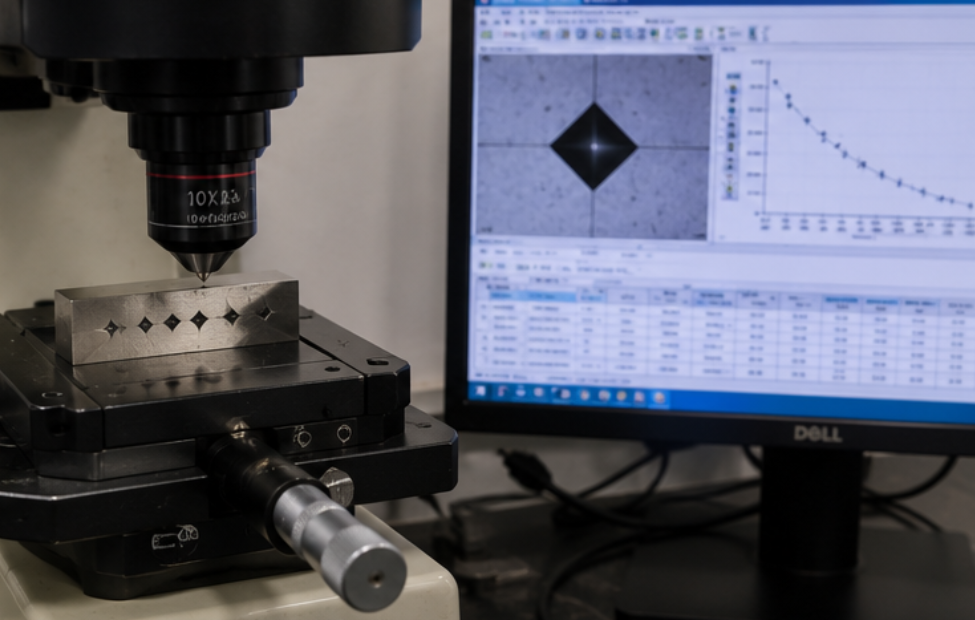
Micro Vickers testing is important when the fastener is too small for stable Rockwell testing, when the test area is limited, or when the supplier needs to inspect case depth or surface-hardened layers. It uses a small indentation and low test force, making it suitable for small screws, precision pins, thin sections, coatings, and carburized or nitrided layers.
For case depth testing, the fastener is usually sectioned, mounted, ground, polished, and tested with multiple Micro Vickers points from the surface toward the core. The software can generate a hardness profile curve and help determine the effective hardened depth.
Micro Vickers testing is useful for:
Small screws with limited test area.
Precision pins and tiny metal components.
Surface-hardened fasteners and case depth testing.
Carburized, nitrided, or carbonitrided fastener layers.
Coated or plated fasteners where substrate influence must be controlled.
Customer reports requiring indentation images and hardness profiles.
5. Do Not Ignore Sample Preparation For Cross-Section Testing
When testing small fasteners, preparation quality can directly affect results. If the sample is cut with too much heat, mounted poorly, polished unevenly, or rounded at the edge, the Micro Vickers indentation may not represent the real hardened layer.
A complete solution for advanced fastener QC may include metallographic cutting, mounting, grinding, polishing, microscope inspection, and Micro Vickers testing. This is especially important for surface-treated screws, precision pins, heat-treated bolts, and customer-approved case depth reports.
| Preparation Step | Purpose | Fastener QC Risk If Ignored |
|---|---|---|
| Cutting | Obtains required cross-section | Heat damage may change small-layer hardness |
| Mounting | Supports small parts and protects edges | Poor edge retention affects case depth result |
| Grinding and polishing | Creates flat surface for indentation measurement | Scratches make tiny indentations hard to measure |
| Microscope check | Confirms sample surface and layer condition | Testing may be done on damaged or unclear area |
6. Calibration Blocks, Indenters And Batch Reports
Fastener manufacturers often test large quantities every day, so daily verification and batch records are important. Calibration blocks should match the method and hardness range. Indenters should be inspected regularly. Test results should be linked to material batch, heat treatment batch, production order, and shipment batch when required.
For customer-facing reports, buyers may need digital data storage, PDF export, Excel export, indentation images, or hardness profile curves. Automatic vision Micro Vickers systems can improve repeatability and reduce manual measurement differences when testing small indentations.
A useful fastener hardness report should include:
Fastener type, size, grade, material, and batch number.
Heat treatment or surface treatment process.
Testing method, scale, test force, and test location.
Hardness values and acceptance range.
Calibration block value and verification record.
Operator, inspection date, machine ID, and report number.
Case depth curve or indentation images if required.
Key Questions Before Requesting A Fastener Hardness Testing Solution
Before requesting a quotation, fastener manufacturers should provide real part details and testing requirements. This helps the supplier recommend the right hardness tester, fixtures, calibration blocks, and sample preparation equipment.
What fasteners need testing: bolts, screws, studs, nuts, washers, rivets, or precision pins?
What material grade and strength class are involved?
What heat treatment or surface treatment process is used?
Which hardness scale is required: HRC, HRB, HV, Micro HV, HBW, or another scale?
Where should the test be performed: head, shank, thread, surface, core, or cross-section?
What are the fastener diameter, length, thickness, and test area size?
Do you need direct surface testing or mounted cross-section testing?
How many samples and test points are checked per batch?
Do you need special fixtures, V anvils, or small-part holders?
Do customers require PDF reports, calibration records, indentation images, or hardness profile curves?
Conclusion: Fastener Hardness Testing Needs Stable Support And Clear Standards
Hardness testing for fastener manufacturers should be selected around real products, not only machine specifications. Bolts, screws, studs, nuts, washers, rivets, and precision pins may require different methods, scales, fixtures, and sample preparation processes.
Rockwell testing is useful for fast production checks when the part size and support are suitable. Vickers and Micro Vickers testing are better for small areas, thin layers, surface-hardened parts, coatings, and case depth analysis. Calibration blocks, indenters, small-part fixtures, and clear reports are essential for stable daily QC.
If your factory produces bolts, screws, or precision pins, share your part size, material grade, hardness standard, testing location, production volume, and report requirements before ordering. A complete recommendation can help avoid unstable readings and customer inspection problems.
FAQ
Which hardness tester is suitable for bolts?
Rockwell hardness testers are commonly used for larger bolts and heat-treated fasteners when the test surface and sample support are suitable.
How do manufacturers test small screws?
Small screws may require Vickers or Micro Vickers testing because the available test area is limited and the indentation must be smaller.
Do fasteners need special fixtures for hardness testing?
Yes. Round, threaded, and small fasteners often need V anvils, small-part holders, or custom fixtures to prevent movement during testing.
When is Micro Vickers testing needed for fasteners?
Micro Vickers testing is needed for small screws, precision pins, surface-hardened layers, coatings, case depth, and prepared cross-sections.
Need Hardness Testing Equipment For Fastener Production?
Share your fastener type, size, material grade, strength class, heat treatment process, hardness scale, test location, daily testing volume, and report requirements. We can help recommend suitable hardness testers, fixtures, calibration blocks, sample preparation equipment, and complete fastener QC solutions.