


Why Metal Parts Fail Customer Inspection Even When Hardness Looks Correct
Why Metal Parts Fail Customer Inspection Even When Hardness Looks Correct
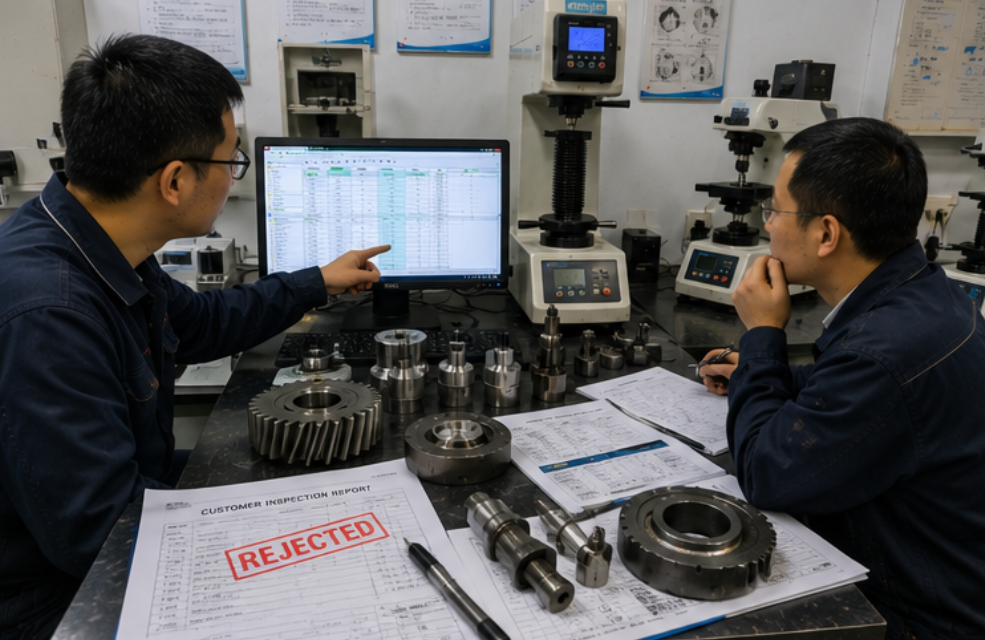
Metal parts may still fail customer inspection even when the hardness value appears to meet specification. Common causes include wrong test location, inconsistent testing method, poor calibration records, unstable sample support, incomplete case depth testing, surface hardness without core hardness verification, batch variation, poor sample preparation, and unclear QC reports.
Wrong Test Location
A correct value from the wrong area may not represent the functional surface or critical zone.
Incomplete Testing
Surface hardness may pass while core hardness, case depth, or hardness profile still fails.
Unclear Records
Customers may reject parts when reports lack method, scale, standard, calibration, or test location.
Batch Variation
A few passing samples cannot prove the whole batch is stable if sampling control is weak.
Why A Correct Hardness Number May Still Not Be Enough
Many metal parts suppliers believe that if the hardness value is within the required range, the shipment should pass customer inspection. In reality, hardness testing is not only about one number. Customers may check whether the testing method, scale, test location, calibration record, sample preparation, batch sampling, and report format match their requirements.
A part can show an acceptable hardness value but still fail inspection if the value was measured on the wrong surface, with the wrong scale, on an unrepresentative sample, or without proper calibration evidence. For heat-treated parts, the surface hardness may pass while the core hardness or case depth does not meet the requirement.
This problem is common in gears, shafts, bearings, fasteners, castings, forgings, molds, tools, welded parts, coated parts, and surface-treated components. To reduce customer rejection, suppliers need to treat hardness testing as a complete QC process instead of a simple final check.
1. The Test Location Does Not Match The Customer Requirement
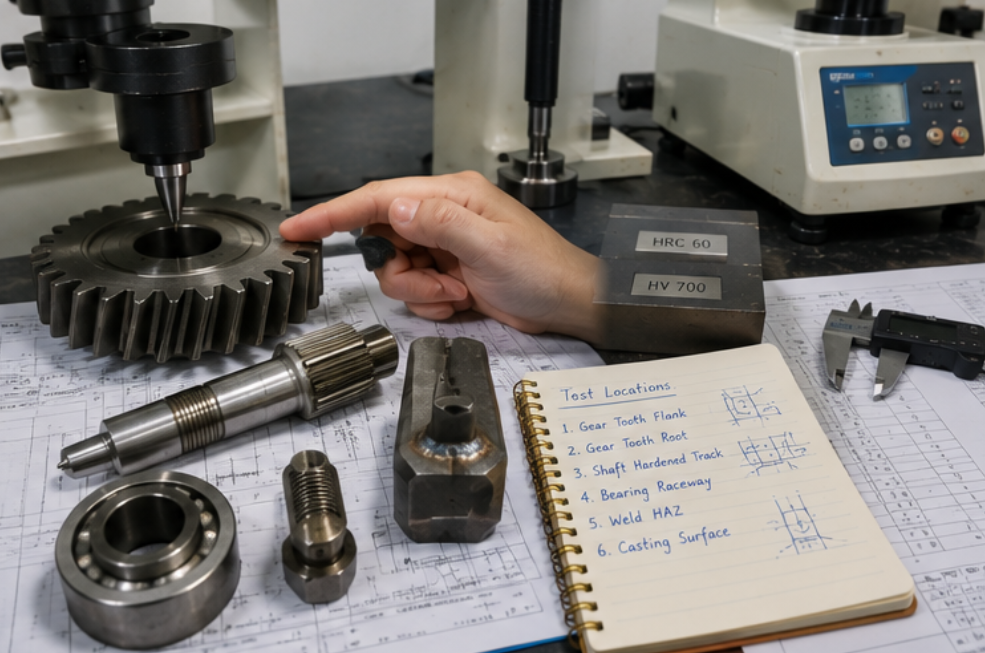
One of the most common reasons for inspection failure is testing the wrong location. Hardness can vary between surface and core, tooth flank and tooth root, weld zone and base metal, raceway and ring body, or hardened layer and substrate. If the supplier tests an easy position instead of the specified position, the reported value may not be accepted.
For example, a gear may need hardness testing on the working tooth surface. A shaft may need testing on an induction-hardened track. A welded part may need Vickers testing across the weld metal, heat-affected zone, and base metal. Testing a random flat area may produce a correct number, but it does not prove the critical area is qualified.
| Part Type | Critical Test Location | Common Mistake |
|---|---|---|
| Gear | Tooth flank, tooth root, surface, core, or cross-section path | Testing only an easy flat area instead of the tooth requirement |
| Shaft | Hardened track, bearing seat, surface layer, or core | Testing away from the functional hardened zone |
| Bearing ring | Raceway or specified ring section | Testing a non-functional surface with easier access |
| Welded part | Weld metal, HAZ, and base metal path | Reporting only one value without zone comparison |
2. Surface Hardness Passes But Core Hardness Fails
Heat-treated metal parts often require a balance between hard surface and tough core. Surface hardness helps improve wear resistance, but the core must still provide mechanical support, toughness, and fatigue resistance. If only the surface is checked, a deeper quality problem may be missed.
In customer inspection, some parts fail because surface HRC or HV values look correct, but the core hardness is outside the allowed range. A core that is too soft may deform under load. A core that is too hard may make the part brittle. This is especially important for gears, shafts, bearings, molds, tools, and automotive parts.
To avoid this problem, suppliers should confirm:
Whether the drawing requires surface hardness only or both surface and core hardness.
Where the core hardness test point should be located.
Whether the test should be done on a sectioned sample.
Whether Rockwell, Vickers, or another method is required.
Whether surface and core values should appear in the same report.
Whether the result is linked to the heat treatment batch record.
3. Case Depth Or Hardened Layer Depth Is Not Verified
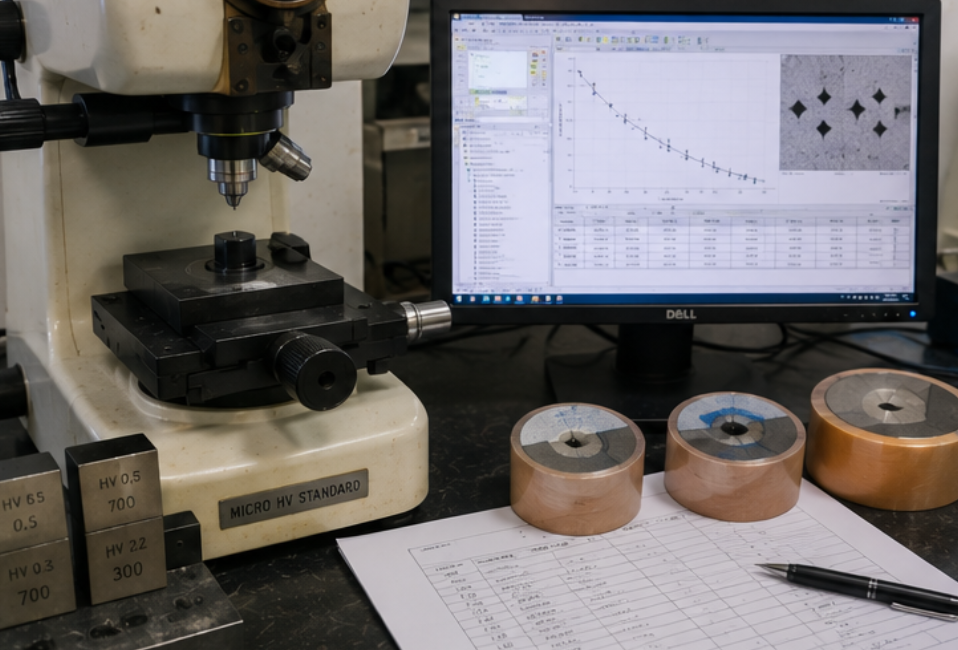
For carburized, nitrided, carbonitrided, or induction-hardened parts, a correct surface hardness value does not prove that the hardened layer is deep enough. Customers may reject parts when the effective case depth is too shallow, too deep, or not supported by a proper hardness profile.
Case depth testing usually requires metallographic sample preparation and Micro Vickers testing. The sample is cut through the required area, mounted, ground, polished, and tested with multiple indentations from the surface toward the core. The result should show a hardness profile curve and effective case depth value.
| Surface Process | Inspection Risk | Recommended Check |
|---|---|---|
| Carburizing | Surface hardness passes but effective case depth is too shallow | Micro Vickers hardness profile from surface to core |
| Nitriding | Thin layer is damaged or not deep enough | Low-load Micro Vickers testing on polished cross-section |
| Induction hardening | Hardened zone width or depth does not match the drawing | Cross-section profile testing along the hardened path |
| Coating or plating | Indentation is affected by substrate hardness | Microhardness testing with proper low load and edge retention |
4. The Testing Method Or Scale Does Not Match The Customer Standard
Another common reason for rejection is method mismatch. A supplier may report Rockwell values, while the customer requires Vickers or Brinell. A supplier may use HRC when the drawing specifies HV or HBW. Even if the value looks reasonable, the customer may reject the report because the method does not match the requirement.
Before inspection, suppliers should confirm the required standard, method, scale, test force, dwell time, and acceptance range. If the customer specification is unclear, it should be clarified before testing and shipment.
Before issuing a hardness report, check:
Required hardness method: Rockwell, Brinell, Vickers, Micro Vickers, Shore, Barcol, or Leeb.
Required scale: HRC, HRB, HBW, HV, Micro HV, or others.
Required test force and test standard if applicable.
Required test location and sampling quantity.
Acceptance range and tolerance.
Whether conversion between scales is allowed by the customer.
5. Calibration Records Are Missing Or Not Traceable
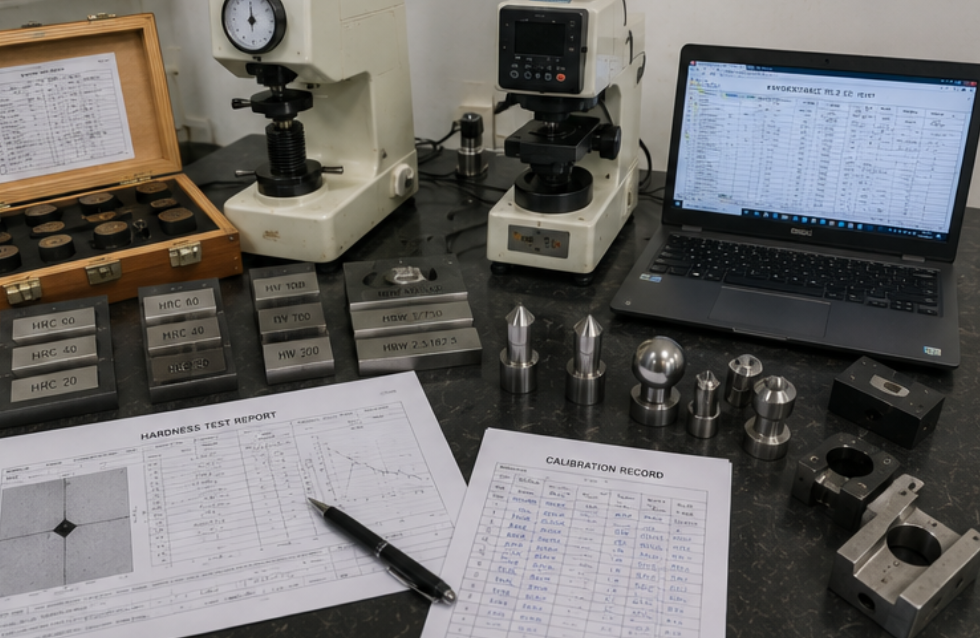
A hardness value is easier to trust when the tester is verified with suitable calibration blocks. If the customer asks for calibration evidence and the supplier cannot provide it, the part may fail inspection even when the reported value looks correct.
Calibration blocks should match the method, scale, and working hardness range. For example, HRC parts should be checked with suitable HRC blocks, Brinell testing should use HBW blocks, and Micro Vickers testing should use Micro HV blocks. The report should record tester ID, block value, verification result, operator, and inspection date when required.
| Missing Record | Customer Concern | Better Practice |
|---|---|---|
| Calibration block value | Tester accuracy cannot be verified | Record block value and serial number |
| Verification result | No proof that the tester was checked before inspection | Verify before batch testing and keep records |
| Test location | Customer cannot confirm whether critical area was tested | Mark test location in report or attach drawing/photo |
| Operator and date | Traceability is weak during audit or dispute | Include operator, date, machine ID, and report number |
6. Batch Sampling Is Too Weak
Sometimes a supplier tests one or two samples and assumes the whole batch is qualified. But if material condition, heat treatment loading, cooling, machining, or surface treatment is not stable, different parts in the same batch may show different hardness values.
Customer inspection may fail when the customer samples different pieces from the shipment and finds variation. Suppliers should define sampling quantity, test location, acceptance range, and retest rules before shipment. For critical parts, batch hardness records should be connected with material certificates and heat treatment records.
Key Questions Before Improving Hardness Inspection
If metal parts fail customer inspection even when hardness looks correct, the factory should review the full testing process instead of only retesting the same sample. The following questions help identify the real cause.
Was the tested location exactly the same as the customer requirement?
Was the correct hardness method and scale used?
Was the tester verified with proper calibration blocks before inspection?
Was the sample supported correctly during testing?
Was the surface condition suitable for the selected method?
Was only surface hardness checked, or were core hardness and case depth also required?
Was the batch sampling quantity enough?
Were different operators getting consistent results?
Were report details complete enough for customer review?
Do you need digital measurement, automatic vision, Micro Vickers profile testing, or better sample preparation equipment?
Conclusion: Customer Inspection Requires A Complete Hardness Testing Process
Metal parts can fail customer inspection even when hardness looks correct because the inspection process may be incomplete. The problem may come from wrong test location, missing core hardness check, no case depth profile, wrong method, weak calibration records, poor sample preparation, unstable support, or insufficient sampling.
A reliable process should combine correct method selection, proper test location, suitable calibration blocks, stable fixtures, sample preparation when required, batch sampling control, and clear report traceability. For heat-treated, coated, welded, cast, forged, or precision parts, Micro Vickers testing and automatic reporting may be necessary.
If your factory has experienced customer rejection, repeated retesting, unclear hardness reports, or disputes after shipment, a complete review of your hardness testing workflow can help reduce risk and improve buyer confidence.
FAQ
Why can parts fail inspection if hardness is within range?
The hardness value may be measured at the wrong location, with the wrong method, without proper calibration, or without checking core hardness, case depth, or batch variation.
Is surface hardness enough for heat-treated parts?
Not always. Some heat-treated parts also require core hardness, effective case depth, or hardness profile testing.
What equipment helps verify case depth?
Micro Vickers hardness testers with prepared cross-sections, XY stages, and profile software are commonly used for case depth testing.
What should be included in a hardness report?
A report should include part information, material, method, scale, test location, hardness values, acceptance range, calibration record, date, operator, and report number.
Need Help Reducing Customer Inspection Failure?
Share your metal part type, material, heat treatment process, hardness standard, test location, current report format, and customer rejection problem. We can help recommend suitable hardness testers, calibration blocks, fixtures, sample preparation equipment, Micro Vickers systems, and complete QC workflow solutions.