
Hardness Testing For Heat-Treated Gears: Surface Hardness, Core Hardness And Case Depth
Hardness Testing For Heat-Treated Gears: Surface Hardness, Core Hardness And Case Depth
Heat-treated gears require reliable hardness testing to verify wear resistance, tooth strength, fatigue performance, and long-term service life. A complete gear hardness testing solution should check surface hardness, core hardness, effective case depth, hardness profile, sample preparation quality, calibration records, and final QC reports.
Surface Hardness
Checks whether gear tooth surfaces reach the required HRC or HV value after heat treatment.
Core Hardness
Confirms whether the gear core keeps enough toughness and mechanical support.
Case Depth
Micro Vickers testing helps measure effective hardened layer depth from surface to core.
QC Reports
Reports can include hardness values, test points, profile curves, images, and calibration records.
Why Heat-Treated Gear Hardness Testing Matters
Gears are often used in transmission systems, reducers, automotive components, construction machinery, industrial equipment, and precision mechanical assemblies. During service, gear teeth must resist wear, contact fatigue, impact, friction, and repeated load. Heat treatment is used to improve surface hardness and service life, but the final result must be verified by proper hardness testing.
For heat-treated gears, checking only one random hardness value is usually not enough. The quality control team may need to confirm tooth surface hardness, core hardness, effective case depth, hardness gradient, and batch consistency. If surface hardness is too low, the gear may wear quickly. If core hardness is too high, the gear may lose toughness and become more likely to crack.
A complete gear hardness testing process should combine Rockwell testing, Vickers or Micro Vickers testing, metallographic sample preparation, calibration blocks, proper fixtures, and traceable reports. This is especially important for gear manufacturers, heat treatment shops, transmission component suppliers, and automotive part factories.
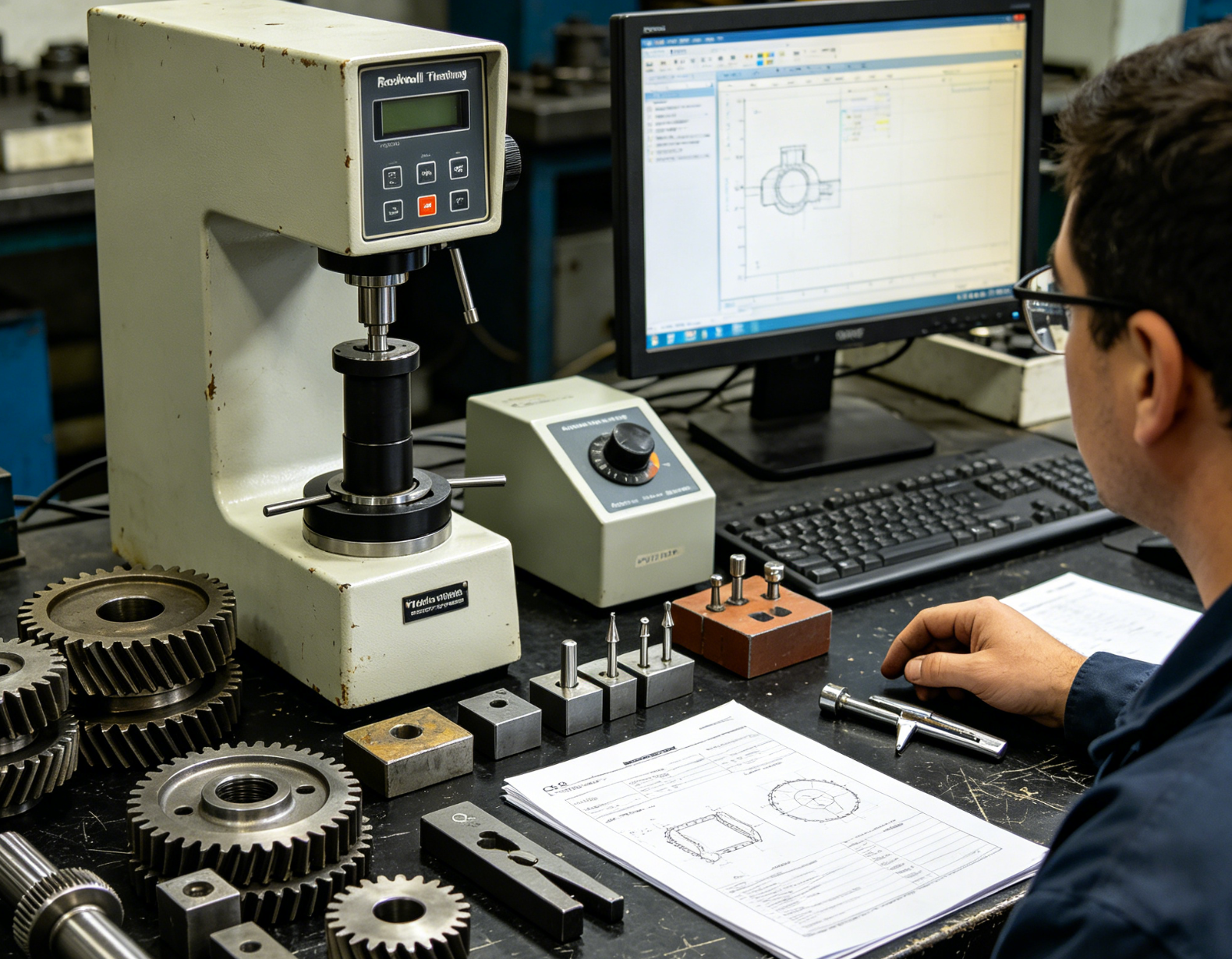
1. Surface Hardness Testing For Gear Teeth
Surface hardness is usually the first inspection item for heat-treated gears. It helps confirm whether carburizing, quenching, tempering, nitriding, carbonitriding, or induction hardening has achieved the required outer layer hardness. Rockwell HRC testing is commonly used for fast inspection when the gear surface and sample support are suitable.
For some gear teeth, Vickers hardness testing may be more suitable because the test area is smaller and the result can be linked to a more precise location. If the tooth geometry makes direct testing difficult, the gear may need to be sectioned and tested on a prepared cross-section.
| Inspection Need | Recommended Method | Buyer Checkpoint |
|---|---|---|
| Fast tooth surface hardness check | Rockwell HRC | Confirm stable support, correct scale, and enough test area |
| Small gear tooth or narrow test area | Vickers or Micro Vickers | Confirm optical measurement and sample preparation needs |
| Induction-hardened gear track | Rockwell / Vickers / Micro Vickers | Confirm test location and hardened zone width |
| Customer report with image proof | Automatic Micro Vickers | Confirm image storage, profile curve, and report export |
2. Core Hardness Testing For Gear Toughness
Core hardness is just as important as surface hardness. A heat-treated gear usually needs a hard surface for wear resistance and a tougher core for load support. If the core is too soft, the gear may deform under load. If the core is too hard, the gear may become brittle and more vulnerable to cracking.
Core hardness is often tested on a sectioned sample or prepared area. The test method depends on gear size, material, required standard, and customer specification. Rockwell testing may be used for larger sections, while Vickers testing can be used when the test area is limited or when a more detailed hardness distribution is needed.
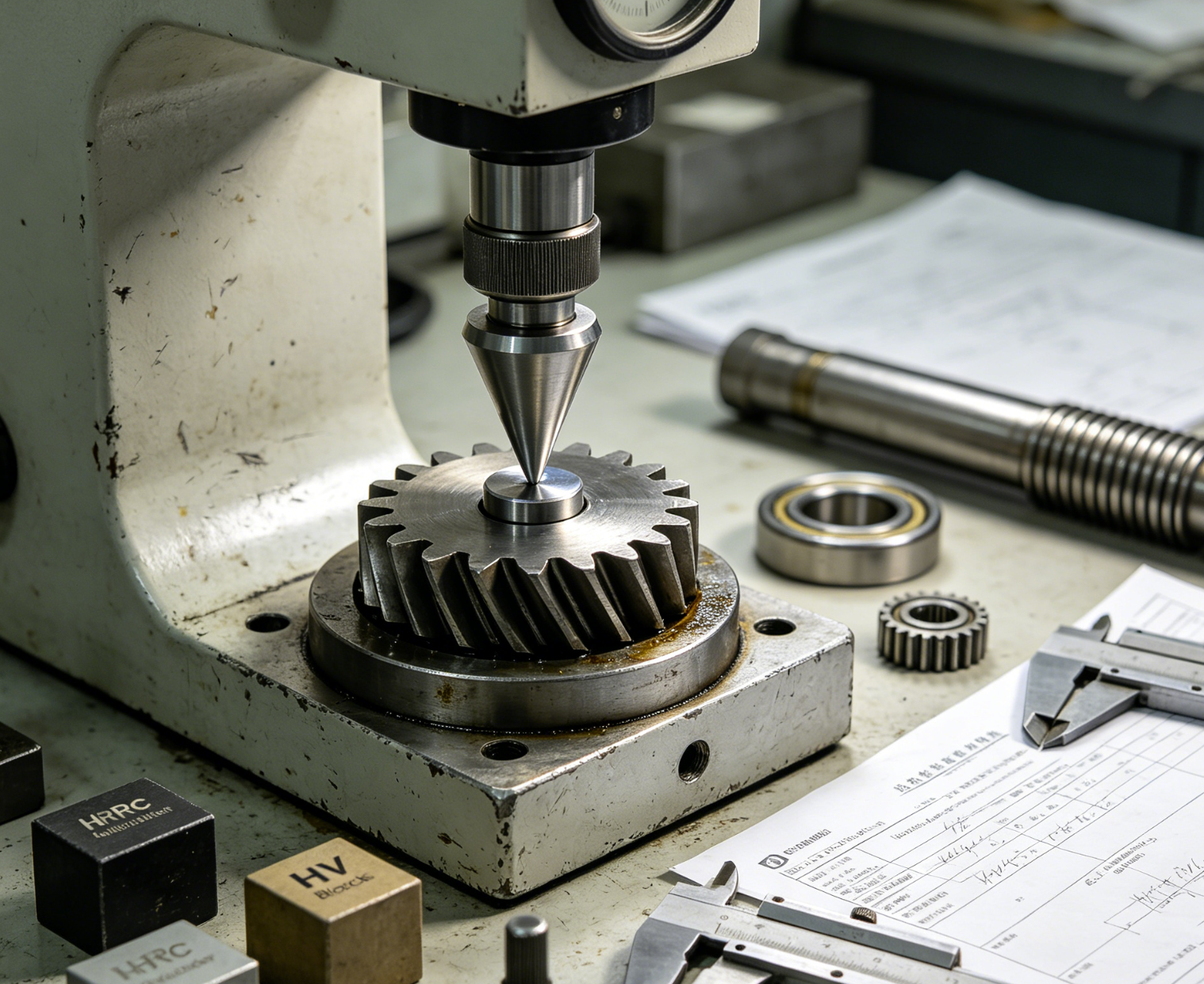
When checking core hardness, confirm:
Whether the drawing requires core hardness or only surface hardness.
Where the core hardness test point should be located.
Whether the sample needs cutting and polishing.
Which hardness scale is required, such as HRC, HV, or HBW.
Whether surface and core hardness should be included in the same report.
Whether the result needs to be compared with heat treatment batch records.
3. Case Depth Testing For Carburized And Nitrided Gears
Many gears are carburized, carbonitrided, nitrided, or induction hardened. For these gears, surface hardness alone cannot show whether the hardened layer is deep enough. Case depth testing is needed to confirm how far the hardened layer extends from the tooth surface toward the core.
Micro Vickers testing is commonly used for effective case depth measurement. The gear is sectioned through the required tooth area, mounted, ground, polished, and tested with multiple Micro Vickers indentations from the surface inward. The hardness values are then plotted as a profile curve.
| Gear Treatment | Testing Purpose | Recommended Equipment |
|---|---|---|
| Carburized gear | Effective case depth and surface-to-core hardness gradient | Micro Vickers tester with profile software |
| Nitrided gear | Thin hardened layer and surface hardness verification | Low-load Micro Vickers tester |
| Induction-hardened gear | Hardened zone depth and profile control | Micro Vickers or Vickers tester with prepared cross-section |
| Gear tooth cross-section | Hardness changes from tooth surface to core | Cutting, mounting, grinding, polishing, microscope, Micro Vickers |
4. Sample Preparation Is Critical For Gear Case Depth Testing
Gear case depth testing requires careful sample preparation. The section must pass through the correct tooth area, and the hardened layer must not be damaged by cutting heat, grinding deformation, edge rounding, or polishing scratches. Poor preparation can make the hardness profile inaccurate.
A complete workflow usually includes low-damage cutting, mounting, grinding, polishing, cleaning, microscope inspection, and Micro Vickers testing. For small gears or fine tooth profiles, edge retention is especially important because the hardened layer may be thin and easy to damage during preparation.
Recommended sample preparation equipment includes:
Metallographic cutting machine for low-damage gear sectioning.
Hot or cold mounting system for gear tooth cross-sections.
Grinding and polishing machine for flat, scratch-controlled surfaces.
Polishing consumables such as grinding paper, polishing cloth, and diamond suspension.
Metallurgical microscope for checking layer quality and surface preparation.
Ultrasonic cleaner or cleaning tools before final Micro Vickers testing.
5. Calibration Blocks, Fixtures And Test Point Control
Accurate gear hardness testing depends on proper calibration and stable positioning. Calibration blocks should match the required method and working hardness range. Rockwell HRC blocks, HV blocks, and Micro HV blocks may all be needed depending on the gear inspection plan.
Fixtures and sample holders are also important. Gear geometry can make testing difficult, especially near tooth flanks, roots, and curved surfaces. If the part or mounted sample is not stable, the result may vary. For Micro Vickers case depth testing, test point spacing and distance from the surface should follow customer standards or internal specifications.
| Control Item | Why It Matters | Recommended Practice |
|---|---|---|
| Calibration block | Verifies tester accuracy before batch inspection | Use HRC, HV, or Micro HV blocks close to working range |
| Gear support | Prevents movement during surface hardness testing | Use stable fixture, flat support, V support, or custom holder |
| Test point spacing | Affects case depth curve accuracy | Set spacing according to standard or customer requirement |
| Test path | Determines whether the profile represents the tooth surface correctly | Measure from tooth surface toward the core on a prepared cross-section |
6. Prepare A Clear Gear Hardness Testing Report
Gear hardness reports should be clear enough for customers, heat treatment engineers, and QC teams to review. A simple final value may not be enough when the gear requires case depth or heat treatment validation. The report should include sample information, material grade, heat treatment process, test method, test force, test location, hardness values, and calibration records.
For case depth testing, the report should also include test point distances, hardness profile curve, effective case depth result, indentation images, and cross-section information. Automatic vision Micro Vickers systems can help improve report consistency by saving images, coordinates, and calculated values.
A useful gear hardness report should include:
Gear type, material grade, batch number, and drawing number.
Heat treatment process such as carburizing, nitriding, quenching, or induction hardening.
Surface hardness, core hardness, and acceptance range.
Test method, scale, force, and calibration block record.
Test location such as tooth flank, tooth root, surface, or core.
Micro Vickers test point distance and hardness profile curve.
Effective case depth result if required.
PDF or Excel report export for customer documentation.
Key Questions Before Choosing A Gear Hardness Testing Solution
Before requesting a quotation, gear manufacturers and heat treatment shops should provide detailed information about the gear, material, heat treatment process, testing standard, and report requirements. This helps the supplier recommend the right hardness tester and sample preparation workflow.
What type of gear will be tested: spur gear, helical gear, bevel gear, worm gear, or transmission gear?
What material grade and heat treatment process are used?
Do you need surface hardness, core hardness, case depth, or hardness profile testing?
Which hardness scale is required: HRC, HV, Micro HV, HBW, or another scale?
What is the expected surface hardness and core hardness range?
What effective case depth range is required?
Where should the test points be located on the gear tooth?
How many samples and test points are measured per batch?
Do you already have cutting, mounting, grinding, polishing, and microscope equipment?
Do customers require hardness profile curves, indentation images, PDF reports, or calibration records?
Conclusion: Gear Hardness Testing Should Cover Surface, Core And Case Depth
Heat-treated gears should be tested with a complete quality control mindset. Surface hardness confirms wear resistance, core hardness confirms internal support and toughness, and case depth testing confirms whether the hardened layer reaches the required depth.
A practical testing solution may include Rockwell hardness tester, Vickers or Micro Vickers hardness tester, metallographic cutting machine, mounting system, grinding and polishing machine, microscope, calibration blocks, fixtures, and software for hardness profile reports.
If your factory manufactures or heat-treats gears, share your gear type, material, process, hardness standard, case depth requirement, and report needs before ordering. A complete recommendation can help you avoid incomplete testing and improve gear quality control reliability.
FAQ
Which hardness tester is used for heat-treated gears?
Rockwell hardness testers are commonly used for fast surface hardness checks, while Micro Vickers testers are used for case depth and hardness profile testing.
Why is core hardness important for gears?
Core hardness helps confirm that the gear has enough internal toughness and load support, instead of only a hard surface layer.
How is gear case depth tested?
The gear is usually sectioned, mounted, polished, and tested with Micro Vickers indentations from the tooth surface toward the core to build a hardness profile.
Does gear hardness testing need sample preparation?
For surface HRC checks, sample preparation may be simple. For core hardness and case depth testing, cutting, mounting, grinding, polishing, and microscope inspection are usually required.
Need A Hardness Testing Solution For Heat-Treated Gears?
Share your gear type, material grade, heat treatment process, hardness scale, surface hardness range, core hardness requirement, case depth standard, and report needs. We can help recommend suitable hardness testers, sample preparation equipment, calibration blocks, fixtures, and complete gear QC solutions.