
How To Choose Hardness Testing Equipment For Casting And Forging Factories
How To Choose Hardness Testing Equipment For Casting And Forging Factories
Casting and forging factories need hardness testing equipment to verify material quality, heat treatment results, mechanical performance, and batch consistency. Because castings and forgings are often large, heavy, rough, and structurally uneven, buyers should choose equipment based on material type, sample size, test force, surface condition, support method, calibration blocks, and reporting requirements.
Brinell Testing
Large indentation helps evaluate castings, forgings, and coarse metal structures more representatively.
Rockwell Testing
Useful for faster inspection of machined, heat-treated, or prepared metal surfaces.
Sample Support
Heavy and irregular parts need stable supports, fixtures, platforms, or portable testing solutions.
QC Reports
Digital measurement, calibration records, and export reports support customer acceptance.
Why Casting And Forging Factories Need The Right Hardness Tester
Castings and forgings are widely used in machinery, automotive, construction equipment, mining, rail, energy, valves, pumps, molds, and heavy industrial components. These parts often need to withstand pressure, impact, friction, load, and long-term service conditions. Hardness testing helps verify whether the material and heat treatment process meet the required mechanical performance.
Compared with small machined parts, castings and forgings are more challenging to test. They may have coarse microstructures, rough surfaces, large dimensions, heavy weight, irregular shapes, and local hardness variation. If the wrong testing method is selected, the result may not represent the real material condition.
For this reason, casting and forging factories should not choose a hardness tester only by price. The correct equipment should match real parts, material grades, production process, test standards, daily workload, and customer report requirements.
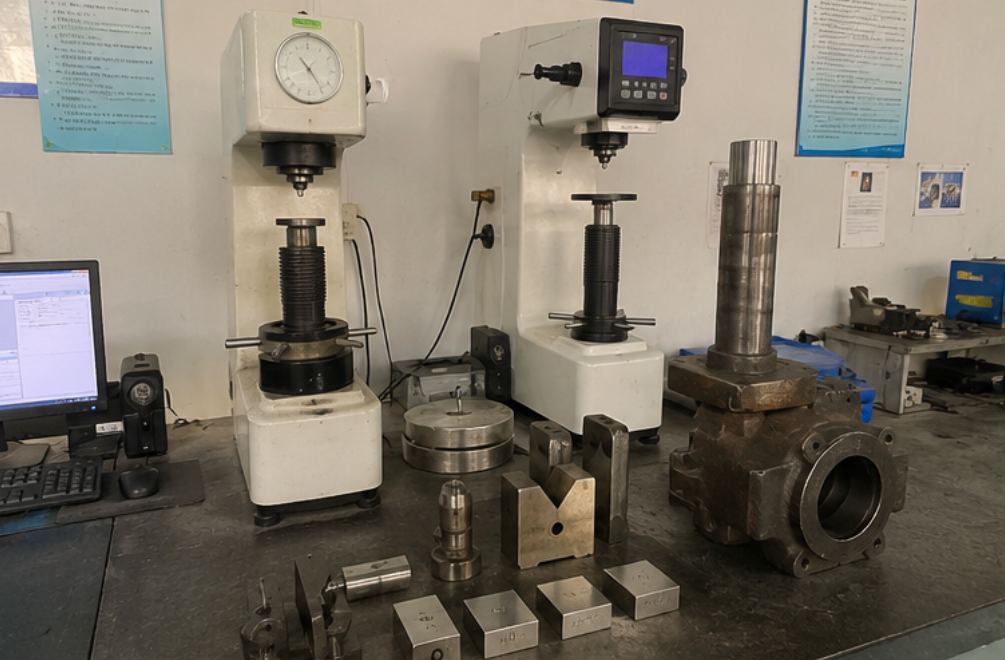
1. Brinell Hardness Tester Is Often The First Choice
Brinell hardness testing is commonly used for castings and forgings because it creates a larger indentation than Rockwell or Vickers testing. This larger indentation can better average local material variation and provide a more representative hardness value for coarse or uneven metal structures.
For cast iron, cast steel, forged steel, aluminum castings, copper alloy castings, and large heat-treated components, Brinell testing is often more practical than testing only a small point. Buyers should check test force, ball diameter, machine capacity, sample space, and indentation diameter measurement method before ordering.
| Material / Part Type | Common QC Need | Recommended Method |
|---|---|---|
| Cast iron parts | Representative hardness for coarse structures | Brinell hardness testing |
| Forged steel parts | Heat treatment verification and batch control | Brinell / Rockwell hardness testing |
| Aluminum and copper alloy castings | Soft metal hardness inspection | Brinell hardness testing with suitable force |
| Machined forged components | Fast surface hardness check | Rockwell hardness testing after surface preparation |
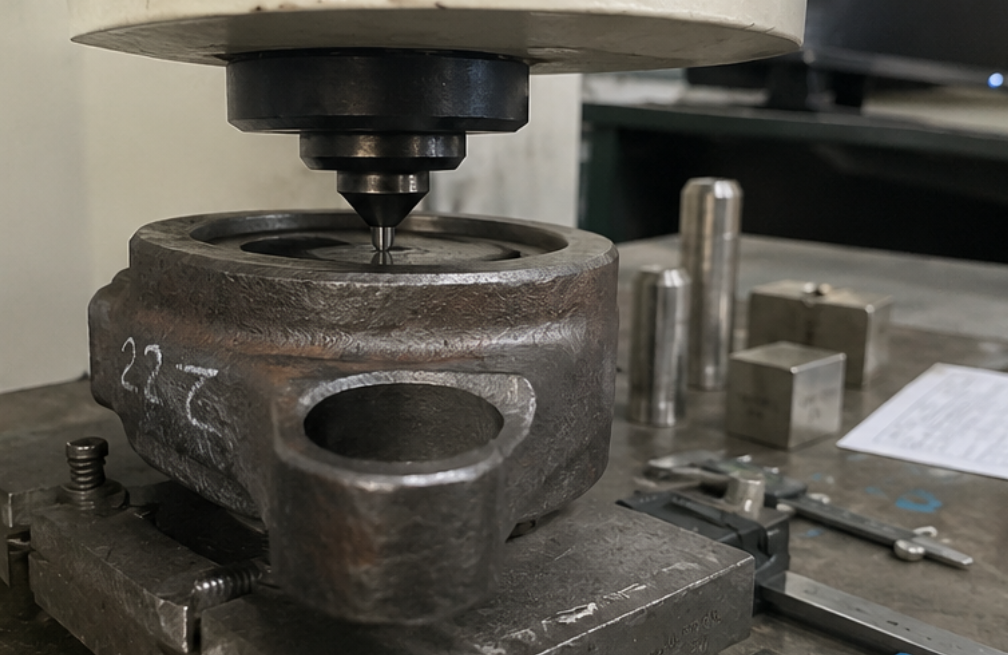
2. Check Test Force, Ball Diameter And Measuring Method
Brinell testing depends on the correct combination of test force and ball diameter. If the force is too low, the indentation may be too small to represent the material. If the force is too high, soft materials may be over-deformed or thin areas may be affected by the backing surface.
Buyers should confirm the required HBW testing condition according to material type, hardness range, and applicable standard. Digital Brinell systems or image measurement software can improve indentation diameter reading and reduce operator variation, especially for factories that need repeated batch inspection.
Before choosing Brinell equipment, confirm:
Material type and expected hardness range.
Required Brinell scale and HBW value range.
Ball diameter and test force combination.
Maximum sample size, height, width, and weight.
Whether manual or digital indentation measurement is needed.
Whether calibration blocks are close to the working hardness range.
3. Do Not Ignore Sample Size, Shape And Surface Condition
Casting and forging parts are often heavy, rough, curved, or irregular. The hardness tester must physically support the part and keep the test area stable during loading. If the sample tilts, bends, vibrates, or moves, the test result may become unreliable.
Surface condition is another important factor. Heavy scale, sand, rust, machining marks, oxide layers, oil, and loose particles may affect indentation formation or measurement. The test area does not always need mirror polishing, but it should be clean, stable, and suitable for the selected method.
| Sample Condition | Possible Problem | Recommended Solution |
|---|---|---|
| Large casting or forging | Machine space or worktable may not fit the part | Check test height, throat depth, platform size, and load capacity |
| Rough or scaled surface | Indentation edge becomes unclear | Clean or grind the test area before hardness testing |
| Curved or irregular part | Sample support is unstable | Use suitable fixtures, supports, or custom holding tools |
| Very large immovable part | Cannot be placed on a bench tester | Consider portable hardness testing as a supplementary method |
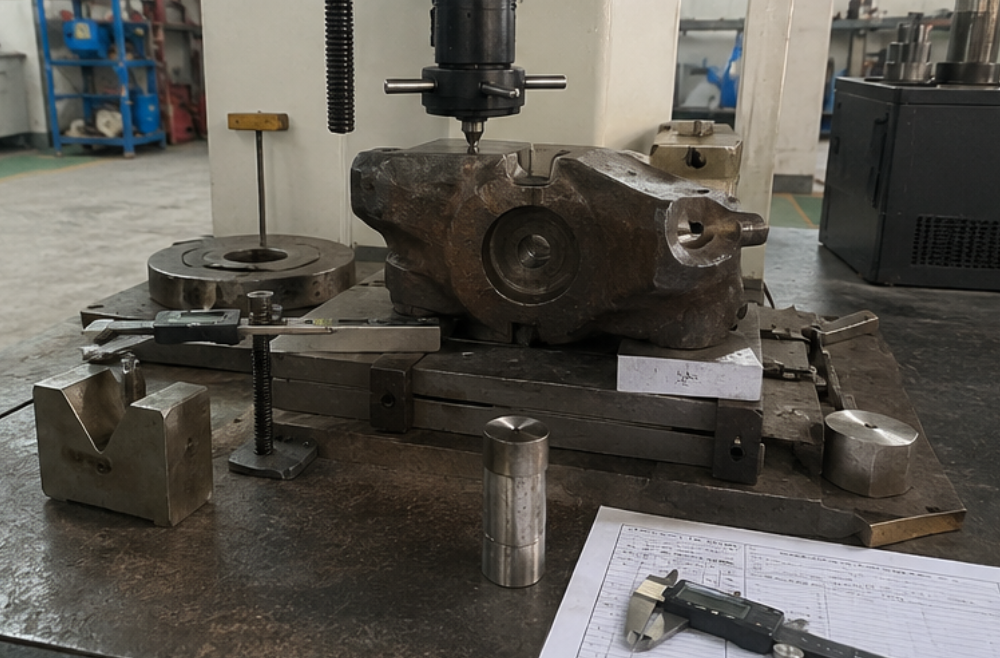
4. When Should Casting And Forging Factories Use Rockwell Testing?
Although Brinell testing is often preferred for large castings and forgings, Rockwell testing is still useful in many situations. If the part has a machined or prepared surface, enough thickness, and stable support, Rockwell testing can provide fast results for routine production inspection.
Rockwell testing may be used for heat-treated forged steel parts, machined components, tool steel, shafts, molds, and parts that require HRC or HRB values. It is faster than Brinell testing and easier to use for repeated daily checks. However, buyers should confirm the correct scale, indenter, calibration blocks, and sample support.
Rockwell testing is useful when:
The part has a clean and stable test surface.
The required hardness value is HRC, HRB, HRA, or superficial Rockwell.
The factory needs fast production inspection.
The sample thickness is suitable for the selected scale.
The part can be supported firmly with proper anvils or fixtures.
The material is more uniform or already machined after forging.
5. Calibration Blocks, Indenters And Daily Verification
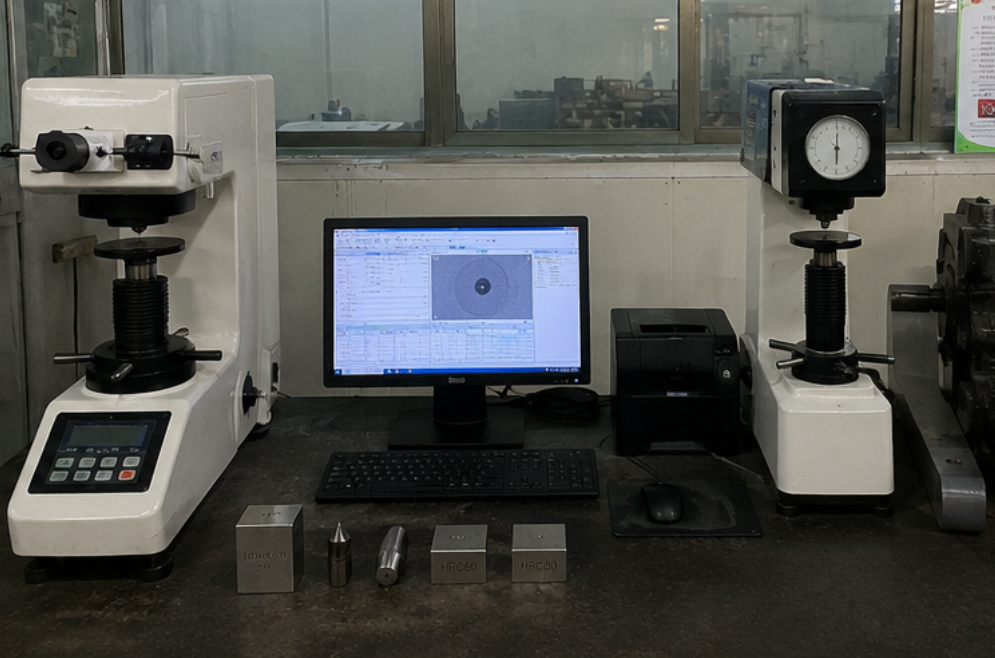
Casting and forging factories should verify hardness testers regularly with suitable calibration blocks. For Brinell testing, HBW calibration blocks should match the testing condition and working hardness range. For Rockwell testing, HRC or HRB blocks should be used according to the scale.
Indenters must also be checked. A worn Brinell ball or damaged Rockwell indenter can create unstable or incorrect readings. Calibration records should be kept before important batch inspections, after machine maintenance, and when abnormal results appear.
| QC Item | Why It Matters | Recommended Practice |
|---|---|---|
| HBW calibration block | Verifies Brinell tester accuracy | Use blocks close to actual casting or forging hardness range |
| HRC / HRB calibration block | Verifies Rockwell tester scale performance | Check before routine production testing |
| Ball indenter | Affects Brinell indentation shape and diameter | Inspect for wear, flattening, damage, or contamination |
| Verification records | Supports customer audits and quality traceability | Record date, block value, result, operator, and machine ID |
6. Digital Measurement And Report Export For Customer Approval
Many casting and forging suppliers need to provide inspection records before shipment. If hardness results are recorded manually, errors may occur in reading, calculation, transcription, or report formatting. Digital Brinell measurement systems can save indentation images, calculate hardness values, store records, and export reports.
For factories serving automotive, rail, energy, mining, pump, valve, or machinery customers, traceable quality reports can improve customer confidence. The report should include sample ID, material, heat treatment condition, test method, test force, calibration record, hardness value, and operator information.
Key Questions Before Requesting A Quotation
To choose the right hardness testing equipment for casting and forging factories, buyers should provide detailed information about parts, materials, surfaces, testing standards, and reporting requirements before requesting a quotation.
What materials will be tested: cast iron, cast steel, forged steel, aluminum alloy, copper alloy, or other metals?
What are the maximum sample size, thickness, weight, and shape?
Is the test surface rough, machined, ground, or heat-treated?
Which hardness method or scale is required: HBW, HRC, HRB, HV, or others?
What hardness range do you expect?
Do you need Brinell testing, Rockwell testing, or both?
Do you need manual or digital indentation measurement?
Do you need special sample support, fixtures, or a large worktable?
Do you need calibration blocks, indenters, and verification records?
Do customers require PDF reports, image records, or batch inspection documents?
Conclusion: Choose Equipment Around Real Casting And Forging Conditions
Hardness testing equipment for casting and forging factories should be selected according to real production conditions. Brinell testing is often the first choice for large, coarse, or uneven metal structures because its larger indentation provides more representative results. Rockwell testing can be useful for faster checks on machined or prepared surfaces.
The correct setup should include proper test force, ball diameter, machine capacity, sample support, calibration blocks, indenters, digital measurement options, and traceable reporting tools. For large or irregular parts, fixture and support design can be just as important as the machine itself.
If your factory produces castings, forgings, heavy metal parts, or heat-treated components, share your sample size, material, hardness range, and report requirements before ordering. A complete recommendation can help prevent wrong model selection and improve long-term QC stability.
FAQ
Which hardness tester is best for castings?
Brinell hardness testers are often preferred for castings because the larger indentation can better represent coarse or uneven metal structures.
Which hardness tester is suitable for forgings?
Forgings may use Brinell testing for representative hardness and Rockwell testing for faster inspection on machined or prepared surfaces.
Do castings need surface preparation before hardness testing?
Yes. Heavy scale, rust, sand, oil, or rough surfaces should be cleaned or prepared so the indentation and measurement are reliable.
Why are calibration blocks important?
Calibration blocks help verify hardness tester accuracy and support traceable quality records before batch inspection or shipment approval.
Need Hardness Testing Equipment For Castings Or Forgings?
Share your material type, casting or forging size, surface condition, hardness range, testing standard, daily workload, and report needs. We can help recommend Brinell testers, Rockwell testers, calibration blocks, indenters, fixtures, digital measurement systems, and complete QC solutions.