
Microhardness Testing For Coatings, Thin Layers And Surface Treatment Parts
Microhardness Testing For Coatings, Thin Layers And Surface Treatment Parts
Microhardness testing is widely used for coatings, thin layers, plating, carburized layers, nitrided layers, surface-treated parts, weld sections, and small precision components. To obtain reliable results, buyers need the right Micro Vickers hardness tester, low-load range, sample preparation process, optical measurement system, calibration blocks, fixtures, and traceable report software.
Coating Hardness
Measure hardness of plated, sprayed, coated, or treated surface layers without excessive substrate influence.
Thin Layer Testing
Low-load Micro Vickers testing helps inspect thin hardened layers and small cross-section areas.
Sample Preparation
Cutting, mounting, grinding, polishing, and edge retention directly affect measurement reliability.
Traceable Reports
Software can save indentation images, test points, hardness values, and profile data for customer review.
Why Microhardness Testing Is Important For Coatings And Thin Layers
Coatings, thin layers, and surface treatment parts are often designed to improve wear resistance, corrosion resistance, fatigue performance, friction control, or service life. However, the surface layer may be much thinner than the base material. If the testing load is too high, the indentation may penetrate through the layer and include the influence of the substrate.
Microhardness testing solves this problem by using lower test forces and smaller indentations. It allows laboratories to measure local hardness on coated parts, plated layers, carburized layers, nitrided layers, induction-hardened zones, weld sections, and small precision components.
For surface treatment suppliers, coating companies, heat treatment shops, metal processing factories, electronics component suppliers, and industrial QC labs, Micro Vickers testing can help verify whether the surface process meets the required hardness and consistency before shipment.
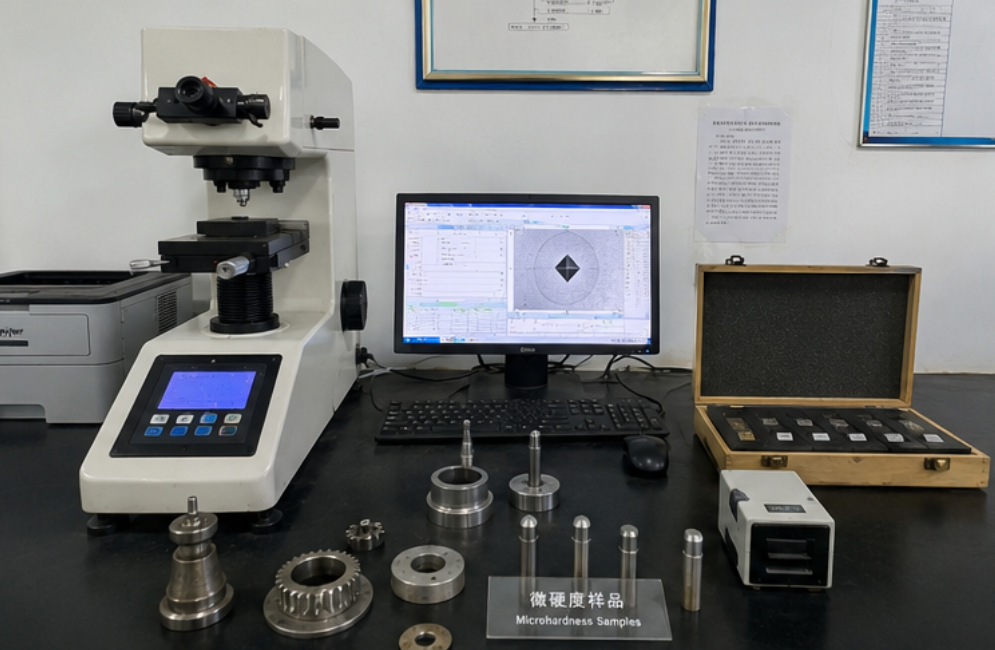
1. Choose The Right Microhardness Testing Method
Micro Vickers testing is the most common method for coatings and thin layers. It uses a diamond pyramid indenter and measures the diagonal of a small indentation. The hardness value is calculated based on the test force and indentation size. Because the indentation is small, the method is suitable for small areas and thin layers.
Buyers should confirm whether they need surface testing, cross-section testing, hardness profile testing, or layer-to-substrate comparison. Different applications may require different test loads, sample preparation methods, and software functions.
| Application | Testing Purpose | Recommended Setup |
|---|---|---|
| Plated or coated parts | Check coating hardness and surface process quality | Micro Vickers tester with low-load range |
| Carburized and nitrided layers | Measure hardness profile from surface to core | Micro Vickers tester with XY stage and profile software |
| Weld sections | Compare hardness across weld metal, HAZ, and base metal | Vickers or Micro Vickers tester with prepared cross-section |
| Small precision parts | Measure local hardness in a limited test area | Microhardness tester with precise optical measurement |
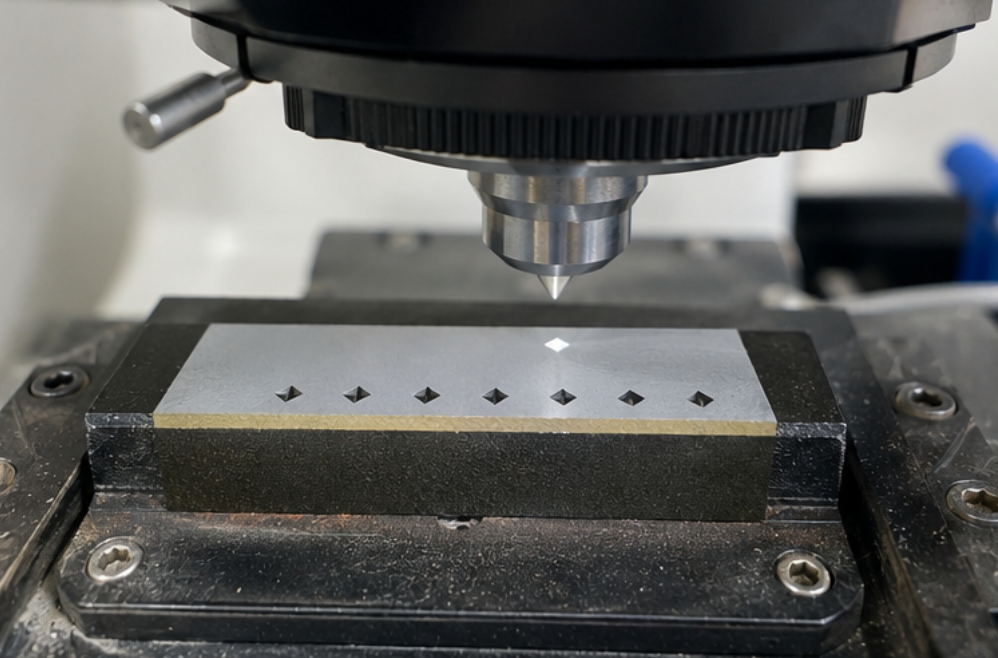
2. Match The Test Load To The Layer Thickness
Test load is one of the most important factors in microhardness testing. If the load is too high, the indentation may be too deep and the result may reflect both the coating and substrate. If the load is too low, the indentation may be too small and difficult to measure accurately.
The correct test load depends on coating thickness, expected hardness, sample surface quality, indentation size, and required standard. For thin coatings and delicate surface layers, buyers should choose a Micro Vickers tester with stable low-load performance and clear optical measurement.
Before selecting the load range, confirm:
Coating or layer thickness.
Expected hardness range of the coating and substrate.
Whether the test is performed on surface or cross-section.
Minimum indentation size that can be measured clearly.
Required Micro HV scale and test standard.
Whether automatic vision measurement is needed for repeatability.
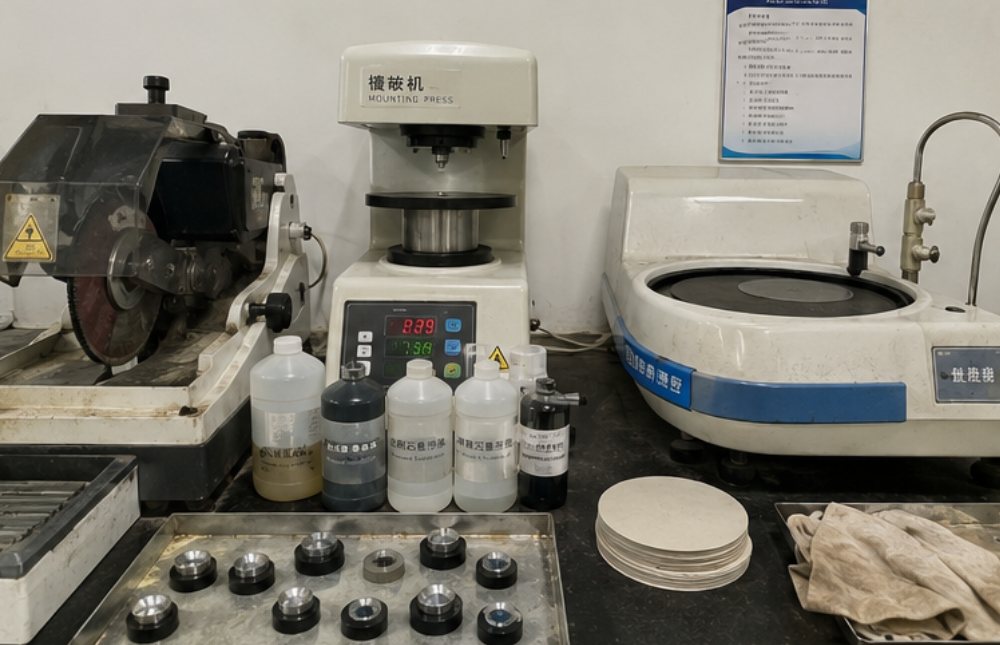
3. Sample Preparation Determines Testing Accuracy
Microhardness testing is very sensitive to sample preparation. Coatings and thin layers can be damaged easily during cutting, mounting, grinding, and polishing. If the layer edge is rounded, pulled out, scratched, overheated, or contaminated, the hardness result may not represent the real surface condition.
For cross-section testing, the sample should be cut with low damage, mounted with good edge retention, ground and polished carefully, cleaned before testing, and checked under a microscope. Surface quality must be high enough for the software or operator to identify indentation diagonals clearly.
| Preparation Step | Risk If Poorly Controlled | Recommended Control |
|---|---|---|
| Cutting | Heat damage, deformation, or coating loss | Use low-damage cutting and proper coolant |
| Mounting | Poor edge retention or tilted sample | Choose mounting method suitable for thin layers |
| Grinding | Scratches and layer deformation | Use controlled steps and avoid excessive pressure |
| Polishing | Unclear indentation edge or surface contamination | Use proper polishing cloths, suspension, and cleaning process |
4. Use Optical Or Automatic Vision Measurement For Better Repeatability
Microhardness results depend on measuring very small indentation diagonals. Manual optical reading can work for experienced operators, but variation may occur when indentation edges are unclear or when multiple operators are involved. Automatic vision measurement can improve repeatability by capturing the image, detecting the indentation, calculating the value, and saving the result.
For coatings, thin layers, case depth profiles, and customer reports, automatic measurement is especially useful. It helps reduce operator subjectivity and provides image evidence for each test point.
Automatic vision functions may include:
Indentation image capture.
Automatic diagonal measurement.
Hardness value calculation.
Test point position record.
Image storage for traceability.
Hardness profile curve generation.
Excel or PDF report export.
5. Build A Hardness Profile For Treated Layers
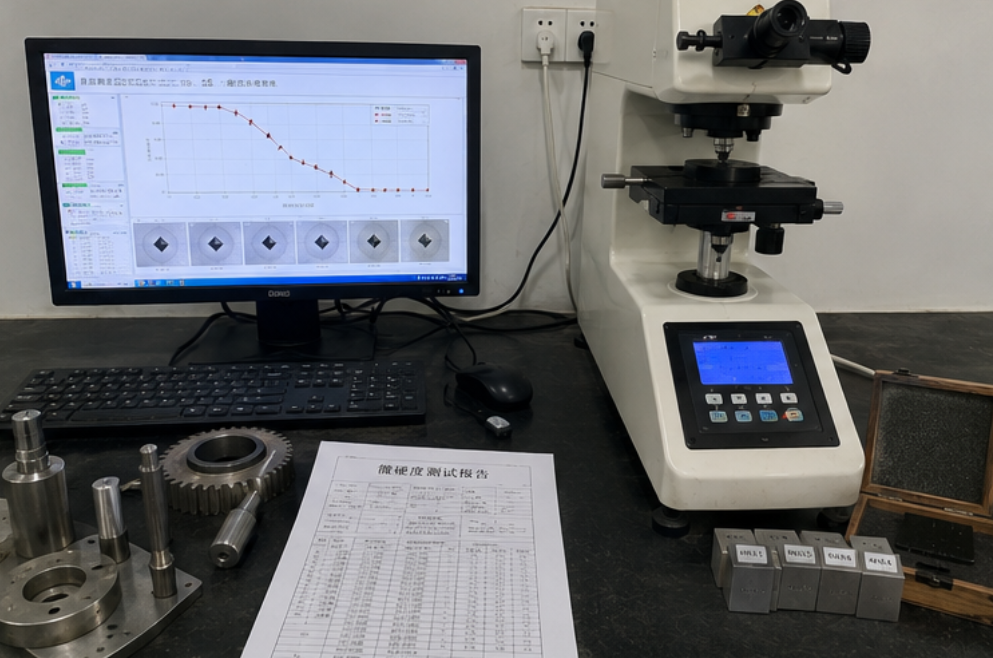
For carburized, nitrided, carbonitrided, induction-hardened, or surface-treated parts, one hardness value is often not enough. The QC team may need to know how hardness changes from the surface toward the core. In this case, multiple Micro Vickers test points are placed along a controlled path.
The software can generate a hardness profile curve and help determine the effective hardened depth or layer performance. This is important for gears, shafts, molds, tools, bearings, and precision mechanical parts that rely on surface hardness and core toughness at the same time.
| Profile Testing Item | Why It Matters | Recommended Equipment |
|---|---|---|
| Test point spacing | Controls profile resolution and accuracy | Precise XY stage or motorized stage |
| Surface-to-core path | Shows hardness gradient across treated layer | Micro Vickers tester with profile software |
| Indentation images | Provides evidence for each hardness value | Automatic vision measurement system |
| Report export | Supports customer approval and audit review | PDF / Excel export software |
Key Questions Before Requesting A Microhardness Testing Solution
Before choosing microhardness testing equipment, buyers should provide clear information about coating type, layer thickness, material, test standard, daily workload, and reporting needs. This helps the supplier recommend a practical configuration instead of a generic machine.
What type of layer will be tested: coating, plating, carburized layer, nitrided layer, weld section, or treated surface?
What is the approximate layer thickness?
What is the base material and expected hardness range?
Do you need surface testing or cross-section testing?
Which test force or Micro HV scale is required?
How many samples and test points are measured per day?
Do you need manual measurement or automatic vision measurement?
Do you need a manual or motorized XY stage?
Do you already have cutting, mounting, grinding, and polishing equipment?
Do customers require indentation images, hardness profiles, PDF reports, or Excel data?
Conclusion: Microhardness Testing Requires A Complete Workflow
Microhardness testing for coatings, thin layers, and surface treatment parts is not only about buying a Micro Vickers tester. Reliable results depend on correct test load, sample preparation, edge retention, optical clarity, calibration blocks, test point control, and report software.
For coating suppliers, heat treatment shops, plating companies, surface engineering labs, and industrial QC departments, a complete solution may include Micro Vickers hardness tester, metallographic cutting machine, mounting system, grinding and polishing machine, microscope, calibration blocks, XY stage, and automatic vision software.
If your factory needs to inspect coatings, thin layers, carburized layers, nitrided layers, weld sections, or surface-treated components, share your sample details before ordering. A complete recommendation can help avoid wrong load selection, poor sample preparation, and unreliable microhardness results.
FAQ
What is microhardness testing used for?
It is used for measuring small areas, coatings, thin layers, surface-treated parts, weld sections, case depth, and precision components.
Why is Micro Vickers suitable for coatings?
Micro Vickers testing uses low loads and small indentations, helping reduce substrate influence when testing thin surface layers.
Do coating samples need polishing before testing?
For cross-section testing, yes. Cutting, mounting, grinding, and polishing are usually required to create a clear and flat surface for indentation measurement.
When should buyers choose automatic vision measurement?
Automatic vision measurement is recommended when indentation size is small, operators need repeatable results, or customers require image-based reports and hardness profiles.
Need A Microhardness Testing Solution For Coatings Or Thin Layers?
Share your coating type, layer thickness, base material, hardness range, test standard, sample preparation condition, and report requirements. We can help recommend Micro Vickers testers, sample preparation equipment, calibration blocks, XY stages, and automatic vision measurement solutions.