



Hardness Testing Before Shipment: What Metal Parts Suppliers Should Check
Hardness Testing Before Shipment: What Metal Parts Suppliers Should Check
Before shipment, metal parts suppliers should verify hardness results, heat treatment quality, batch consistency, calibration records, test locations, sample preparation, and inspection reports. A reliable pre-shipment hardness testing process can reduce customer complaints, prevent rejected batches, and improve buyer confidence.
Batch Verification
Check whether hardness values match drawings, specifications, and customer acceptance ranges.
Calibration Records
Use suitable calibration blocks before shipment inspection to confirm tester accuracy.
Correct Test Location
Test the required surface, core, layer, or functional area instead of random positions.
Report Traceability
Keep sample ID, batch number, hardness value, operator, date, and calibration information.
Why Hardness Testing Before Shipment Matters
For metal parts suppliers, hardness testing before shipment is one of the last opportunities to catch quality problems before products reach the customer. A part may look correct in size and surface finish, but if hardness is outside specification, it may fail during assembly, wear too quickly, crack under load, or be rejected during incoming inspection.
This is especially important for heat-treated parts, gears, shafts, bearings, fasteners, springs, molds, tools, castings, forgings, welded parts, and surface-treated components. These parts often depend on hardness to achieve wear resistance, fatigue performance, strength, or service life.
A good pre-shipment hardness testing process should not only produce a number. It should confirm the right test method, correct scale, representative test location, stable sample support, valid calibration, and traceable report. This makes the inspection result easier for customers to trust.
1. Confirm The Required Hardness Method And Scale
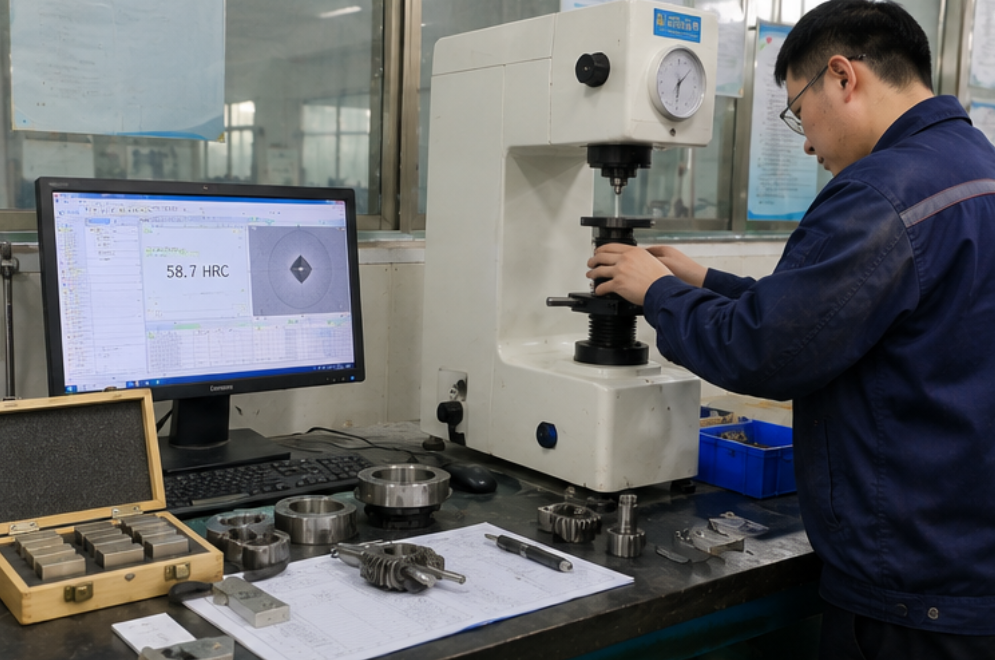
Before testing, suppliers should confirm which hardness method and scale are required by the drawing, purchase order, technical agreement, or customer standard. Rockwell, Brinell, Vickers, Micro Vickers, Shore, Barcol, and Leeb testing are not interchangeable. Using the wrong method may create a report that the customer does not accept.
For example, HRC is commonly used for hardened steel parts, HBW may be required for castings and forgings, and Micro HV may be needed for case depth, coatings, carburized layers, or nitrided layers. If the customer specification is unclear, suppliers should clarify it before shipment rather than guessing during final inspection.
| Part Type | Common Hardness Requirement | Recommended Testing Method |
|---|---|---|
| Hardened gears, shafts, tools | Surface hardness after heat treatment | Rockwell HRC or Vickers HV |
| Castings and forgings | Representative hardness for large metal structures | Brinell HBW |
| Carburized or nitrided parts | Case depth and hardness profile | Micro Vickers Micro HV |
| Coated or plated parts | Thin layer hardness | Micro Vickers or suitable surface method |
2. Verify The Tester With Calibration Blocks Before Batch Inspection
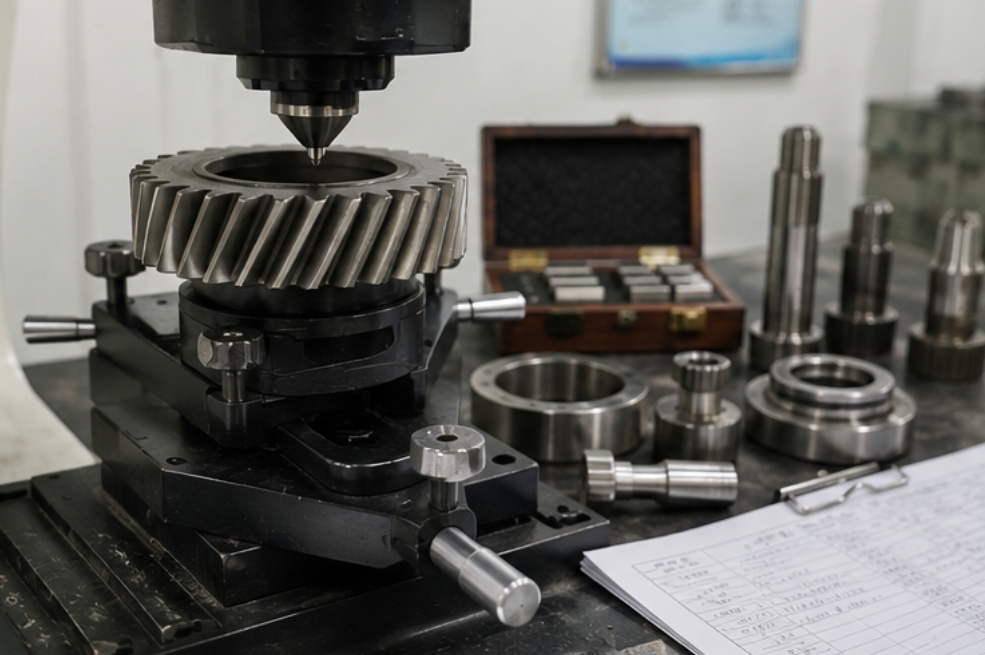
Before shipment testing, the hardness tester should be checked with suitable calibration blocks. The calibration block should match the method, scale, and hardness range of the parts being inspected. If the parts are around HRC 60, using a block far from that range may not be enough to confirm real working accuracy.
Calibration blocks should be clean, traceable, and not overused. The serial number, certificate, hardness value, and scale should be recorded. If the tester fails verification, the inspection should not continue until the cause is found.
Before shipment inspection, check:
Calibration block method and scale.
Hardness value close to the production part range.
Block certificate and serial number.
Block surface condition and valid test area.
Indenter condition before testing.
Verification result, date, operator, and machine ID.
3. Check The Correct Test Location
Hardness can vary across different areas of a metal part. A gear tooth, shaft surface, bearing raceway, casting body, weld area, and heat-affected zone may all have different hardness values. If the operator tests the wrong location, the result may not represent the functional area required by the customer.
For pre-shipment inspection, test locations should follow drawings, customer standards, or internal control plans. If a part has been heat-treated, suppliers should confirm whether the customer wants surface hardness, core hardness, case depth, or hardness profile.
| Inspection Area | Why It Matters | Recommended Practice |
|---|---|---|
| Gear tooth surface | Directly affects wear and contact performance | Test according to drawing or customer control point |
| Shaft hardened track | Verifies induction hardening or surface treatment result | Use stable support and correct test direction |
| Bearing raceway | Affects fatigue and rolling contact performance | Use suitable fixture and avoid unstable positioning |
| Weld or heat-affected zone | Checks risk of brittle or softened zones | Use Vickers or Micro Vickers on prepared cross-section |
4. Control Sample Surface, Support And Fixture Stability
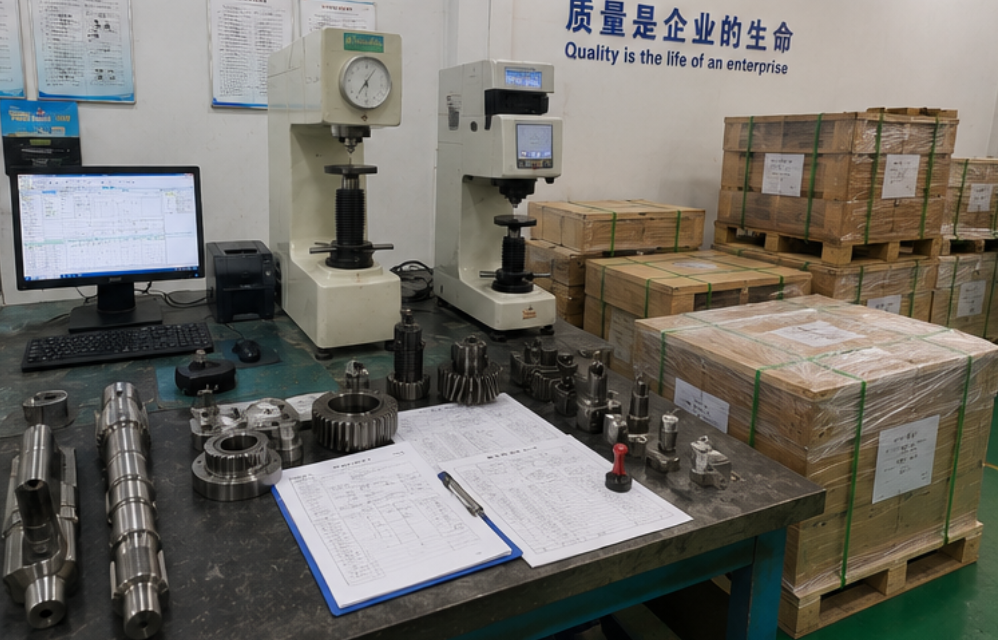
Even when the machine is accurate, poor sample support can create unstable results. Round shafts, bearing rings, rollers, gears, fasteners, castings, and forgings may require V anvils, flat anvils, ring supports, small-part fixtures, or custom holding tools.
Surface condition also matters. Scale, oil, rust, burrs, coating residue, polishing scratches, or machining marks may affect indentation formation. Before shipment testing, suppliers should clean or prepare the test area according to the required method. For Vickers and Micro Vickers testing, a polished surface is usually necessary.
Common support and surface checks include:
Use V anvils for shafts, rollers, and round parts.
Use flat anvils for stable flat surfaces.
Use ring supports for bearing rings and circular parts.
Remove oxide scale, oil, burrs, and loose surface particles.
Confirm the test area has enough thickness for the selected scale.
Use polished cross-sections for Micro Vickers case depth testing.
5. Compare Hardness Results With The Acceptance Range
A hardness value is useful only when it is compared with the correct acceptance range. Suppliers should check whether the result meets the drawing, technical agreement, heat treatment standard, or customer quality requirement. If the result is close to the limit, additional testing or process review may be needed before shipment.
Batch consistency should also be checked. If different parts in the same batch show large variation, the supplier should review material, heat treatment, cooling, surface preparation, or test location. Shipping a batch with unstable results may lead to customer rejection even if some samples pass.
| Result Situation | Risk | Suggested Action Before Shipment |
|---|---|---|
| Result within acceptance range | Low risk if method and location are correct | Record result and attach report if required |
| Result close to upper or lower limit | Possible shipment dispute | Retest, verify calibration, and check process condition |
| Large variation within batch | Possible process instability | Increase sampling and review material or heat treatment process |
| Result outside specification | High risk of customer rejection | Hold shipment and investigate before release |
6. Prepare A Traceable Hardness Testing Report
A pre-shipment hardness report should be clear enough for the customer to review. It should include part name, material grade, batch number, heat treatment condition, test method, hardness scale, test force when applicable, test location, hardness values, calibration information, inspection date, and operator record.
For Micro Vickers case depth testing, reports may also include cross-section images, indentation images, test point distances, hardness profile curves, and effective case depth results. Digital report export can reduce manual mistakes and make customer communication easier.
A useful pre-shipment report should include:
Part name, drawing number, and batch number.
Material grade and heat treatment process.
Testing method, scale, force, and standard.
Test location and sampling quantity.
Hardness values and acceptance range.
Calibration block record and tester ID.
Operator, inspection date, and review status.
PDF or Excel export for customer documentation.
Key Questions Before Building A Pre-Shipment Hardness Testing Process
If your factory wants to improve pre-shipment inspection, prepare the following information before choosing equipment or upgrading the process. This helps determine whether you need Rockwell, Brinell, Vickers, Micro Vickers, sample preparation equipment, automatic vision measurement, or report software.
What metal parts are shipped: gears, shafts, bearings, castings, forgings, fasteners, springs, tools, or welded parts?
What material grades and heat treatment processes are used?
Which hardness scale and acceptance range are required?
What test location does the customer specify?
How many pieces or test points must be checked per batch?
Do you need surface hardness, core hardness, or case depth testing?
Are calibration blocks and indenters available for the required method?
Do samples need cutting, mounting, grinding, and polishing?
Do customers require PDF reports, hardness curves, images, or calibration records?
Do you need digital data storage or automatic report export?
Conclusion: Pre-Shipment Hardness Testing Should Be A Controlled Release Process
Hardness testing before shipment is not just a quick final check. It should be a controlled release process that confirms the correct method, scale, sample support, calibration status, test location, acceptance range, and report traceability.
For metal parts suppliers, a reliable process can reduce rejections, protect customer relationships, and improve quality confidence. The right equipment may include Rockwell hardness testers, Brinell hardness testers, Vickers or Micro Vickers testers, calibration blocks, fixtures, sample preparation equipment, and report software.
If your factory supplies heat-treated, cast, forged, machined, welded, coated, or precision metal parts, a stronger pre-shipment hardness testing workflow can help avoid costly disputes after delivery.
FAQ
Why should metal parts suppliers test hardness before shipment?
Pre-shipment hardness testing helps confirm that parts meet customer specifications before delivery and reduces the risk of rejected batches.
Which hardness tester is used for shipment inspection?
It depends on the part and standard. Rockwell is common for fast metal part inspection, Brinell for castings and forgings, and Micro Vickers for case depth or thin layers.
What should be included in a hardness testing report?
A report should include part information, batch number, material, method, scale, test location, hardness values, acceptance range, calibration record, date, and operator.
What if hardness results are close to the limit?
The supplier should verify the tester, confirm the test location, repeat testing if needed, and review the heat treatment or production process before shipment release.
Need A Pre-Shipment Hardness Testing Solution?
Share your metal part type, material grade, hardness scale, acceptance range, test location, batch quantity, and report requirements. We can help recommend suitable hardness testers, calibration blocks, fixtures, sample preparation equipment, and report software for shipment inspection.