
Hardness Testing Equipment For Heat Treatment Shops: What Should Be Included
Hardness Testing Equipment For Heat Treatment Shops: What Should Be Included
Heat treatment shops need reliable hardness testing equipment to verify quenching, tempering, carburizing, nitriding, induction hardening, and surface hardening results. A complete hardness testing setup should include the right hardness tester, calibration blocks, indenters, fixtures, sample preparation equipment, case depth testing capability, and traceable QC report functions.
Rockwell Testing
Fast HRC, HRB, and HRA checks for quenched, tempered, and hardened metal parts.
Micro Vickers
Case depth testing for carburized, nitrided, and induction-hardened layers.
Sample Preparation
Cutting, mounting, grinding, and polishing prepare cross-sections for accurate testing.
QC Reports
Software reports, images, calibration records, and batch data support customer audits.
Why Heat Treatment Shops Need A Dedicated Hardness Testing Setup
Heat treatment changes the mechanical properties of metal parts. Processes such as quenching, tempering, carburizing, nitriding, carbonitriding, and induction hardening are often used to improve wear resistance, strength, fatigue life, and surface durability. If the hardness result is not controlled, the final part may be too soft, too brittle, unevenly hardened, or rejected by the customer.
For heat treatment shops, hardness testing is not only a final inspection step. It is part of process control. A hardness tester can help confirm furnace parameters, cooling conditions, surface hardening quality, core hardness, and batch stability. When customers send gears, shafts, molds, bearings, tools, fasteners, or automotive parts for heat treatment, they often require hardness records before shipment.
A basic hardness tester may be enough for simple HRC checks. But if the shop needs to inspect case depth, hardened layer distribution, carburized layers, nitrided layers, or induction-hardened zones, a complete solution should include Micro Vickers testing and proper metallographic sample preparation equipment.
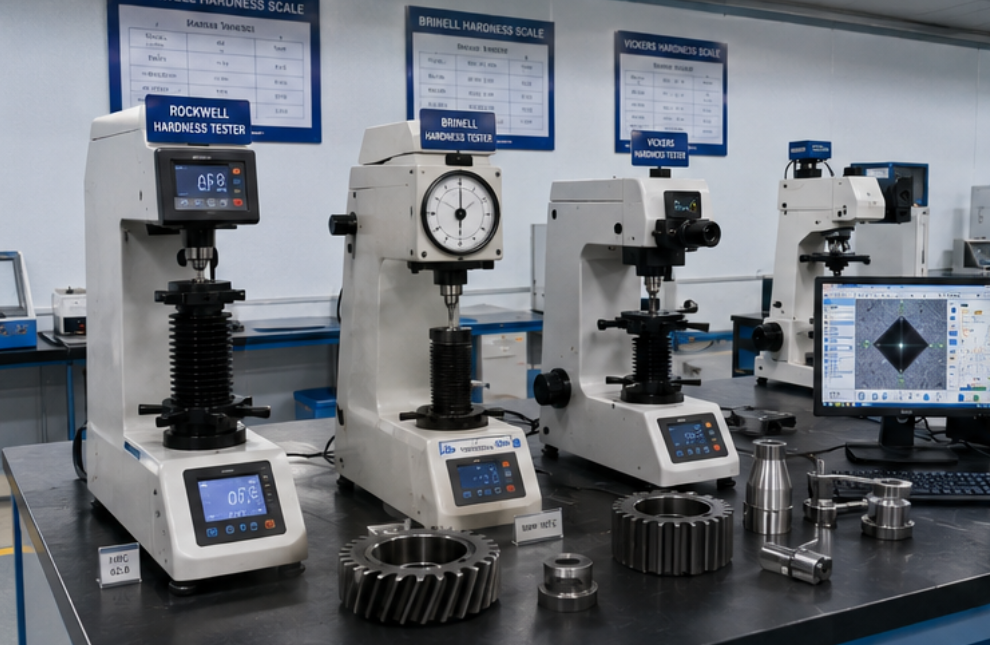
1. Rockwell Hardness Tester For Fast Production Checks
Rockwell hardness testing is commonly used in heat treatment shops because it is fast, direct-reading, and practical for daily production inspection. HRC testing is especially common for hardened steel parts after quenching and tempering. HRB or HRA may also be required depending on material type and customer specifications.
A digital Rockwell hardness tester can improve daily operation by giving clear readings, stable loading, and easier result recording. For shops that test many parts every day, automatic or semi-automatic loading can reduce operator variation and improve testing efficiency.
| Heat Treatment Application | Common Hardness Check | Recommended Equipment |
|---|---|---|
| Quenched and tempered steel | Surface or finished-part HRC value | Digital Rockwell hardness tester |
| Tool steel and mold steel | Hardness after heat treatment | Rockwell tester with HRC calibration blocks |
| Shafts, bearings, and gears | Batch consistency and final hardness | Rockwell tester with suitable anvils and fixtures |
| Thin or surface-hardened parts | Shallow hardness verification | Superficial Rockwell or Micro Vickers solution |
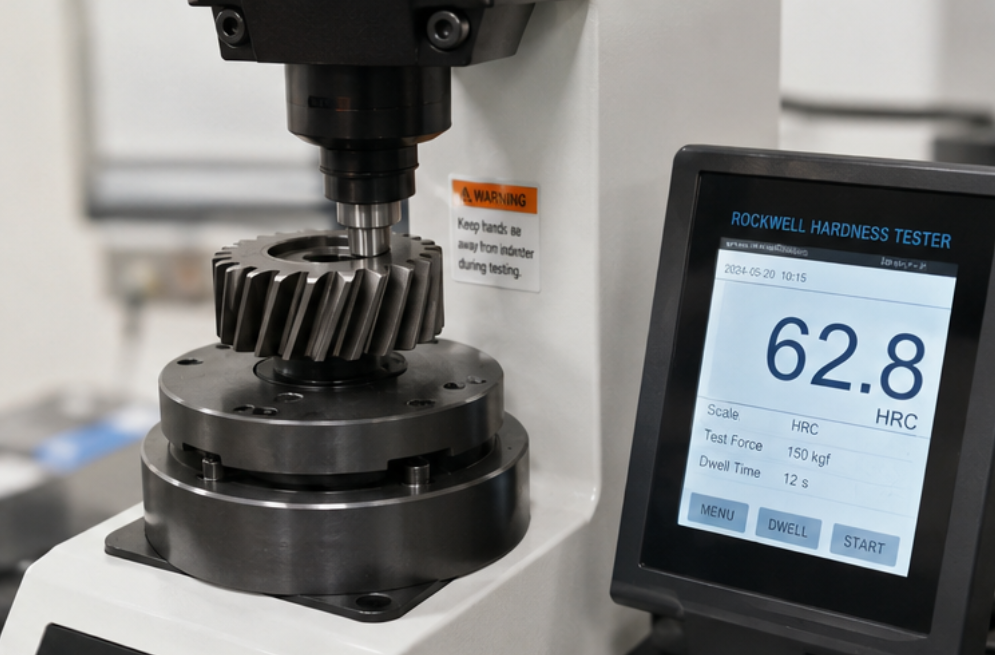
2. Micro Vickers Tester For Case Depth And Hardened Layer Analysis
Many heat treatment jobs require more than one surface hardness value. For carburized, nitrided, carbonitrided, and induction-hardened parts, customers may need to know the effective case depth or hardness profile from the surface to the core. In this case, Micro Vickers testing is usually required.
Micro Vickers hardness testing uses low test forces and small indentations, making it suitable for measuring hardened layers, thin sections, coating-like surface treatments, and polished cross-sections. With proper software and an XY stage, the lab can record multiple test points and generate a hardness profile curve.
Micro Vickers testing is important for:
Carburized gears and shafts.
Nitrided molds, tools, and precision parts.
Induction-hardened tracks and bearing surfaces.
Case depth analysis from surface to core.
Hardness profile reports for customer approval.
Small parts where Rockwell indentation is too large.
3. Metallographic Sample Preparation Equipment
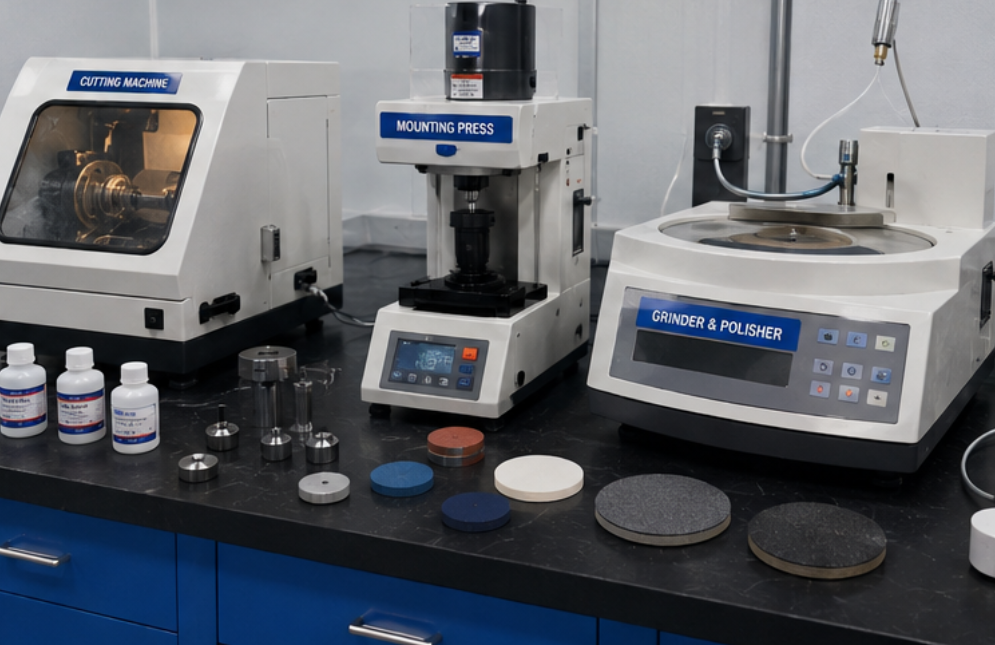
Case depth and Micro Vickers testing require a prepared cross-section. The sample usually needs to be cut, mounted, ground, polished, cleaned, and inspected before testing. If the preparation quality is poor, the indentation edge may be unclear or the surface layer may be damaged.
Heat treatment shops that provide case depth reports should consider a complete metallographic preparation workflow. Low-damage cutting prevents heat influence. Mounting supports small or irregular samples. Grinding and polishing create a flat, scratch-controlled surface for accurate Micro Vickers measurement.
| Equipment | Function In Heat Treatment QC | Buyer Checkpoint |
|---|---|---|
| Metallographic cutting machine | Cuts representative cross-sections | Check cutting capacity, coolant, and clamping fixtures |
| Mounting press or cold mounting kit | Supports small samples and protects edges | Choose hot or cold mounting based on sample sensitivity |
| Grinding and polishing machine | Creates polished surfaces for indentation measurement | Check disc size, speed, pressure control, and consumables |
| Metallurgical microscope | Checks surface quality and layer structure | Check image capture and measurement software if needed |
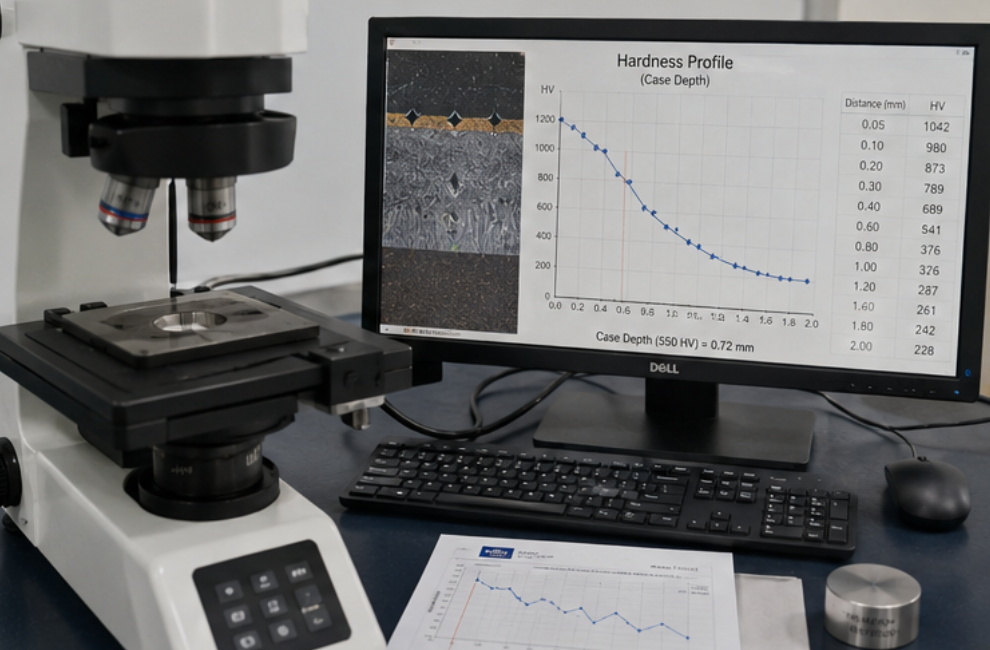
4. Calibration Blocks, Indenters, Anvils And Fixtures
A hardness testing setup for heat treatment shops should include the correct accessories. Calibration blocks are used for daily verification. Indenters must match the method and scale. Anvils and fixtures help support real production parts, especially round shafts, bearings, gears, fasteners, and irregular components.
For Rockwell testing, HRC calibration blocks and diamond cone indenters are commonly required. For Micro Vickers testing, HV or Micro HV blocks and Vickers diamond indenters are needed. If the shop tests many part shapes, flat anvils, V anvils, small-part fixtures, and custom supports should be considered.
Common accessories for heat treatment QC include:
HRC, HRB, HV, and Micro HV calibration blocks.
Rockwell diamond cone indenter and ball indenters.
Vickers diamond indenter for Micro Vickers testing.
Flat anvils, V anvils, and small-part fixtures.
Sample holders for mounted cross-sections.
Software for hardness profile, statistics, and report export.
5. Report Software And Traceability For Customer Approval
Heat treatment shops often need to provide inspection records to customers. A simple handwritten hardness value may not be enough when customers require batch traceability, case depth curves, test point images, calibration records, or inspection reports.
Digital hardness testers and automatic Micro Vickers systems can help store sample IDs, test values, indentation images, hardness profiles, operator names, and report files. This is especially useful for automotive parts, precision machinery, tooling, and export orders where quality records are part of customer approval.
| Report Function | Why It Matters | Recommended For |
|---|---|---|
| Batch data storage | Links hardness values to production batches | Routine heat treatment QC |
| Hardness profile curve | Shows hardness change from surface to core | Carburizing, nitriding, induction hardening |
| Indentation image storage | Provides visual proof of test quality | Micro Vickers and case depth reports |
| PDF / Excel export | Supports customer-ready documentation | Export orders and customer audits |
Key Questions Before Requesting A Heat Treatment QC Equipment Proposal
Before requesting a quotation, heat treatment shops should provide clear information about the parts, materials, processes, and reporting needs. This helps the supplier recommend a practical configuration instead of only quoting a single machine.
What heat treatment processes do you perform: quenching, tempering, carburizing, nitriding, or induction hardening?
What parts are tested: gears, shafts, bearings, molds, tools, fasteners, springs, or automotive components?
What materials and hardness ranges are involved?
Which hardness scale is required: HRC, HRB, HRA, HV, Micro HV, or HBW?
Do you need only surface hardness, or also core hardness and case depth?
How many samples and test points are measured per day?
Do you need Rockwell testing, Micro Vickers testing, or both?
Do you need cutting, mounting, grinding, polishing, and microscope equipment?
Do you need calibration blocks, indenters, anvils, and special fixtures?
Do customers require PDF reports, hardness profile curves, images, or batch records?
Conclusion: Build The Setup Around Heat Treatment Inspection Needs
Hardness testing equipment for heat treatment shops should be selected according to real production needs. A Rockwell hardness tester is useful for fast HRC checks after quenching and tempering. A Micro Vickers hardness tester is important for case depth, carburized layers, nitrided layers, and induction-hardened zones.
For shops that need customer-ready reports, the setup should also include calibration blocks, correct indenters, fixtures, sample preparation equipment, microscope inspection, and software export functions. This makes the testing process more stable, traceable, and professional.
If you are planning to build or upgrade a heat treatment QC lab, share your parts, materials, processes, hardness standards, and reporting requirements before ordering. A complete recommendation can help you avoid missing key equipment and improve long-term inspection reliability.
FAQ
Which hardness tester is most common for heat treatment shops?
Rockwell hardness testers are commonly used for fast HRC checks on quenched, tempered, and hardened steel parts.
When does a heat treatment shop need a Micro Vickers tester?
Micro Vickers testing is needed when the shop must measure case depth, carburized layers, nitrided layers, induction-hardened zones, or small test areas.
Do case depth samples need metallographic preparation?
Yes. Case depth testing usually requires cutting, mounting, grinding, polishing, and microscope inspection before Micro Vickers testing.
Why are calibration blocks important for heat treatment QC?
Calibration blocks help verify machine accuracy before batch testing and support traceable quality control records.
Need A Hardness Testing Solution For Your Heat Treatment Shop?
Share your heat treatment process, part type, material grade, hardness scale, case depth requirement, daily testing volume, and report needs. We can help recommend Rockwell testers, Micro Vickers testers, sample preparation equipment, calibration blocks, fixtures, and complete QC lab solutions.