
Hardness Testing Solution For Gear, Shaft And Bearing Manufacturers
Hardness Testing Solution For Gear, Shaft And Bearing Manufacturers
Gear, shaft, and bearing manufacturers need reliable hardness testing to verify material quality, heat treatment results, surface hardening depth, wear resistance, and batch consistency. A complete solution may include Rockwell hardness testing, Micro Vickers case depth testing, metallographic sample preparation, calibration blocks, special fixtures, and traceable QC reports.
Gear Hardness
Check tooth surface hardness, carburized layer, and case depth after heat treatment.
Shaft Testing
Verify induction-hardened tracks, nitrided surfaces, and core hardness stability.
Bearing QC
Control hardness consistency for rings, rollers, races, and precision bearing components.
Traceable Reports
Save hardness values, profile curves, sample images, and batch inspection records.
Why Hardness Testing Is Critical For Gears, Shafts And Bearings
Gears, shafts, and bearings often work under high load, friction, impact, vibration, and long service cycles. Their hardness condition directly affects wear resistance, fatigue strength, contact performance, and service life. If hardness is too low, the part may wear quickly. If hardness is too high or uneven, the part may become brittle, crack, or fail during operation.
Many of these components require heat treatment, carburizing, nitriding, induction hardening, or quenching and tempering. The quality control team needs to verify not only the surface hardness, but also the hardened layer depth, hardness distribution, and batch consistency.
For manufacturers, a practical hardness testing solution should match real part geometry, material grade, heat treatment process, test standard, daily workload, and report requirements. This is especially important for automotive, machinery, bearing, transmission, tool, and industrial component suppliers.
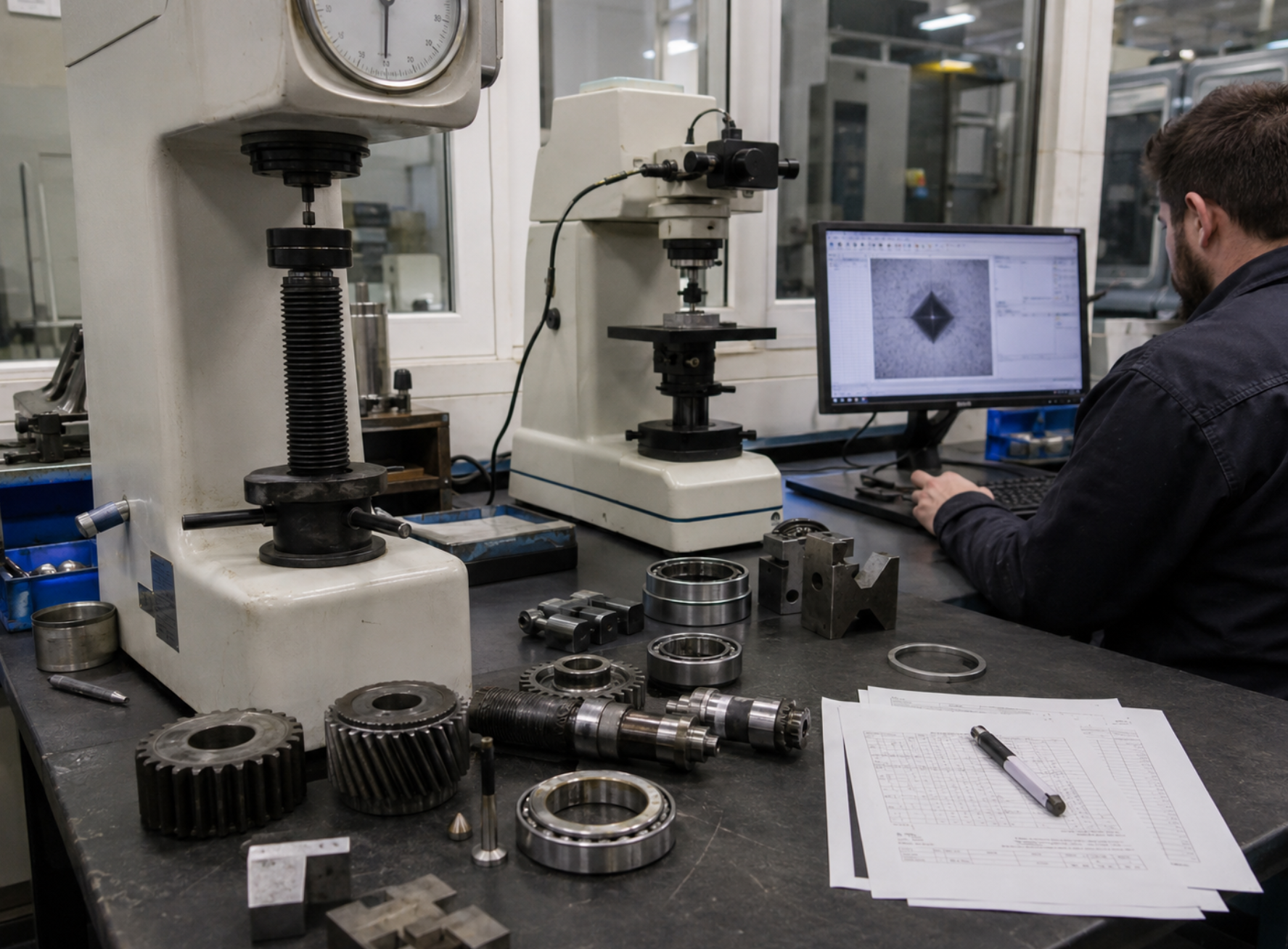
1. Rockwell Testing For Fast Production Hardness Checks
Rockwell hardness testing is commonly used for fast production inspection of gears, shafts, and bearing parts. HRC testing is especially useful for hardened steel components after quenching, tempering, carburizing, or induction hardening. It gives direct readings and is efficient for batch QC.
However, Rockwell testing requires stable sample support. Gears, shafts, and bearing rings are not always flat samples. Round parts may require V anvils, special fixtures, or custom supports. If the part moves or tilts during loading, the hardness result may become unstable.
| Part Type | Common QC Need | Recommended Setup |
|---|---|---|
| Gears | Tooth surface hardness and heat treatment verification | Rockwell tester plus suitable support fixture |
| Shafts | Induction-hardened surface and core hardness check | Rockwell tester with V anvil or shaft support |
| Bearing rings | Raceway hardness and batch consistency | Rockwell tester with stable ring positioning |
| Rollers and small bearing parts | Small contact area hardness control | Small-part fixture or Vickers / Micro Vickers testing |
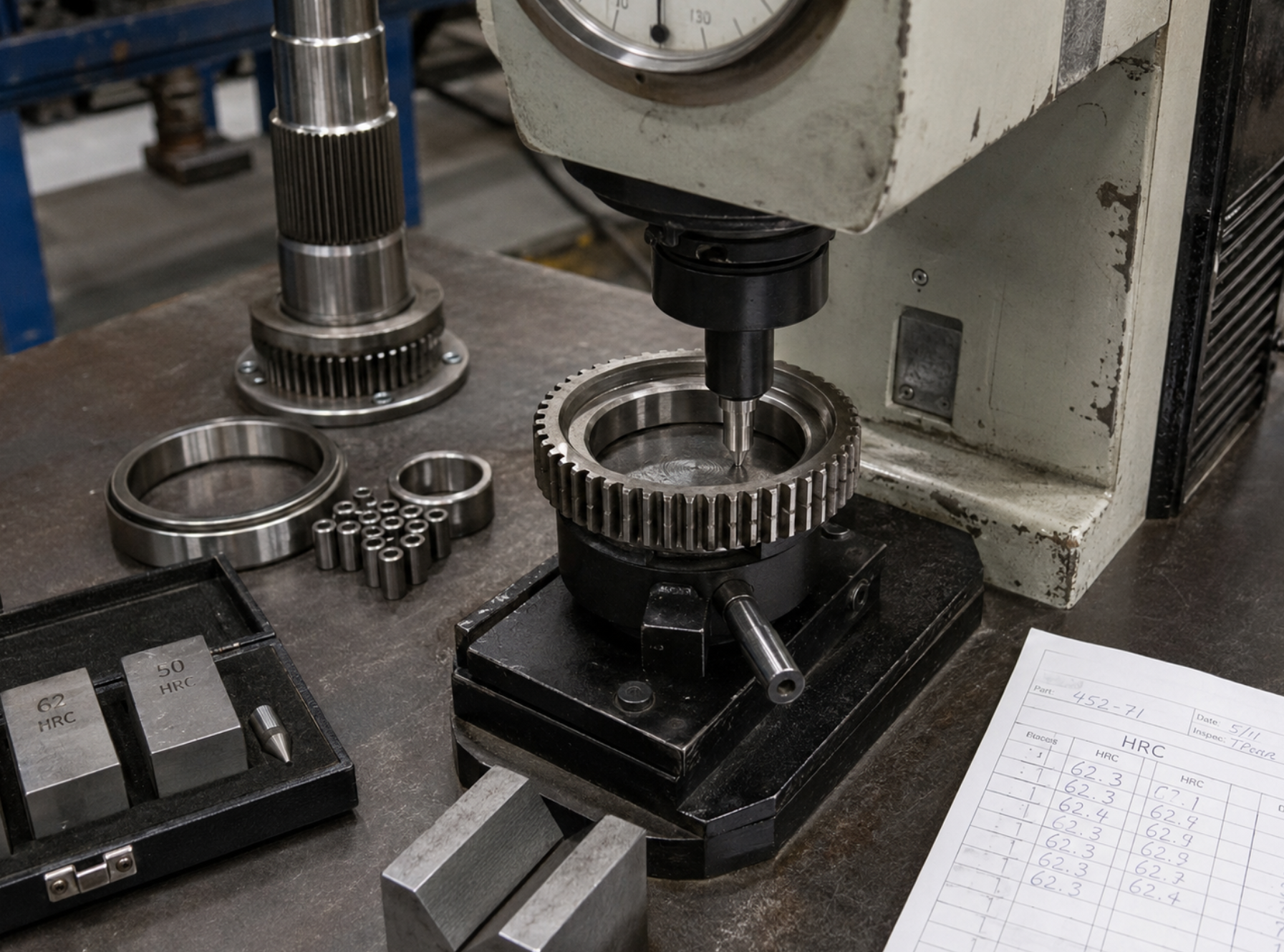
2. Micro Vickers Testing For Case Depth And Hardened Layer Profiles
For many gear, shaft, and bearing applications, a single surface hardness value is not enough. Carburized gears, nitrided shafts, induction-hardened surfaces, and hardened bearing races may require case depth or hardness profile testing. Micro Vickers testing is commonly used for this purpose.
The sample is usually cut, mounted, ground, polished, and tested across the cross-section. Micro Vickers indentations are placed from the surface toward the core. The software then generates a hardness profile curve and helps determine the effective case depth according to the required hardness limit.
Micro Vickers testing is useful for:
Carburized gear tooth case depth testing.
Nitrided shaft surface layer inspection.
Induction-hardened track hardness profile testing.
Bearing raceway hardened layer verification.
Small precision parts where Rockwell indentation is too large.
Customer reports requiring hardness curve and test point records.
3. Sample Preparation Equipment For Cross-Section Testing
Case depth and Micro Vickers testing require a prepared cross-section. Poor cutting or polishing can damage the hardened layer and lead to inaccurate results. Gear teeth, shafts, and bearing rings often need careful sectioning so the tested area represents the actual working surface.
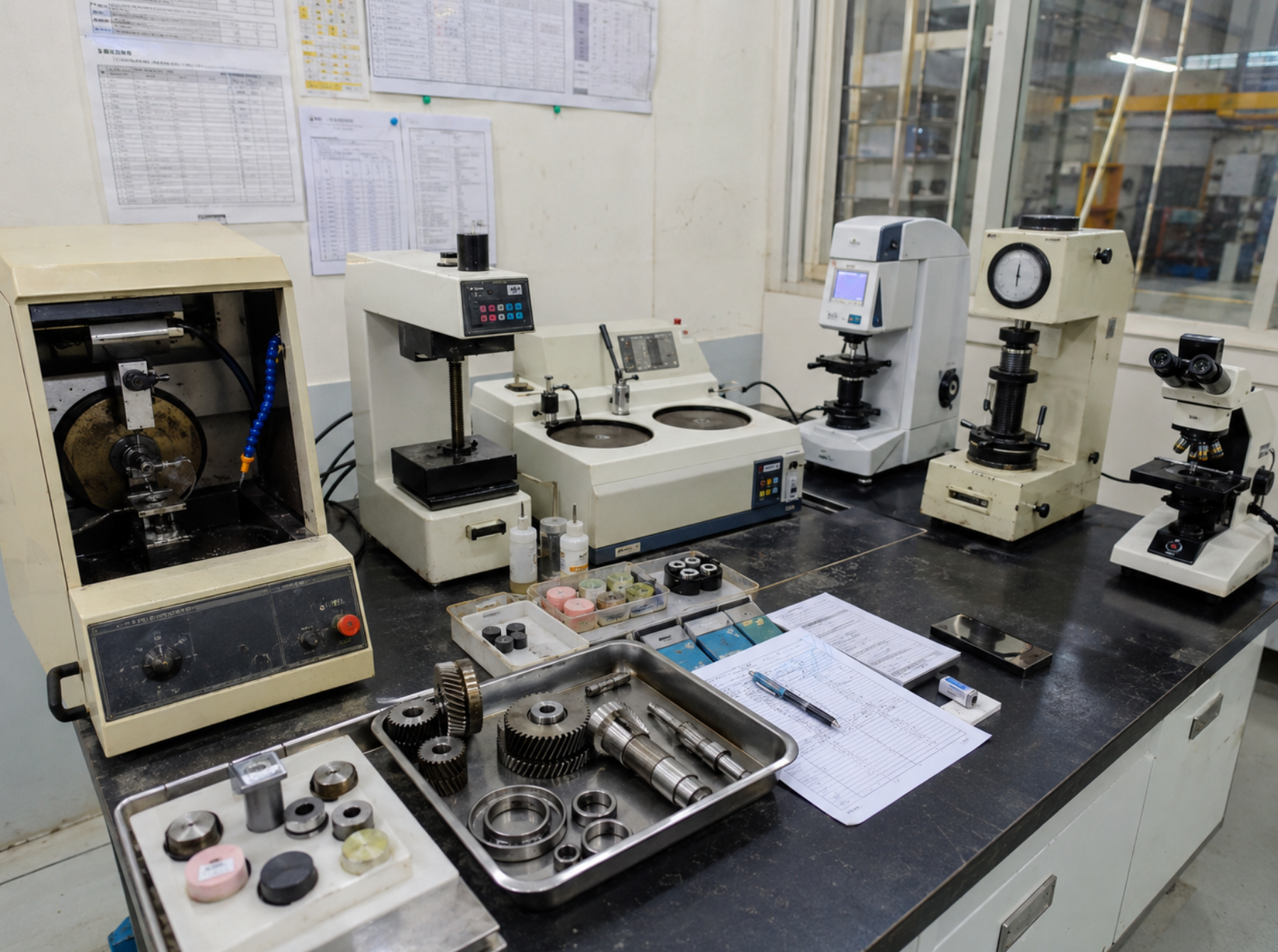
A complete solution may include a metallographic cutting machine, mounting press, grinding and polishing machine, ultrasonic cleaner, and microscope. For heat-treated samples, cutting heat, edge rounding, polishing scratches, and poor mounting must be controlled carefully.
| Preparation Step | Purpose | Risk If Ignored |
|---|---|---|
| Cutting | Creates cross-section of gear, shaft, or bearing part | Heat damage or wrong test location |
| Mounting | Supports irregular samples and protects edges | Poor edge retention and unstable surface |
| Grinding and polishing | Creates flat surface for Micro Vickers indentation | Unclear indentation edge and measurement error |
| Microscope check | Confirms layer structure and surface quality | Testing on damaged or unrepresentative area |
4. Fixtures, Anvils And Sample Support Are Not Optional
Gear, shaft, and bearing parts often have complex shapes. Testing accuracy depends not only on the machine, but also on how the part is supported during testing. A shaft may roll if it is not supported with a V anvil. A bearing ring may tilt if the support surface is not stable. A gear tooth may be difficult to position if no proper fixture is used.
Buyers should provide real part drawings, dimensions, and photos before quotation. This helps determine whether standard anvils are enough or whether special fixtures are required. Correct support reduces measurement variation and improves repeatability in daily production inspection.
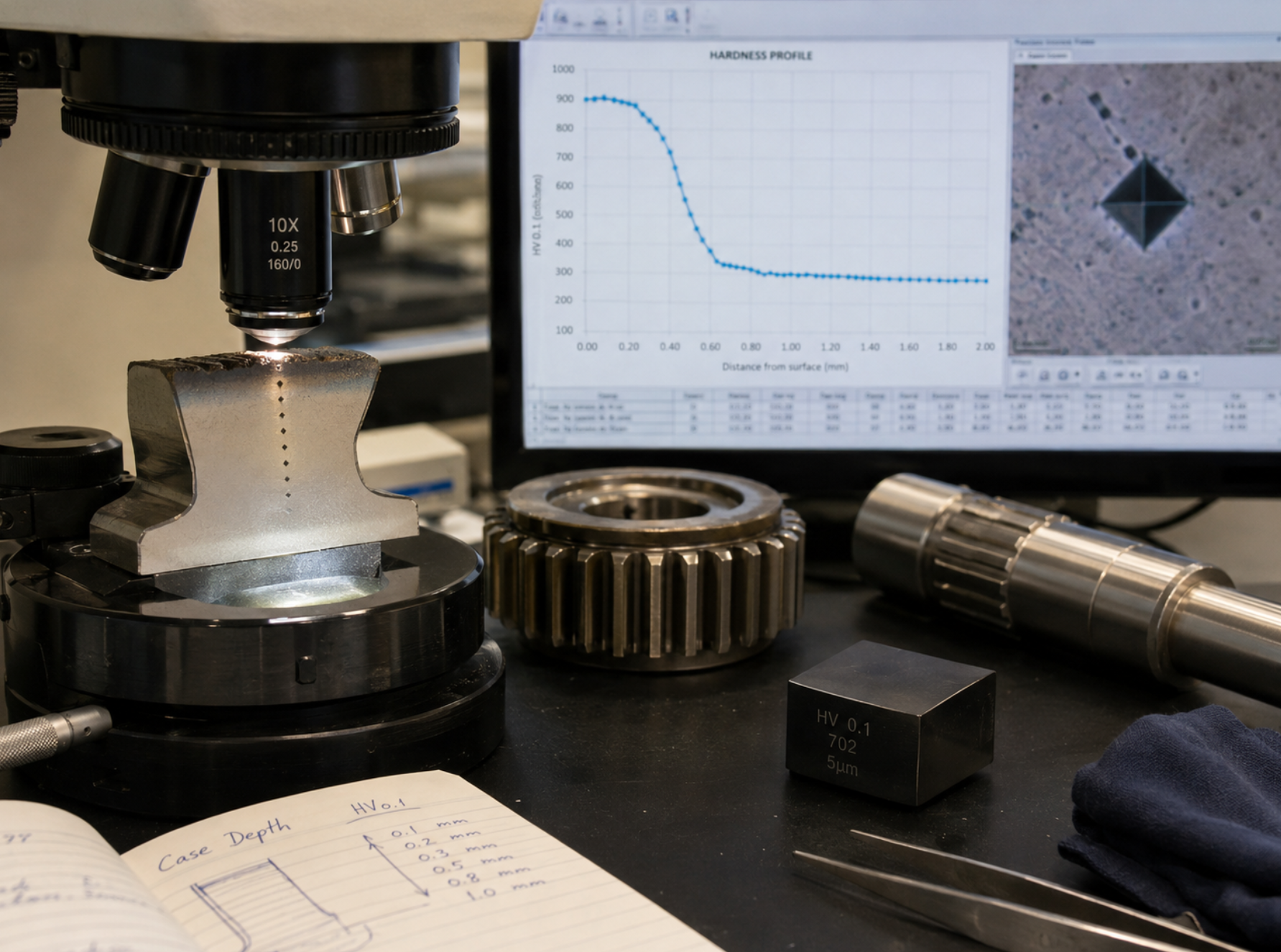
Common accessories may include:
Flat anvils for general metal parts.
V anvils for shafts, rollers, and round parts.
Ring supports for bearing rings and circular samples.
Small-part fixtures for rollers, pins, and precision components.
Mounted sample holders for Micro Vickers testing.
Custom fixtures for special gear or transmission parts.
5. Calibration Blocks And Traceable QC Reports
For manufacturers supplying gears, shafts, and bearings to automotive, machinery, and industrial customers, hardness testing records are often required before shipment. Calibration blocks help verify machine accuracy before batch testing. Reports help prove that parts meet customer specifications.
Digital Rockwell testers and automatic Micro Vickers systems can store sample IDs, test values, indentation images, hardness profile curves, operator records, and exportable reports. This improves traceability and reduces manual recording errors.
| QC Item | Why It Matters | Recommended Setup |
|---|---|---|
| Calibration blocks | Verify tester accuracy before production inspection | HRC, HRB, HV, Micro HV blocks as required |
| Indenters | Correct indenter is essential for valid results | Rockwell diamond cone, ball indenter, Vickers diamond indenter |
| Hardness profile report | Shows hardened layer depth and hardness gradient | Micro Vickers software with profile curve export |
| Batch record | Supports shipment approval and customer audits | Data storage, PDF export, Excel export, image archive |
Key Questions Before Requesting A Hardness Testing Solution
Before requesting a quotation, gear, shaft, and bearing manufacturers should prepare clear information about the parts and testing requirements. This helps the supplier recommend a practical equipment configuration instead of a generic machine.
What parts need testing: gears, shafts, bearing rings, rollers, races, pins, or fasteners?
What material grades are used?
What heat treatment process is applied: carburizing, nitriding, quenching, tempering, or induction hardening?
Which hardness scale is required: HRC, HRB, HV, Micro HV, HBW, or others?
Do you need surface hardness, core hardness, case depth, or hardness profile testing?
What are the sample size, thickness, shape, and test location?
How many samples and test points are measured per day?
Do you need special fixtures or V anvils for round parts?
Do you need cutting, mounting, grinding, polishing, and microscope equipment?
Do customers require PDF reports, hardness curves, images, and calibration records?
Conclusion: Build The Testing Solution Around Real Parts
Gear, shaft, and bearing manufacturers should choose hardness testing equipment based on real production parts, not only equipment catalogue specifications. Rockwell testing is efficient for fast HRC inspection, while Micro Vickers testing is important for case depth, hardened layer profiles, and small test areas.
A complete solution may include Rockwell hardness tester, Micro Vickers hardness tester, metallographic sample preparation equipment, microscope, calibration blocks, indenters, fixtures, and report software. This gives the factory a more reliable workflow from production inspection to shipment approval.
If your factory manufactures gears, shafts, bearings, or precision transmission parts, share your samples, heat treatment process, hardness standard, and reporting requirements before ordering. A complete recommendation can help avoid wrong equipment selection and improve long-term QC reliability.
FAQ
Which hardness tester is suitable for gears?
Rockwell testers are suitable for fast surface hardness checks, while Micro Vickers testers are used for carburized layer and case depth testing.
How do manufacturers test hardness on shafts?
Shafts may be tested with Rockwell hardness testers using V anvils, or with Micro Vickers testers when induction-hardened layer depth needs to be measured.
Do bearing parts need special fixtures for hardness testing?
Yes, bearing rings, rollers, and races often need stable supports or special fixtures to prevent movement during testing.
When is Micro Vickers testing needed?
Micro Vickers testing is needed for case depth, hardened layer profiles, small parts, thin sections, and precision hardness analysis.
Need A Hardness Testing Solution For Gears, Shafts Or Bearings?
Share your part type, material grade, heat treatment process, hardness scale, case depth requirement, sample size, testing volume, and report needs. We can help recommend suitable hardness testers, sample preparation equipment, fixtures, calibration blocks, and complete QC solutions.