-
06-01 2026
How To Test Case Depth In Carburized And Nitrided Metal Parts
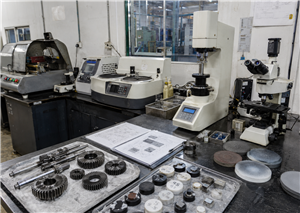
Testing case depth in carburized and nitrided metal parts requires more than surface hardness measurement. It needs a prepared cross-section, controlled test point spacing, Micro Vickers hardness values from surface to core, and a clear hardness profile report. For heat treatment shops, the most practical solution usually includes metallographic cutting, mounting, grinding and polishing, microscope inspection, Micro Vickers hardness testing, calibration blocks, and software for profile analysis and report export. If your factory needs to verify carburized layers, nitrided layers, or induction-hardened zones, share your sample details and reporting requirements before ordering. A complete recommendation can help you build a reliable case depth testing workflow and avoid incomplete equipment configuration.
-
05-31 2026
Hardness Testing Equipment For Heat Treatment Shops: What Should Be Included
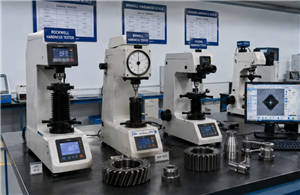
Hardness testing equipment for heat treatment shops should be selected according to real production needs. A Rockwell hardness tester is useful for fast HRC checks after quenching and tempering. A Micro Vickers hardness tester is important for case depth, carburized layers, nitrided layers, and induction-hardened zones. For shops that need customer-ready reports, the setup should also include calibration blocks, correct indenters, fixtures, sample preparation equipment, microscope inspection, and software export functions. This makes the testing process more stable, traceable, and professional. If you are planning to build or upgrade a heat treatment QC lab, share your parts, materials, processes, hardness standards, and reporting requirements before ordering. A complete recommendation can help you avoid missing key equipment and improve long-term inspection reliability.
-
05-24 2026
Micro Vickers Hardness Testers: Which One Fits Thin Layers & Small Parts
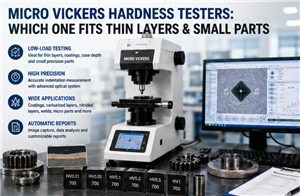
Micro Vickers hardness testers are ideal for thin layers, coatings, small parts, case depth analysis, weld sections, and precision hardness measurement. The right model should be selected according to test force range, layer thickness, sample size, optical clarity, stage control, automation level, and reporting requirements. Buyers should not choose only by price. A low-cost manual model may be enough for occasional testing, while an automatic Micro Vickers tester with motorized stage and software is better for high-volume labs, hardness profiles, traceable reports, and customer documentation. If your factory is testing coatings, carburized layers, nitrided layers, induction-hardened zones, or small precision components, provide your sample details before quotation. A complete recommendation can help you avoid wrong model selection and improve long-term QC reliability.
-
05-15 2026
How To Choose Hardness Testing Equipment For Automotive Parts Inspection
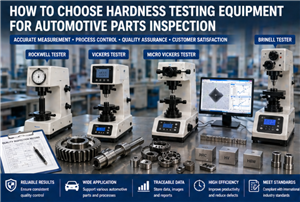
Choosing hardness testing equipment for automotive parts inspection should start from the part type, material, heat treatment process, hardness scale, and testing location. Rockwell testers are suitable for fast production checks. Brinell testers are useful for larger castings and forgings. Vickers and Micro Vickers testers are important for precision testing, case depth analysis, coatings, and small samples. Buyers should also consider sample fixtures, calibration blocks, indenters, sample preparation equipment, automation level, and report functions. For automotive quality control, repeatability and traceability are just as important as the hardness value itself. A well-selected hardness testing solution helps improve process control, reduce rejected parts, support customer audits, and provide reliable documentation for production and quality teams.
-
05-14 2026
How To Select A Hardness Tester For Heat Treatment Quality Control
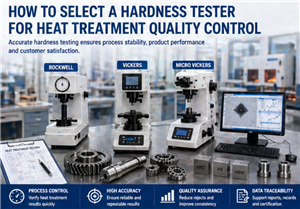
Selecting a hardness tester for heat treatment quality control should start from the actual process and inspection purpose. Rockwell testers are highly practical for fast batch inspection after quenching and tempering. Vickers and Micro Vickers testers are better for precision testing, case depth analysis, carburized layers, nitrided layers, and hardness profiles. Brinell testers may be suitable for large heat-treated castings and forgings. Buyers should not compare only price. They should evaluate hardness method, scale, load range, sample size, fixtures, calibration blocks, automation level, sample preparation needs, and data reporting functions. A well-selected tester helps improve production control, reduce quality disputes, and provide reliable documentation for customers. If your heat treatment process involves multiple materials and hardness requirements, a complete solution may include Rockwell testing for fast production checks and Micro Vickers testing for detailed layer analysis.