-
05-16 2026
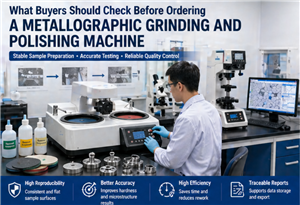
What Buyers Should Check Before Ordering A Metallographic Grinding And Polishing Machine
A metallographic grinding and polishing machine should be selected according to sample material, preparation volume, surface quality requirement, operator skill, and laboratory workflow. Manual machines are economical for low-volume use. Semi-automatic and automatic systems are better for repeatable QC preparation and higher sample throughput. Buyers should check disc size, speed control, pressure mode, sample holder compatibility, consumable matching, cooling and drainage, safety design, and after-sales support before ordering. For laboratories that perform Vickers, Micro Vickers, coating, weld, or case depth testing, preparation quality directly affects final measurement reliability. A well-matched grinding and polishing machine helps reduce sample rework, improve surface consistency, and support more reliable hardness testing and metallographic analysis.
-
05-10 2026
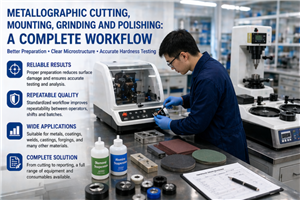
Metallographic Cutting, Mounting, Grinding And Polishing: A Complete Workflow
Metallographic cutting, mounting, grinding, and polishing should be treated as one connected workflow. Each step affects the next step, and the final surface quality directly influences hardness testing accuracy, microscope observation clarity, and laboratory efficiency. A reliable workflow helps laboratories prepare samples with less damage, better flatness, stronger edge retention, clearer indentation visibility, and more repeatable results. For factories and testing centers, this means fewer retests, faster sample turnaround, and stronger quality documentation. When selecting equipment, buyers should consider the complete process instead of purchasing each machine separately without workflow planning. The right combination of cutting machine, mounting press, grinding and polishing machine, consumables, cleaning tools, hardness tester, and microscope can significantly improve laboratory quality control performance.
-
04-05 2026
Why Sample Preparation Capability Matters More Than Just The Microscope In Metallographic Equipment Procurement
in metallographic equipment procurement, sample preparation capability matters more than just the microscope because preparation quality determines whether the real structure can be revealed, whether results can be repeated, and whether the laboratory can work efficiently in daily practice. A microscope is essential, but it only shows what the specimen allows it to show. For serious buyers, the smarter decision is to choose a complete metallographic solution with strong cutting, mounting, grinding, polishing, consumable support, and application guidance. That is what turns metallography from a beautiful demonstration into a reliable quality-control tool.
-
03-10 2026
How to Achieve a Mirror Finish on Metallographic Samples
Achieving a pristine mirror finish on a metallographic sample is a disciplined art that blends precision equipment, high-grade consumables, and methodical technique. Each step, from careful sectioning to the final ultrasonic clean, is a critical link in a chain that leads to an artifact-free surface. This flawless preparation is the indispensable prerequisite for any meaningful microstructural analysis, enabling metallographers and scientists to see the true story written within the material's structure, free from the distortions of preparation flaws.