


What Buyers Should Check Before Ordering A Metallographic Grinding And Polishing Machine
What Buyers Should Check Before Ordering A Metallographic Grinding And Polishing Machine
A metallographic grinding and polishing machine is essential for preparing clean, flat, and scratch-controlled samples before hardness testing, microstructure analysis, coating inspection, weld evaluation, and failure analysis. Before ordering, buyers should check the sample type, preparation volume, disc configuration, speed control, pressure mode, sample holder, consumables, cooling system, and laboratory workflow.
Stable Sample Surface
Good grinding and polishing create flat, clean surfaces for accurate hardness testing and microscope observation.
Manual Or Automatic
Manual machines suit low-volume labs, while automatic systems improve repeatability and efficiency for batch preparation.
Consumable Matching
Grinding papers, polishing cloths, diamond suspension, and sample holders must match the material and testing purpose.
Metallographic grinding and polishing is a key step before hardness testing and microstructure analysis. Even if the hardness tester or microscope is accurate, poor sample preparation can still cause unreliable results. Deep scratches, uneven surfaces, edge rounding, embedded abrasive particles, or polishing deformation may affect indentation visibility, measurement accuracy, and microstructure observation. For Vickers and Micro Vickers hardness testing, the sample surface must be flat and clean enough for clear indentation measurement. For coating cross-sections, case depth analysis, weld inspection, and failure analysis, edge retention and scratch control are especially important. A suitable grinding and polishing machine helps laboratories prepare samples more consistently and reduce rework. Buyers should not choose a machine only by price or appearance. The right machine should match the sample material, preparation volume, surface quality requirement, operator skill level, and long-term laboratory workflow. The first step is to define what samples will be prepared. Different materials require different grinding force, polishing cloths, abrasive sequence, and preparation time. Hardened steel, aluminum alloy, cast iron, copper alloy, coatings, weld sections, ceramics, composites, and small precision parts do not behave the same during grinding and polishing. Buyers should also confirm the final purpose of the prepared sample. A sample for routine hardness testing may not require the same surface quality as a sample for detailed microstructure analysis. A coating cross-section requires stronger edge retention than a simple metal block. A high-volume QC lab needs stronger repeatability than an occasional testing lab.1. Why Grinding And Polishing Quality Matters
2. Confirm The Sample Material And Application
Sample Type Preparation Challenge Machine Selection Focus Hardened steel parts Hard surface and scratch removal Stable pressure, proper speed range, diamond polishing support Aluminum and soft metals Smearing and surface deformation Lower pressure control and suitable polishing consumables Coatings and thin layers Edge rounding and layer damage Good sample holder, controlled force, edge retention consumables Weld sections and case depth samples Large cross-section and multiple hardness points Flatness, repeatability, automatic preparation option
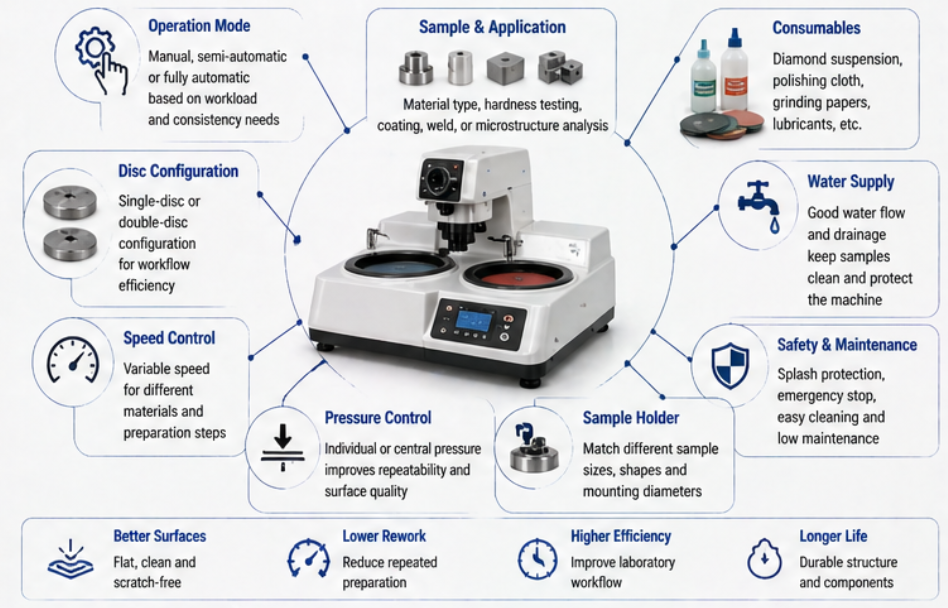
Grinding and polishing machines can be manual, semi-automatic, or fully automatic. Manual machines are suitable for simple sample preparation, lower budgets, and laboratories with experienced operators. Semi-automatic machines improve consistency by controlling pressure, time, and rotation. Automatic systems are better for high-volume laboratories that need repeatable results and reduced operator variation. If the lab prepares only a few samples per day, a manual or basic model may be enough. If the lab prepares many mounted samples, coating sections, heat treatment samples, or customer reports, an automatic grinding and polishing system can save time and improve surface consistency. Disc configuration affects preparation efficiency. A single-disc machine is compact and suitable for small laboratories or lower sample quantities. A double-disc machine allows two preparation steps to be set up at the same time, such as coarse grinding on one disc and fine grinding or polishing on the other. This improves workflow efficiency when many samples are prepared daily. Buyers should check disc diameter, rotation speed range, working space, water supply, drainage, splash protection, and whether the machine supports quick consumable replacement. A larger disc may improve sample handling and batch preparation, while a compact disc may be enough for small mounted samples. Daily sample quantity. Sample diameter and mounting size. Grinding and polishing step sequence. Available laboratory bench space. Need for faster consumable changeover. Manual or automatic sample holder use.3. Choose Manual, Semi-Automatic, Or Automatic Operation
Machine Type Best For Main Advantage Buyer Consideration Manual Grinding And Polishing Machine Low-volume preparation and basic labs Lower cost and flexible operation More dependent on operator skill Semi-Automatic Machine Routine QC labs Better repeatability with controlled parameters Check pressure mode and sample holder compatibility Automatic Grinding And Polishing Machine High-volume industrial labs Stable workflow, lower labor, consistent surface quality Higher investment but better long-term efficiency 4. Check Single-Disc Or Double-Disc Configuration
Disc configuration should match:
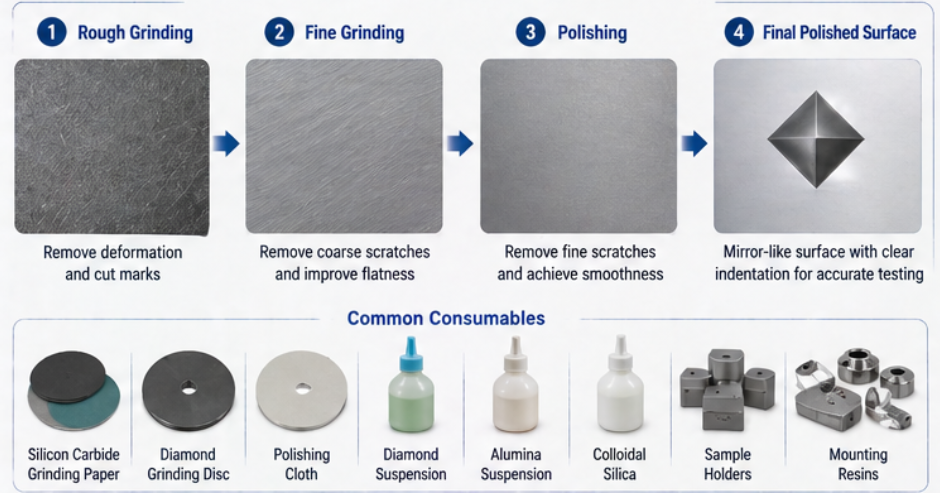
Grinding and polishing quality depends on controlled speed, pressure, time, and movement. A machine with adjustable speed allows the operator to match different materials and consumables. Soft metals may need gentler conditions, while harder materials may require stronger grinding action. Automatic systems may also allow programmable preparation methods. Pressure control is important for repeatability. Manual pressure depends heavily on the operator. Automatic or semi-automatic systems can apply individual or central force to samples, helping reduce variation between operators and batches. Rotation direction and head speed can also affect material removal, scratch patterns, and polishing efficiency. Sample holders are important for automatic or semi-automatic preparation. They keep samples stable, control contact with the disc, and help maintain flatness. Different labs may prepare round mounted samples, rectangular sections, small parts, coating cross-sections, weld sections, or irregular samples. The machine should support suitable holders and fixtures for these sample types. If the sample holder does not match the sample shape, preparation quality can suffer. The sample may tilt, move, vibrate, or polish unevenly. Buyers should provide sample photos, dimensions, mounting diameter, and preparation requirements before ordering. Consumables strongly affect final surface quality. Grinding papers, diamond grinding discs, polishing cloths, diamond suspensions, alumina suspensions, colloidal silica, lubricants, and cleaning materials should match the sample material and required finish. A good machine cannot produce reliable results with unsuitable consumables. Buyers should ask whether the supplier can recommend a complete consumable package for their application. For example, hardened steel, aluminum alloy, cast iron, coatings, ceramics, and composites may need different grinding and polishing sequences. For Vickers or Micro Vickers hardness testing, the final surface must allow clear indentation edge measurement.5. Evaluate Speed Control, Pressure Control, And Rotation Direction
Feature Why It Matters Buyer Checkpoint Variable speed Matches different materials and preparation steps Check speed range and stability Pressure control Improves repeatability and reduces operator influence Check manual, individual force, or central force mode Timer function Controls preparation time for consistent results Check programmable method storage if needed Rotation direction Affects material removal and polishing behavior Check head/disc rotation compatibility 6. Confirm Sample Holder And Fixture Compatibility
7. Match Consumables With The Machine And Material
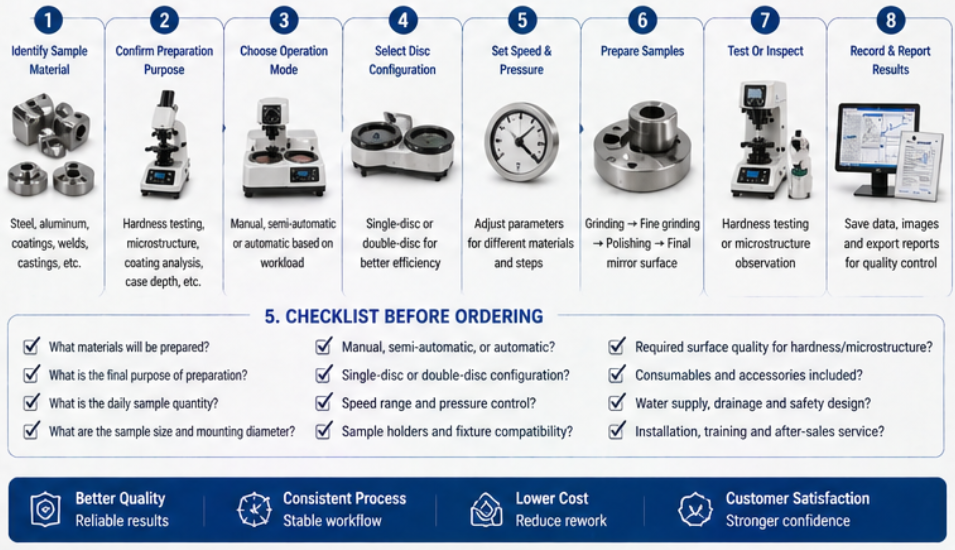
Grinding and polishing machines are used with water, abrasive particles, polishing media, and sample debris. Good water supply and drainage help keep the preparation process stable and the working area clean. Splash protection, emergency stop, corrosion-resistant structure, and easy cleaning are also important for laboratory safety and long-term use. Maintenance should be simple. Buyers should check how to replace discs, clean the water tray, service the motor, replace sample holder parts, and obtain spare parts. If the machine will be used daily in a QC lab, durability and after-sales support are important purchasing factors. Before ordering a metallographic grinding and polishing machine, buyers should prepare clear sample and workflow information. This allows the supplier to recommend a suitable machine model, holders, discs, and consumables. What materials will be prepared? What is the final purpose: hardness testing, microstructure analysis, coating inspection, weld inspection, or failure analysis? What sample size, shape, and mounting diameter will be used? How many samples need to be prepared per day? Do you need manual, semi-automatic, or automatic operation? Do you prefer single-disc or double-disc configuration? Do you need individual force or central force pressure control? What surface quality is required for Vickers or Micro Vickers testing? Do you need sample holders, fixtures, polishing cloths, diamond suspension, and other consumables? Do you also need cutting, mounting, cleaning, microscope, or hardness testing equipment? A metallographic grinding and polishing machine should be selected according to sample material, preparation volume, surface quality requirement, operator skill, and laboratory workflow. Manual machines are economical for low-volume use. Semi-automatic and automatic systems are better for repeatable QC preparation and higher sample throughput. Buyers should check disc size, speed control, pressure mode, sample holder compatibility, consumable matching, cooling and drainage, safety design, and after-sales support before ordering. For laboratories that perform Vickers, Micro Vickers, coating, weld, or case depth testing, preparation quality directly affects final measurement reliability. A well-matched grinding and polishing machine helps reduce sample rework, improve surface consistency, and support more reliable hardness testing and metallographic analysis. A flat, clean, and scratch-controlled surface helps create clear indentations and improves measurement reliability, especially for Vickers and Micro Vickers testing. Manual machines are suitable for low-volume labs and experienced operators. Automatic machines are better for batch preparation, repeatability, and lower operator variation. A double-disc machine is useful when the lab prepares many samples or wants to set up different grinding and polishing steps at the same time. For small labs, a single-disc model may be enough. Yes. Grinding papers, polishing cloths, diamond suspension, and lubricants must match the sample material and required surface finish.8. Check Water Supply, Drainage, Safety, And Maintenance
9. Key Questions Before Requesting A Quote
Conclusion: Choose The Machine Around Your Preparation Workflow
FAQ
Why is grinding and polishing important before hardness testing?
Should I choose a manual or automatic grinding and polishing machine?
Is a double-disc machine necessary?
Do consumables affect sample preparation quality?
Need Help Choosing A Metallographic Grinding And Polishing Machine?
Share your material type, sample size, daily preparation volume, surface quality requirement, and hardness testing method. We can help recommend a suitable grinding and polishing machine, sample holders, consumables, and complete metallographic preparation solution.