


How To Choose A Metallographic Cutting Machine For Metal Sample Preparation
How To Choose A Metallographic Cutting Machine For Metal Sample Preparation
A metallographic cutting machine is used to obtain clean and representative metal sample sections before mounting, grinding, polishing, hardness testing, and microstructure analysis. To choose the right machine, buyers should check material type, cutting capacity, cutting wheel selection, cooling system, clamping method, feed control, safety design, and sample preparation workflow.
Low-Damage Cutting
Proper cutting control helps reduce heat damage, deformation, cracks, and microstructure changes.
Stable Clamping
Secure clamping improves cutting accuracy and protects small, irregular, or hard metal samples.
Complete Workflow
Cutting should match later mounting, grinding, polishing, hardness testing, and microscope analysis.
Metallographic sample preparation starts with cutting. The purpose is not only to separate a small sample from a larger part, but also to obtain a representative section without changing the material structure. If the cutting process creates excessive heat, mechanical deformation, surface burning, cracks, or smearing, the following grinding, polishing, hardness testing, and microstructure observation may all be affected. For industrial quality control laboratories, a metallographic cutting machine is commonly used for steel, cast iron, aluminum alloy, copper alloy, heat-treated parts, welded sections, coatings, gears, shafts, fasteners, castings, forgings, and small precision components. The machine should cut the sample safely, accurately, and with minimal damage. Buyers should not select a cutting machine only by machine size or price. The right model should match the material hardness, sample size, cutting wheel type, cooling requirement, clamping method, daily sample quantity, and downstream testing purpose. Different materials behave differently during cutting. Hardened steel requires strong cutting ability and suitable abrasive wheels. Soft metals such as aluminum and copper may smear or deform if the cutting method is not suitable. Cast iron and castings may create more debris. Heat-treated parts, coatings, and welded sections require careful control to avoid changing the tested area. Buyers should provide the sample material, hardness range, maximum diameter or thickness, part shape, and expected cutting frequency before requesting a quotation. A machine that works well for small lab samples may not be suitable for large forged parts or thick metal bars.1. Why Metallographic Cutting Matters In Sample Preparation
2. Confirm The Material Type And Sample Size
Material / Sample Type Cutting Challenge Machine Selection Focus Hardened steel parts High hardness and heat generation Rigid structure, proper cutting wheel, strong cooling Aluminum and soft metals Smearing and deformation Suitable wheel, controlled feed, low-damage cutting Castings and forgings Large size and rough shape Cutting capacity, chamber space, strong clamping Coatings and welded sections Layer damage or heat-affected area Precise cutting, cooling control, stable positioning
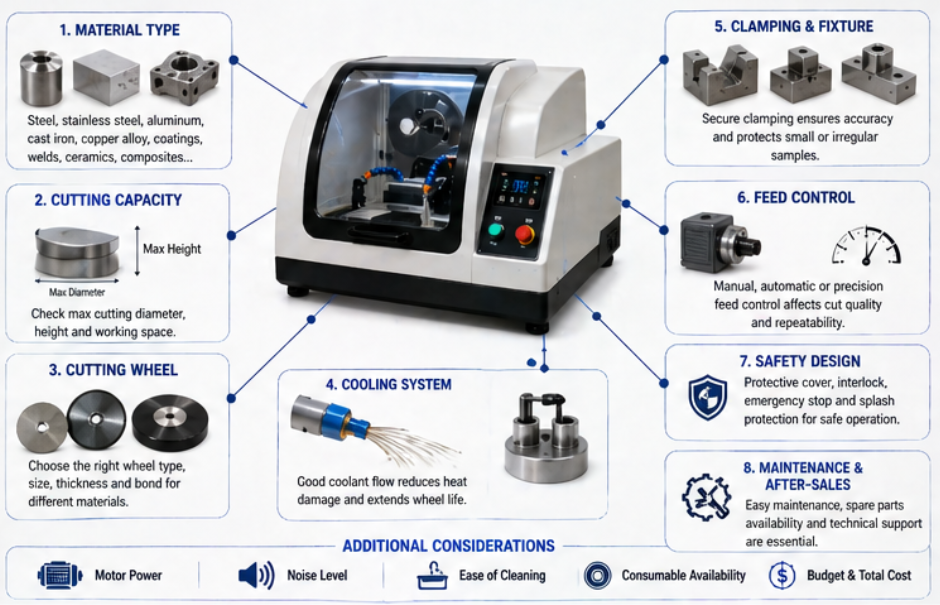
Cutting capacity should match the largest sample you need to prepare. Buyers should check the maximum cutting diameter, cutting chamber size, wheel diameter, motor power, sample table size, and feed travel. If the machine is too small, the operator may need to cut the sample in multiple steps or use unsafe positioning methods. Machine rigidity also matters. A stable structure helps reduce vibration, wheel deflection, uneven cuts, and surface damage. For hard metal samples or larger cross-sections, a stronger machine frame and reliable feed system are important. The cutting wheel has a direct impact on cutting quality. Using the wrong wheel can cause overheating, fast wheel wear, burning marks, sample deformation, or poor cutting efficiency. Different materials require different abrasive types, bond strengths, thicknesses, and wheel specifications. Buyers should ask whether the supplier can recommend cutting wheels according to the sample material. A laboratory preparing hardened steel, soft aluminum, cast iron, copper alloy, and coated samples may need different wheel options. The machine should also support easy wheel replacement and safe wheel operation. Material type and hardness. Sample size and cross-section area. Required surface damage control. Cutting speed and feed pressure. Cooling condition and coolant compatibility. Wheel thickness, abrasive type, and service life.3. Check Cutting Capacity And Machine Structure
Specification Why It Matters Buyer Checkpoint Maximum cutting diameter Determines the largest sample that can be cut Compare with your largest metal part or bar diameter Cutting chamber space Affects handling of irregular or long samples Check length, height, and fixture clearance Motor power Affects cutting stability for hard or thick materials Match motor power with material hardness and workload Machine rigidity Reduces vibration and improves cutting quality Check frame design, table stability, and feed smoothness 4. Choose The Right Cutting Wheel
Cutting wheel selection should consider:
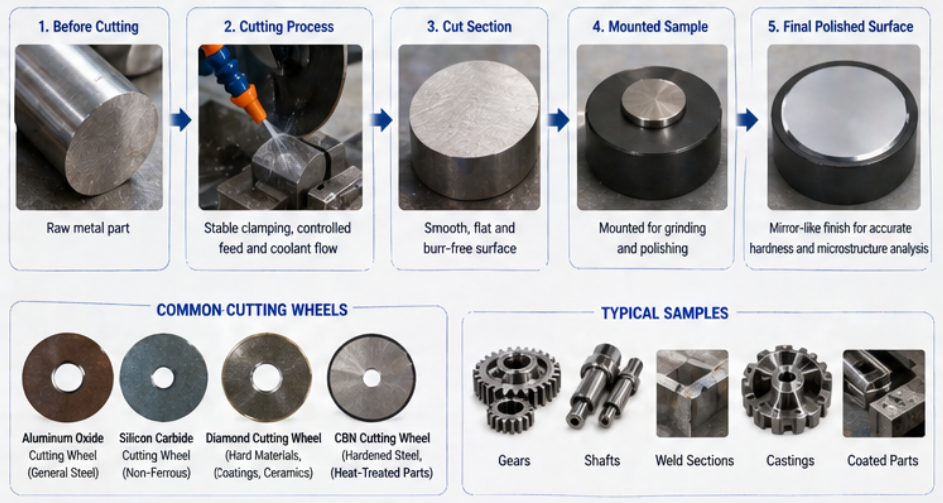
Heat control is one of the most important requirements in metallographic cutting. Excessive heat can change microstructure, affect hardness values, create surface burning, or damage thin layers and coatings. A good cutting machine should provide effective coolant flow to the cutting zone and remove debris during operation. Buyers should check coolant tank capacity, pump performance, nozzle design, filtration, splash protection, and drainage. For materials sensitive to heat or deformation, stable coolant delivery is essential. If the cut sample will be used for hardness testing or microstructure analysis, heat damage control should be treated as a core requirement. Secure clamping protects both the sample and the operator. If the sample moves during cutting, the wheel may break, the cut surface may be damaged, or the section may become inaccurate. This is especially important for irregular parts, small components, round bars, thin samples, gears, shafts, weld sections, and hardened parts. Buyers should confirm whether the machine includes standard clamps and whether additional fixtures are available. For laboratories that handle many sample shapes, flexible clamping options are important. If your parts are not simple round or flat samples, provide sample photos and dimensions before quotation. Metallographic cutting machines can be manual, semi-automatic, automatic, or precision cutting types. Manual machines are practical for basic sample preparation and lower budgets. Automatic machines provide more consistent feed control and are suitable for higher sample volume. Precision cutting machines are often used for small, delicate, fragile, or high-value samples where damage must be minimized. Cutting machines work with high-speed wheels, metal debris, coolant, and clamped samples. Safety design should include a protective cover, reliable door interlock, emergency stop, stable clamping, splash protection, and easy access for cleaning. A clear viewing window and good lighting also help operators monitor the cutting process. Maintenance should also be considered before purchase. Buyers should check wheel replacement, coolant tank cleaning, pump maintenance, debris removal, fixture adjustment, and spare parts availability. If the machine will be used daily, easy maintenance and reliable after-sales support are important. The cutting machine should fit into the complete workflow: cutting, mounting, grinding, polishing, cleaning, hardness testing, and microscopy. Good cutting quality reduces grinding time and improves final sample preparation efficiency.5. Evaluate Cooling System And Heat Damage Control
6. Check Clamping Fixtures And Sample Support
Sample Shape Clamping Concern Recommended Check Round bars and shafts Rolling or rotation during cutting V-block clamp or suitable round sample fixture Small precision parts Difficult positioning and vibration Small-part fixture and stable clamping pressure Gears and irregular parts Uneven support and contact points Adjustable fixture or custom support Welded sections Need precise cross-section location Accurate positioning and smooth feed control 7. Manual, Automatic, Or Precision Cutting?
Machine Type Best For Main Advantage Buyer Consideration Manual Cutting Machine Basic lab preparation and low-volume cutting Lower cost and simple operation More operator-dependent Automatic Cutting Machine Routine QC labs and repeated cutting tasks Consistent feed and better repeatability Higher investment but better workflow efficiency Precision Cutting Machine Small parts, delicate samples, coatings, electronics Low damage and high cutting control Usually lower capacity than heavy-duty machines 8. Safety, Maintenance, And Laboratory Workflow
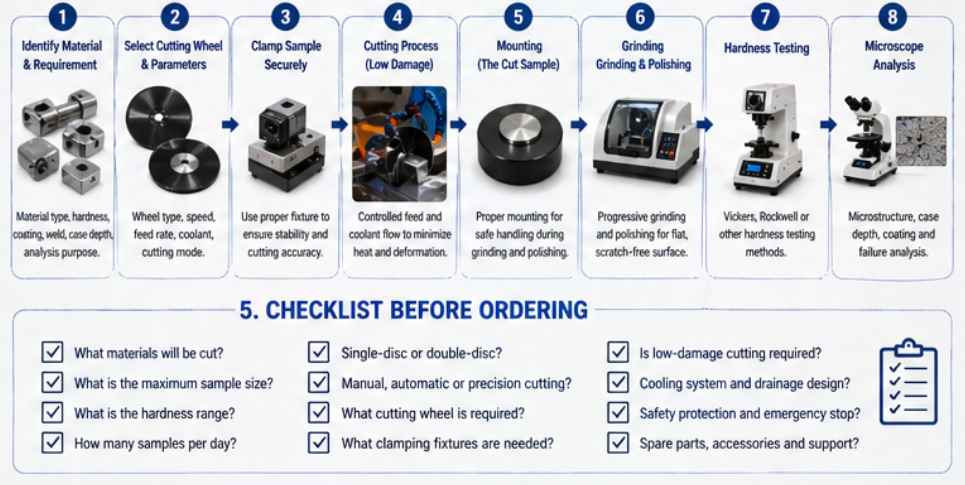
Before ordering a metallographic cutting machine, buyers should provide clear sample and workflow information. This helps the supplier recommend the correct cutting capacity, wheel type, clamping system, cooling system, and machine configuration. What materials will be cut? What is the material hardness range? What is the maximum sample diameter, thickness, or cross-section size? Are the samples round, flat, small, long, irregular, coated, welded, or heat-treated? How many samples need to be cut per day? Is low-damage cutting required for hardness testing or microstructure analysis? Do you need manual, automatic, or precision cutting? What cutting wheel type or wheel diameter is required? Do you need special fixtures or clamps? Do you also need mounting, grinding, polishing, microscope, or hardness testing equipment? A metallographic cutting machine should be selected based on the real sample material, size, hardness, shape, and final testing purpose. For hardness testing and microstructure analysis, the cutting process must control heat, deformation, cracks, and surface damage. Buyers should check cutting capacity, machine rigidity, cutting wheel compatibility, coolant system, clamping fixtures, feed control, safety design, and maintenance support before ordering. If the laboratory prepares many different sample types, flexible fixtures and proper cutting wheel recommendations are especially important. A suitable cutting machine improves the entire sample preparation workflow. It reduces grinding time, protects the material structure, improves polishing quality, and supports more reliable hardness testing and metallographic analysis. Metallographic cutting focuses on obtaining a representative sample with minimal heat damage, deformation, cracking, and microstructure change. Yes. Excessive heat or deformation during cutting can change the surface condition and affect hardness readings, especially for heat-treated parts and thin layers. Manual cutting is suitable for low-volume basic preparation. Automatic cutting is better for routine QC labs that need consistent feed control and repeatable sample quality. Provide material type, hardness range, maximum sample size, sample shape, daily cutting volume, required surface quality, and whether the sample is for hardness testing or microscopy.9. Key Questions Before Requesting A Quote
Conclusion: Choose The Cutting Machine Around The Sample And Final Test
FAQ
Why is metallographic cutting different from normal cutting?
Does cutting affect hardness testing results?
Should I choose manual or automatic cutting?
What information should I provide before ordering?
Need Help Choosing A Metallographic Cutting Machine?
Share your material type, sample size, hardness range, daily cutting volume, and final testing purpose. We can help recommend a suitable metallographic cutting machine and complete sample preparation solution for your quality control laboratory.