

W900 W-Band High-Frequency EPR Spectrometer
The W900 operates at 94 GHz for superior spectral and orientational resolution in disordered systems. It features a W-band microwave bridge (93.5–94.5 GHz, 30 mW CW/2 W pulse), a 6-free superconducting magnet with ±1000 Gauss scan coils, and a high-Q resonator (≥4000 Q-value, 93.7–94.4 GHz). Paired with EPR ProCT software for automated CW/pulsed experiments (DEER/EDNMR/ENDOR), it enables precise quantum material and radical analysis.
W900 W-Band High-Frequency EPR Spectrometer Applications and Related Testing Solutions
W900 W-Band High-Frequency EPR Spectrometer supports color, gloss, and appearance evaluation applications that require repeatable measurement, clear display, and reliable inspection results.
Related Products: Scanning NV Microscope | EASY-G 1310M Gas Pycnometer | Specific Surface & Porosimetry Analyzer EASY-V
Product Description
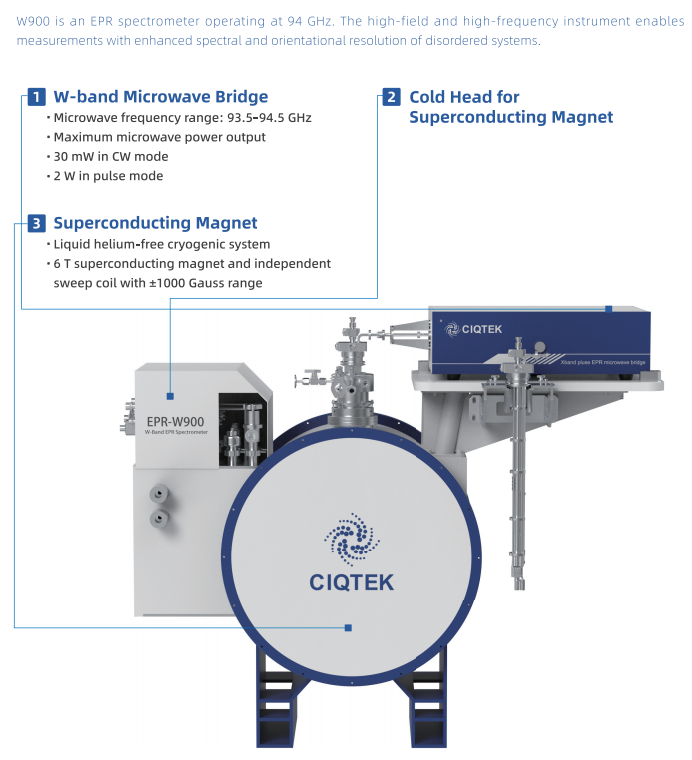
The W900 W-Band High-Frequency EPR Spectrometer is a cutting-edge instrument designed for high-resolution electron paramagnetic resonance (EPR) studies, operating at 94 GHz to deliver enhanced spectral and orientational resolution for disordered systems. Developed by CIQTEK, it integrates advanced hardware, a high-performance resonator, and intelligent control software (EPR ProCT) for versatile research materials, chemistry, and biology.
Core Hardware Components
1. W-Band Microwave Bridge
The heart of the system, this bridge operates at 93.5–94.5 GHz, supporting both continuous-wave (CW) and pulsed modes. It delivers 30 mW maximum power in CW mode and 2 W in pulsed mode, with precise timing control for experiments like electron-electron double resonance (ELDOR) and electron-nuclear double resonance (ENDOR).
2. Superconducting Magnet System
Equipped with a 6 T superconducting magnet and a helium-free cryogenic system, the W900 eliminates liquid helium dependency for cost-effective operation. An independent sweep coil provides ±1000 Gauss scanning range, ensuring stable magnetic field control for high-sensitivity measurements. The cold head maintains ultra-low temperatures, preserving magnet performance over extended use.
3. High-Q Resonator
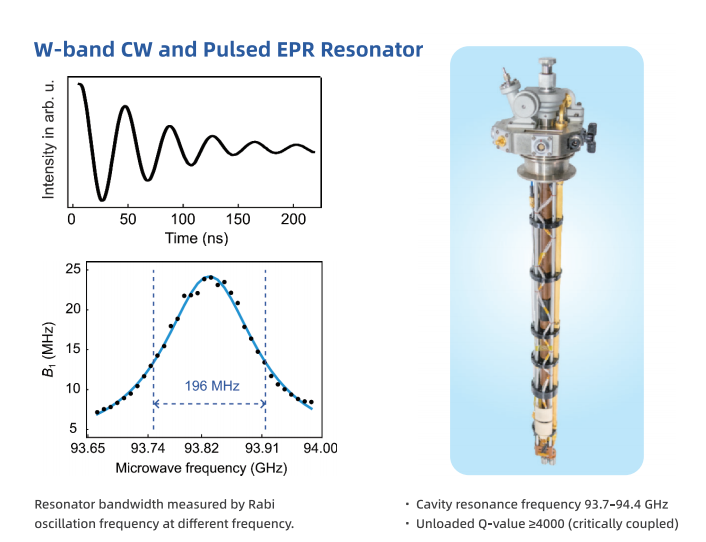
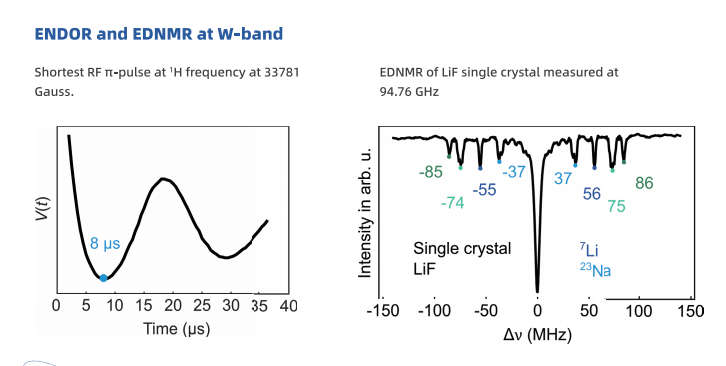
The W-band CW/pulsed resonator features a cavity resonance frequency of 93.7–94.4 GHz and an unloaded Q-value ≥4000 (critically coupled). Measured via Rabi oscillation, its bandwidth spans 196 MHz, enabling efficient excitation of samples. This resonator supports key experiments like ENDOR and electron-nuclear double magnetic resonance (EDNMR), with demonstrated performance in LiF single crystals (detecting ⁷Li, ²³Na resonances at 94.76 GHz).
Intelligent Control Software: EPR ProCT
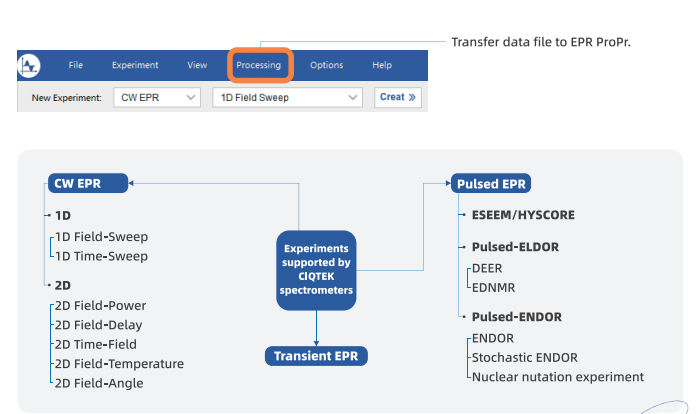
The W900 is paired with EPR ProCT, a user-friendly control software tailored for both novice and expert users. Key features include: CW Mode Tuning: Auto-tune functionality and optional Q-value calculation for rapid setup.
Pulse Editor: Graphical interface for programming time-domain experiments (e.g., DEER, EDNMR), with pulse sequence parameters (frequency, amplitude, timing).
Experiment Library: Supports 1D/2D CW EPR (field-sweep, time-sweep), transient EPR, and pulsed EPR (ESEEM/HYSCORE, Pulsed-ELDOR, Pulsed-ENDOR).
Data Workflow: Basic processing tools and one-click file transfer to EPR ProPr for advanced analysis.
Applications & Performance
The W900 excels in studying quantum materials ( defect centers in solids), radical dynamics in chemistry, and biological systems (e.g., protein radicals). For example, it achieved a shortest RF π-pulse at ¹H frequency (33781 Gauss) and resolved EDNMR spectra of LiF single crystals, showcasing its ability to detect weak nuclear interactions. The system’s high frequency (94 GHz) enhances resolution in disordered systems, where conventional X-band EPR struggles with spectral overlap.
Advantages Over Conventional EPR
Resolution: 94 GHz operation provides 3x higher spectral resolution than X-band (9 GHz), critical for complex samples.
Versatility: Seamless switching between CW/pulsed modes and support for ENDOR/EDNMR/DEER experiments.
Usability: Helium-free magnet and automated software reduce operational complexity and cost.
Keywords
94 GHz High-Frequency EPR
CIQTEK EPR ProCT Software
Superconducting Magnet EPR
High-Q Resonator EPR
ENDOR/EDNMR Experiments
Quantum Material Characterization EPR