

EPR Series Spectrometers And Resonators
The EPR Series combines X-band CW (EPR300) and pulsed (EPR100) spectrometers with advanced resonators (PW-4201-DR, High-Q, Dual-Mode). EPR100 delivers 200mW CW/pulsed power, 500W SSPA, and 4ns timing resolution; EPR300 offers 10,000:1 SNR and Q-band extension. Resonators feature 400MHz FWHM (PW-4201-DR), ≥18,000 Q-factor (High-Q), and dual-mode frequencies. Ideal for materials science, chemistry, and quantum research with automated workflows and multi-nucleus detection.
EPR Series Spectrometers & Resonators Applications and Related Testing Solutions
EPR Series Spectrometers & Resonators supports color, gloss, and appearance evaluation applications that require repeatable measurement, clear display, and reliable inspection results.
Related Products: Scanning NV Microscope | EASY-G 1310M Gas Pycnometer | Specific Surface & Porosimetry Analyzer EASY-V
The EPR Series integrates cutting-edge Electron Paramagnetic Resonance (EPR) spectrometers and resonators, designed for high-resolution molecular structure analysis, dynamic studies, and quantum material characterization. The series includes the EPR100 X-band Pulse EPR Spectrometer, EPR300 X-band CW-EPR Spectrometer,ators (PW-4201-DR Pulsed Resonator, High-Q Resonator, Dual-Mode Resonator), offering versatile solutions for academic and industrial research.
Core Product Architecture
1. EPR100 Pulse EPR Spectrometer
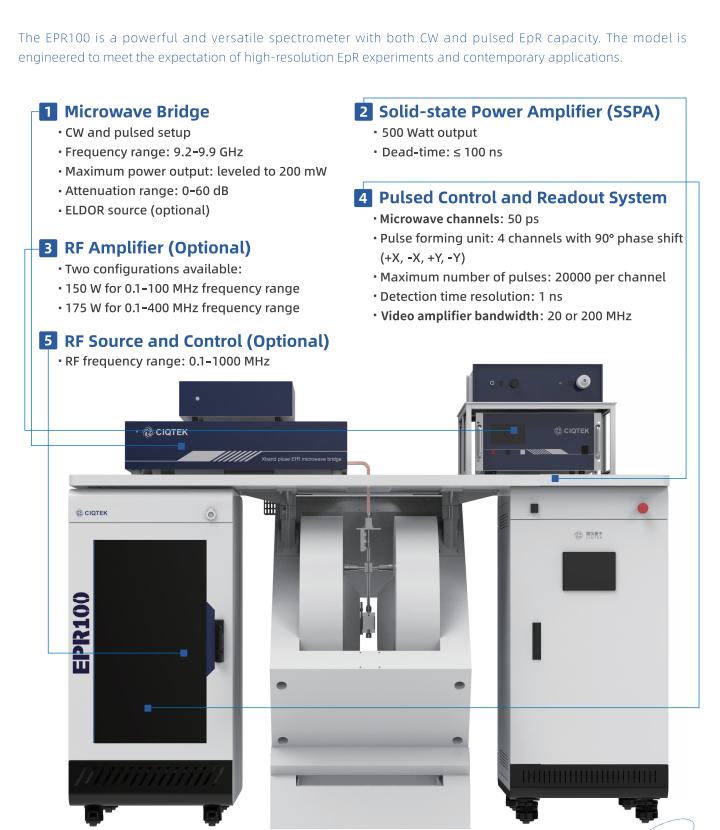
Engineered for pulsed EPR experiments, EPR100 features a 9.2–9.9 GHz microwave bridge (200mW max power, 0–60dB attenuation) and a 500W solid-state power amplifier (SSPA, ≤100ns dead time). Its pulse control system supports 4 channels (90° phase shift, 20,000 pulses/channel) with 50ps timing resolution and 1ns detection. Optional components include RF amplifiers (150W/175W) and a 0.1–1000MHz RF source, enabling double-resonance (ENDOR) and distance measurements (DEER).
2. EPR300 CW-EPR Spectrometer
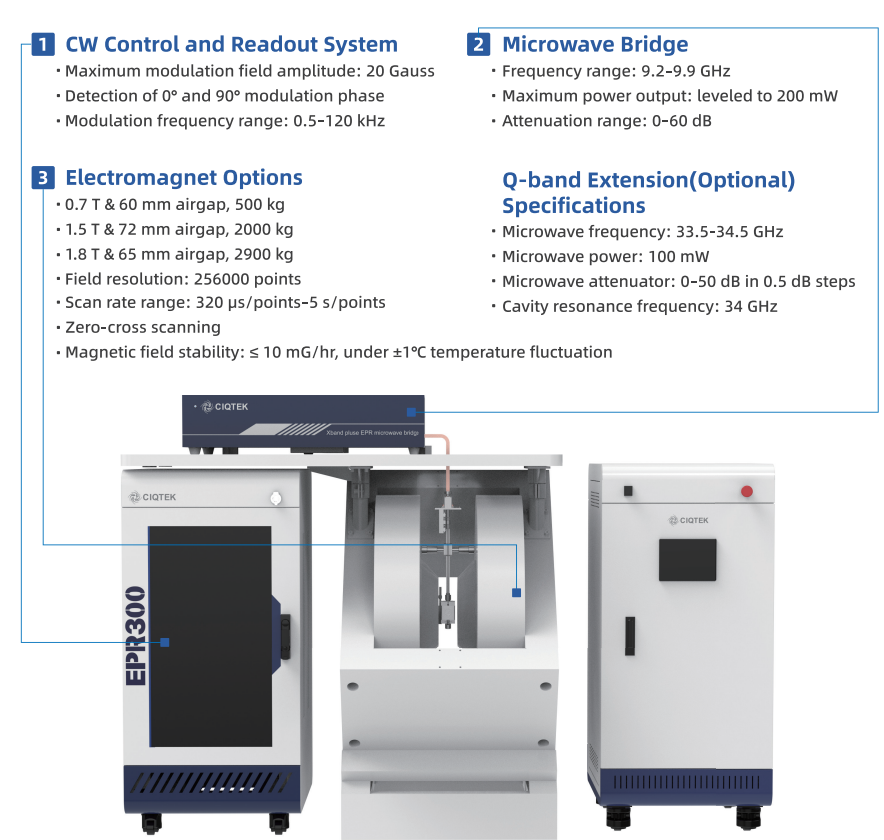
Optimized for continuous-wave (CW) EPR, EPR300 delivers enhanced sensitivity (10,000:1 SNR) with a modular design. Key components include a 9.2–9.9 GHz microwave bridge (200mW power), CW control system (20 Gauss modulation, 0.5–120kHz frequency), and interchangeable electromagnets (0.7T–1.8T, 256,000-point field resolution). An optional Q-band extension (33.5–34.5 GHz, 100mW power) expands frequency coverage for advanced studies.
Advanced Resonator Technologies
PW-4201-DR Pulsed Resonator
A standard pulsed resonator with a 400MHz full-width-half-maximum (FWHM) B₁ field distribution (9.5–9.8 GHz), supporting double-resonance experiments. It enables four-pulse DEER for EPR distance measurements and integrates with EPR100 for biradical analysis.
High-Q Resonator
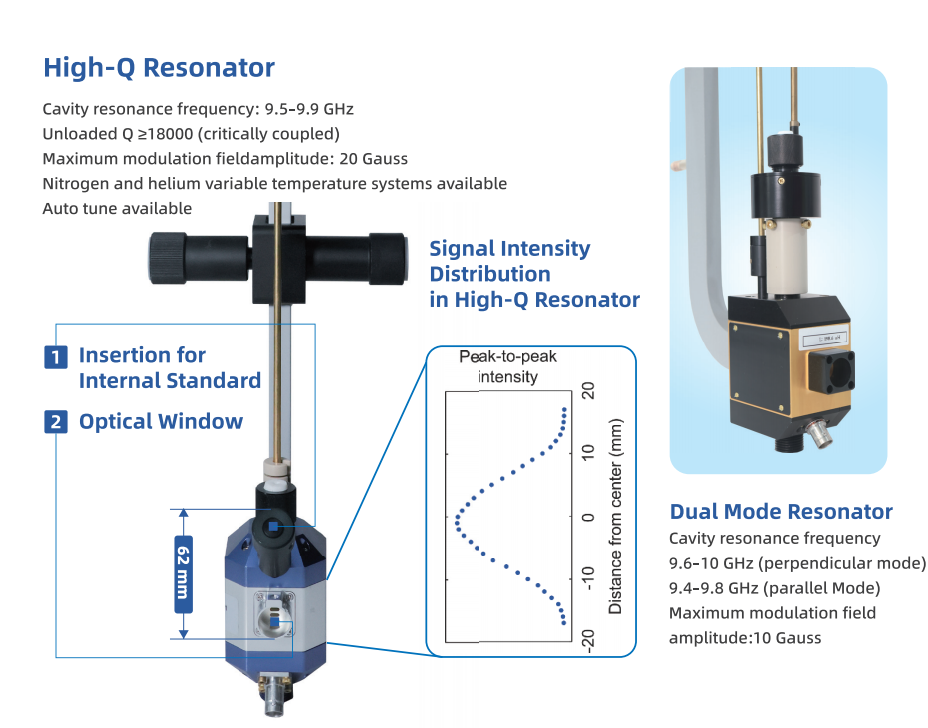
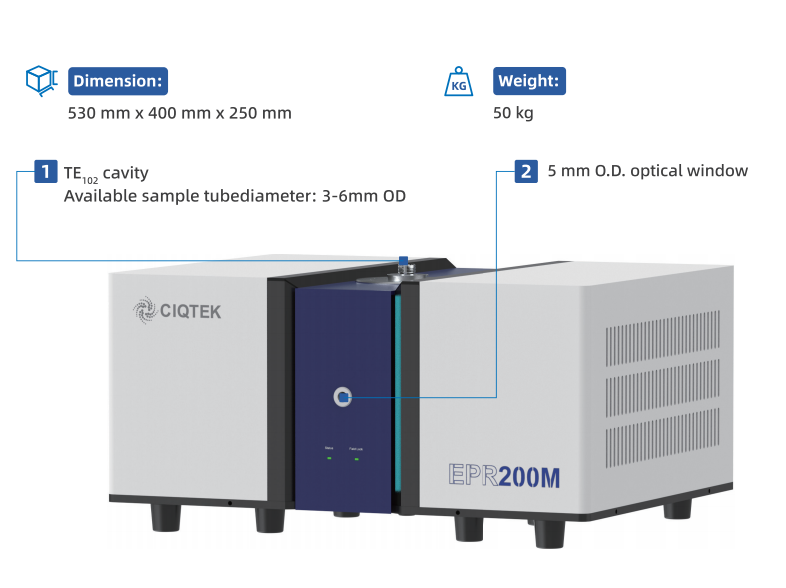
Features a cylindrical design (62mm height) with 9.5–9.9 GHz cavity frequency, ≥18,000 unloaded Q-factor (critically coupled), and 20 Gauss modulation. Equipped with an internal standard insertion, optical window, and auto-tune function, it supports nitrogen/helium variable temperature systems for sensitive sample analysis (e.g., ¹⁴N@C₆₀).
Dual-Mode Resonator
Offers perpendicular (9.6–10 GHz) and parallel (4–9.8 GHz) modes with 10 Gauss modulation. Its black-box design suits multi-modal experiments, such as Cr³⁺ transition studies in CsAl(SO₄)₂.
Technical Specifications (Key Parameters)
Component | EPR100 Pulse | EPR300 CW | PW-4201-DR Resonator | High-Q Resonator |
|---|---|---|---|---|
Frequency Range | 9.2–9.9 GHz | 9.2–9.9 GHz (X-band); 33.5–34.5 GHz (Q-band) | 9.4–9.9 GHz | 5–9.9 GHz |
Power Output | 200mW (microwave); 500W (SSPA) | 200mW (microwave); 100mW (Q-band) | N/A | N/A |
Key Feature | 4ns timing resolution; 20,000 pulses/channel | 10,000:1 SNR; 256,000-point field resolution | 400MHz FWHM B₁ field | ≥18,000 Q-factor; auto-tune |
Applications
Quantum Materials: Characterize defect centers (e.g., Cr³⁺) and spin dynamics.
Chemistry/Biology: Analyze radicals (¹⁴N@C₆₀), proteins, and DNA via ENDOR/DEER.
Energy Storage: Study battery electrode materials and catalytic reactions.
Advantages
Versatility: Seamlessly switch between CW/pulsed modes and X/Q bands.
Precision: Sub-nanosecond timing (EPR100) and high field stability (EPR300).
Expandability: Modular design supports optional amplifiers, resonators, and cryogenic systems.
SEO Keywords
EPR spectrometer
X-band CW-EPR spectrometer EPR300
Pulse EPR spectrometer EPR100
PW-4201-DR pulsed resonator
High-Q resonator EPR
Dual-mode resonator
Electron paramagnetic resonance spectroscopy
ENDOR/DEER experiments