


When Should Factories Upgrade From Manual Hardness Testing To Automatic Vision Systems
When Should Factories Upgrade From Manual Hardness Testing To Automatic Vision Systems
Factories should consider upgrading from manual hardness testing to automatic vision systems when manual reading causes unstable results, testing volume increases, Vickers or Brinell indentation measurement becomes time-consuming, case depth testing requires many points, customers require image-based reports, or QC labs need better traceability and repeatability.
Manual Reading Error
Automatic vision reduces differences caused by operator judgment and visual measurement.
Higher Testing Volume
Batch testing, multiple samples, and repeated test points need faster measurement and recording.
Case Depth Profiles
Micro Vickers profile testing benefits from automatic point positioning and curve generation.
Traceable Reports
Images, coordinates, hardness values, statistics, and PDF reports support customer audits.
Why Manual Hardness Testing Becomes A Bottleneck
Manual hardness testing is suitable for many basic inspection tasks. A trained operator can perform routine Rockwell checks, read Brinell indentation diameters, or measure Vickers diagonals through an optical system. For low-volume testing and simple internal QC, manual operation may be enough.
However, as the factory grows, manual hardness testing can become a bottleneck. Different operators may read indentation edges differently. Test values may be recorded by hand and transferred into reports manually. Case depth testing may require many test points, making manual reading slow and inconsistent. When customers request image evidence or traceable reports, manual records may no longer meet the requirement.
Automatic vision hardness testing systems are designed to improve measurement repeatability, reduce operator variation, speed up data handling, and generate more professional reports. They are especially useful for Vickers, Micro Vickers, Brinell, case depth testing, weld hardness testing, coating hardness testing, and high-volume QC labs.
1. Upgrade When Different Operators Get Different Results
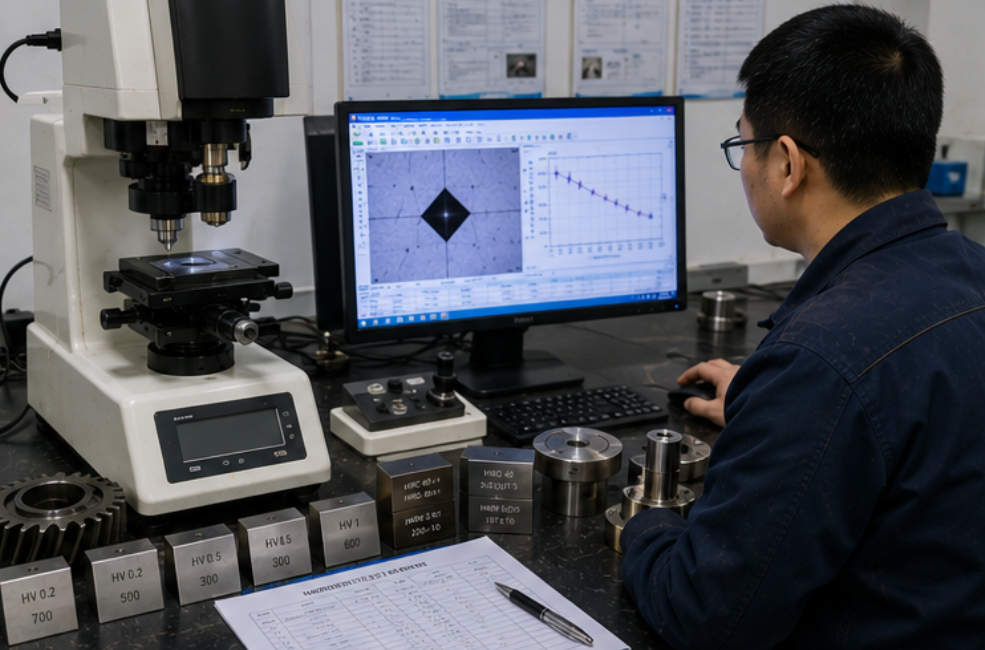
One of the clearest signs that a factory should consider automatic vision testing is inconsistent results between operators. For Vickers, Micro Vickers, and Brinell testing, hardness values depend on measuring indentation size. If different operators judge the indentation edge differently, the final result may vary.
Automatic vision systems capture indentation images and use software to measure diagonals or diameters. This reduces manual reading variation and makes results more consistent across operators, shifts, and production batches.
| Manual Testing Problem | Typical Result | How Automatic Vision Helps |
|---|---|---|
| Different operators read indentation edges differently | Hardness values vary even on the same sample | Software identifies and measures indentation images more consistently |
| Manual focusing and visual judgment are unstable | Repeatability becomes poor | Digital image capture supports clearer measurement review |
| Manual records are written incorrectly | Reports contain mistakes or missing values | Data is stored and exported directly from the software |
| Customer disputes the result | No image proof is available | Indentation images and test records can be saved for review |
2. Upgrade When Testing Volume Becomes Too High
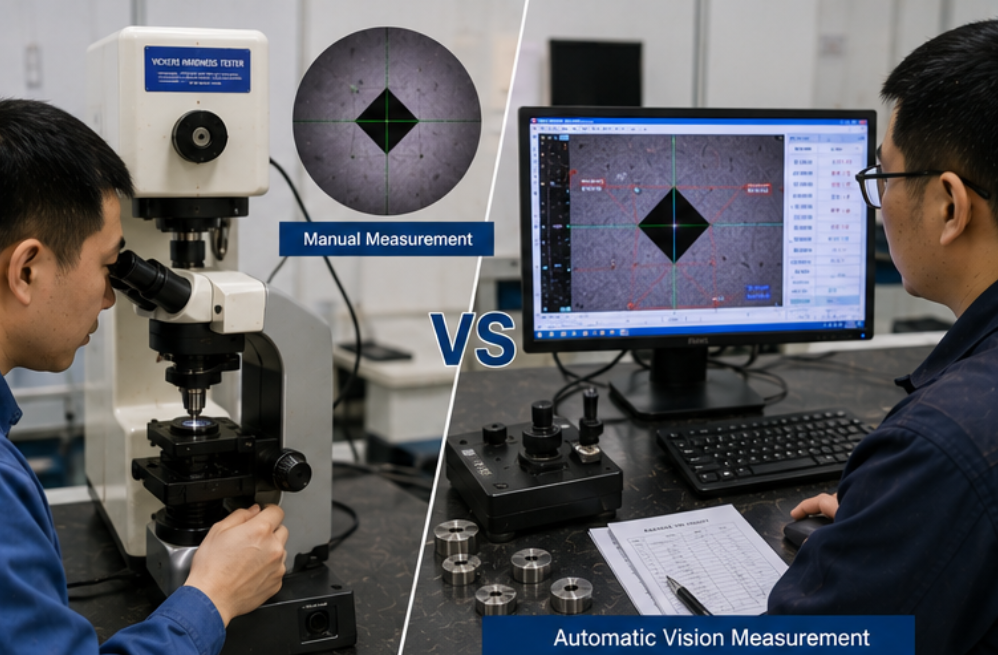
Manual hardness testing is manageable when the lab tests only a few samples per day. But when the factory tests many batches, many test points, or many customer reports, manual reading becomes slow. Operators may spend more time measuring, recording, checking, and formatting reports than actually controlling quality.
Automatic vision systems can improve efficiency by capturing images, measuring indentations, calculating hardness values, storing results, and exporting reports. For labs that test many Brinell indentations, Vickers points, or Micro Vickers case depth profiles, this can greatly reduce repetitive manual work.
Automatic vision becomes valuable when:
The lab tests many samples every day.
Each sample requires multiple hardness points.
Case depth testing requires long surface-to-core profiles.
Brinell diameter measurement is repeated frequently.
Operators spend too much time writing reports manually.
Customers require consistent data format and traceable inspection records.
3. Upgrade For Micro Vickers Case Depth And Hardness Profile Testing
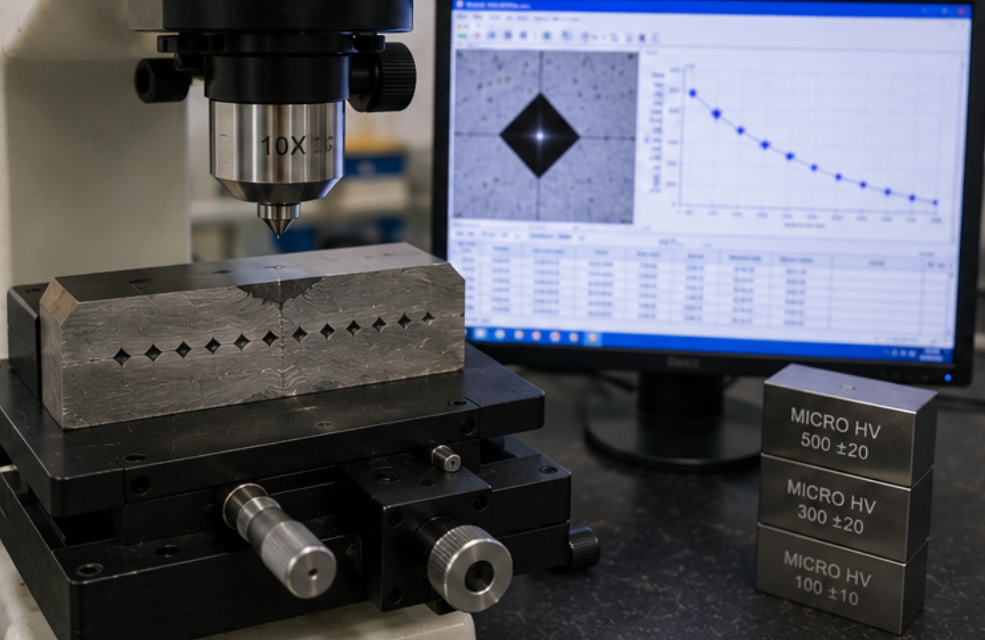
Case depth testing is one of the strongest reasons to upgrade. For carburized, nitrided, carbonitrided, induction-hardened, coated, or surface-treated parts, the QC lab may need to measure hardness values from the surface to the core. This can involve many Micro Vickers test points on one polished cross-section.
A manual system can be slow and operator-dependent. An automatic vision system with software and an XY stage can help position points, measure indentations, store coordinates, generate hardness profile curves, and export reports. This is useful for gears, shafts, bearings, fasteners, molds, tools, and heat-treated parts.
| Application | Manual Testing Challenge | Automatic Vision Benefit |
|---|---|---|
| Carburized gears | Many points from tooth surface to core | Hardness profile curve and effective case depth report |
| Nitrided shafts | Thin layer requires small and clear indentations | Image measurement improves repeatability |
| Welded parts | Many points across weld metal, HAZ, and base metal | Saved test path, images, and zone comparison |
| Coatings and thin layers | Small indentations are difficult to read manually | Automatic diagonal measurement and image proof |
4. Upgrade When Customers Require Image-Based Reports
Some customers no longer accept only handwritten or simple numeric hardness values. They may ask for indentation images, test point locations, calibration records, hardness profile curves, batch traceability, and exported PDF reports. This is common in automotive, aerospace-related supply chains, precision machining, heat treatment, welding, tool steel, and high-value metal parts.
Automatic vision systems make reporting more professional. The software can save sample information, test method, force, indentation image, measurement value, test point coordinates, operator, date, and exported reports. This reduces customer communication problems and supports audit review.
Report functions buyers should check:
Indentation image capture and storage.
Automatic diagonal or diameter measurement.
Hardness value calculation and statistics.
Test point coordinate storage.
Hardness profile curve generation.
Calibration record input or export.
PDF and Excel report export.
Sample ID, batch number, operator, and inspection date records.
5. Upgrade When Manual Brinell Measurement Slows Down Production QC
Brinell testing is widely used for castings, forgings, aluminum alloys, copper alloys, and large metal parts. Manual Brinell indentation measurement can be time-consuming, especially when the factory checks many batches. Operators must measure indentation diameter carefully and calculate or read the corresponding hardness value.
Digital or automatic vision Brinell systems can capture the indentation image, measure the diameter, calculate hardness, and save the result. This is useful for foundries, forging plants, heavy machinery suppliers, and metal material inspection labs that need repeatable HBW reports.
6. Upgrade When Quality Traceability Becomes A Sales Requirement
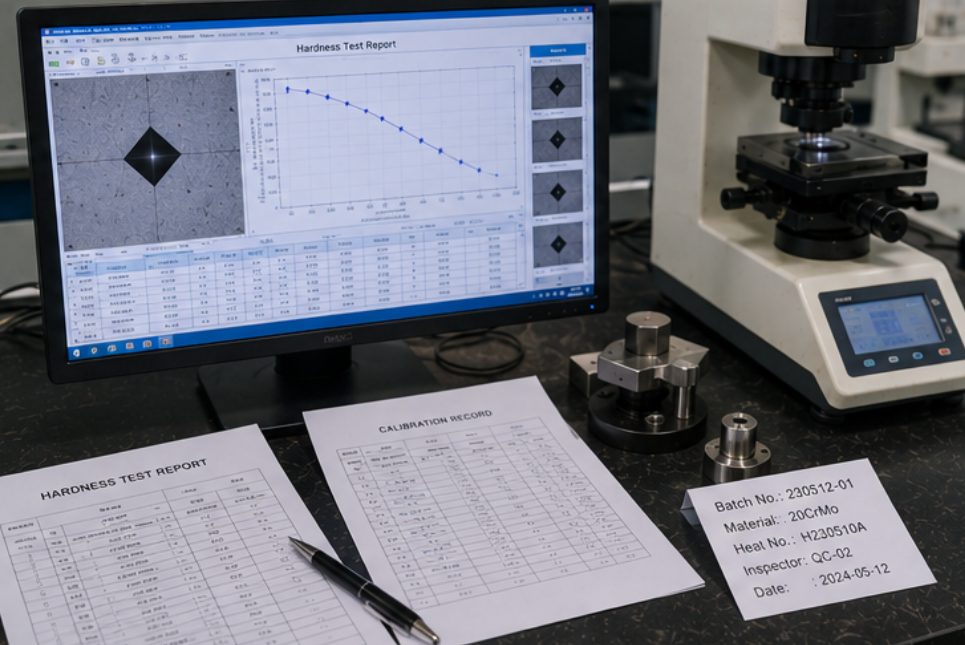
For many factories, the reason to upgrade is not only technical. Customers increasingly care about traceability. They want to know which sample was tested, where it was tested, who tested it, which calibration block was used, what the image looked like, and whether the result is linked to the production batch.
Automatic vision hardness testing systems help transform hardness testing from a simple inspection step into a traceable quality control process. This can support higher-value customers, export orders, supplier audits, and long-term quality improvement.
Manual vs Automatic Vision Hardness Testing
Manual systems are still suitable for simple, low-volume inspection. Automatic vision systems are better when factories need better repeatability, faster reporting, image evidence, profile testing, or customer audit support.
| Comparison Item | Manual Testing | Automatic Vision System |
|---|---|---|
| Initial cost | Lower | Higher |
| Operator dependence | Higher | Lower |
| Indentation image storage | Limited or unavailable | Available |
| Case depth profile | Slow and manual | Faster with curve generation |
| Report export | Manual records | PDF / Excel export |
| Best for | Low-volume internal checks | High-volume labs, customer reports, Vickers, Micro Vickers, Brinell |
Key Questions Before Upgrading To Automatic Vision Testing
Before upgrading, factories should review their real testing workload, current pain points, customer requirements, and future QC needs. This helps choose the right system instead of overbuying or missing important functions.
Which methods do you use most often: Brinell, Vickers, Micro Vickers, or Rockwell?
How many samples and test points are measured per day?
Do different operators get different results?
Do you need indentation images for customer reports?
Do you need case depth or hardness profile curves?
Do you need a manual or motorized XY stage?
Do you need automatic diagonal or diameter measurement?
Do customers require PDF reports, Excel data, images, or calibration records?
Do you already have suitable sample preparation equipment?
Do you need a full new tester or an upgrade package for an existing tester?
Conclusion: Upgrade When Manual Testing Limits Accuracy, Speed Or Traceability
Factories do not need automatic vision systems for every hardness testing task. Manual hardness testing is still practical for simple, low-volume, internal checks. However, when manual reading causes inconsistent results, when testing volume grows, when case depth testing requires many points, or when customers need image-based reports, automatic vision becomes a valuable upgrade.
For Vickers, Micro Vickers, Brinell, coating hardness, weld hardness, and case depth applications, automatic vision systems can improve repeatability, efficiency, and report quality. The right system should match real samples, test methods, software needs, stage requirements, and customer documentation expectations.
If your factory is planning to upgrade from manual hardness testing to automatic vision measurement, share your testing method, sample type, daily workload, report requirements, and current tester model before ordering. A complete recommendation can help you choose a practical and scalable solution.
FAQ
Is automatic vision hardness testing necessary for every factory?
No. It is most useful for high-volume testing, Vickers, Micro Vickers, Brinell measurement, case depth profiles, and customer report requirements.
Which hardness methods benefit most from automatic vision?
Vickers, Micro Vickers, and Brinell testing benefit strongly because their results depend on optical indentation measurement.
Can automatic vision help with case depth testing?
Yes. It can measure multiple Micro Vickers points, save images, record positions, and generate hardness profile curves for case depth reports.
Can an existing hardness tester be upgraded?
In some cases, existing Vickers, Micro Vickers, or Brinell testers may support camera and software upgrades. The exact possibility depends on the model and optical structure.
Need To Upgrade Your Hardness Testing Lab?
Share your current hardness tester model, testing method, sample type, daily testing volume, report requirements, and automation needs. We can help recommend suitable automatic vision hardness testing systems, software, XY stages, calibration blocks, and complete QC upgrade solutions.