


Hardness Testing For Welded Parts: What QC Labs Should Check Before Delivery
Hardness Testing For Welded Parts: What QC Labs Should Check Before Delivery
Welded parts require hardness testing before delivery to verify weld metal, heat-affected zone, base metal, post-weld heat treatment results, and potential brittle or softened areas. A reliable QC process should include correct test method selection, sample preparation, Vickers or Micro Vickers test path planning, calibration verification, and clear inspection reports.
Weld Metal
Check whether the deposited weld metal meets required hardness and mechanical performance.
HAZ Control
The heat-affected zone may become too hard, too soft, or uneven after welding.
Vickers Testing
Vickers and Micro Vickers testing are commonly used across weld cross-sections.
Delivery Reports
Reports should show test locations, hardness values, calibration records, and acceptance status.
Why Welded Parts Need Hardness Testing Before Delivery
Welding changes the local structure of metal parts. The weld metal, heat-affected zone, and base metal may show different hardness values after welding, cooling, and post-weld heat treatment. If these areas are not checked before delivery, hidden quality risks may appear later during assembly, pressure testing, service loading, fatigue operation, or customer inspection.
For welded structures, pressure vessels, pipelines, machinery frames, construction components, shafts, flanges, tools, molds, and repaired metal parts, hardness testing helps confirm whether the welding process created brittle zones, softened zones, excessive hardness, or inconsistent local properties.
A proper hardness testing process should not only test one random position. QC labs should define the test path across weld metal, heat-affected zone, and base metal, then record values clearly in a traceable report. This is especially important when welded parts are supplied to industrial buyers who require quality records before delivery.
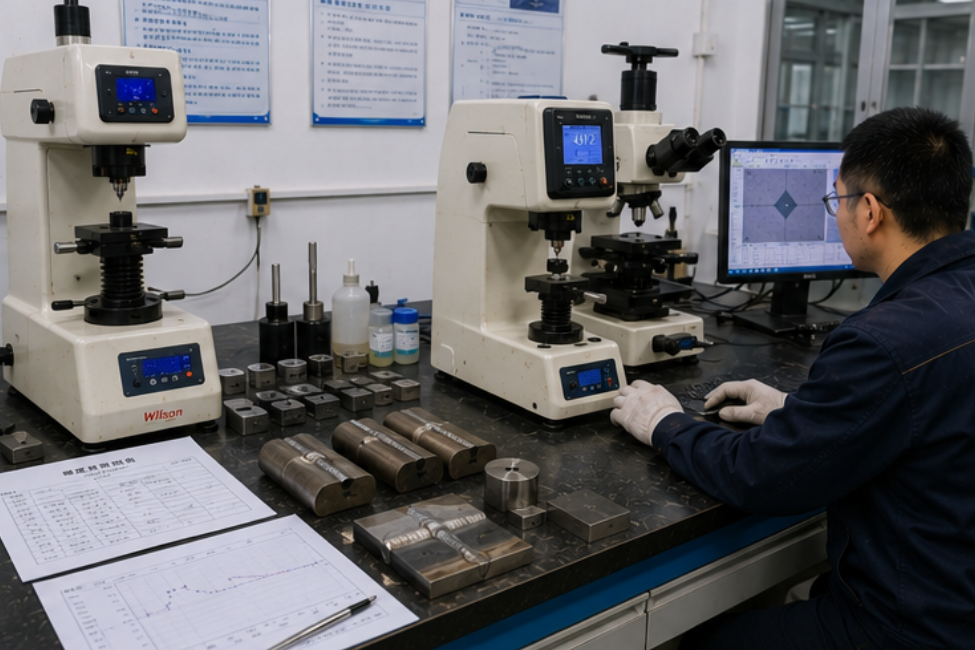
1. Check Weld Metal, HAZ And Base Metal Separately
A welded part is not one uniform material area. The weld metal is the deposited material. The heat-affected zone is the area beside the weld that was changed by welding heat. The base metal is the original material outside the welding influence. Each zone may have a different hardness value.
If the QC lab only tests the base metal or an easy flat area, the result may not prove the weld quality. A delivery inspection report should clearly show where each hardness value was measured. For critical welded parts, customers may require multiple test points across the weld section.
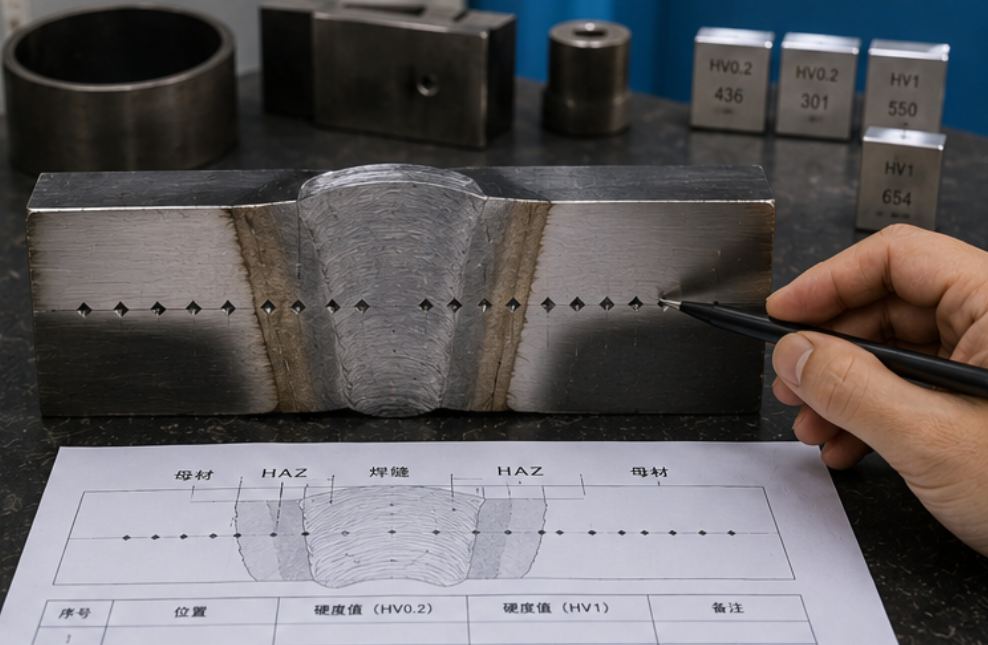
| Test Zone | Why It Matters | Recommended Check |
|---|---|---|
| Weld metal | Confirms deposited weld area meets required hardness | Vickers or Micro Vickers test points in weld center |
| Heat-affected zone | Identifies brittle or softened areas caused by welding heat | Multiple points along the HAZ on prepared cross-section |
| Base metal | Provides reference value outside welding influence | Compare with weld metal and HAZ values |
| Repair weld area | Checks whether repair welding created local hardness risk | Test original area, repair weld, and transition zone |
2. Choose The Correct Hardness Testing Method
Vickers hardness testing is widely used for welded part inspection because it can measure small areas and provide a clear comparison across the weld cross-section. Micro Vickers testing is useful when the zones are narrow, the material is thin, or the lab needs more detailed hardness distribution.
Rockwell testing can be used for some larger welded parts when the test surface is stable, flat, and large enough. Brinell testing may be suitable for large weldments or cast and forged structures when a more representative large indentation is required. However, for most weld zone comparison work, Vickers or Micro Vickers is usually more practical.
Before choosing the method, confirm:
Material type and expected hardness range.
Weld size, plate thickness, and joint geometry.
Whether the customer requires HV, Micro HV, HRC, HBW, or another scale.
Whether the test is performed on surface or cross-section.
How many test points are required across weld metal, HAZ, and base metal.
Whether indentation images and PDF reports are required for customer review.
3. Prepare The Weld Cross-Section Correctly
Weld hardness testing often requires cross-section preparation. The sample may need to be cut through the weld joint, mounted, ground, polished, cleaned, and inspected under a microscope. Poor sample preparation can hide the real HAZ boundary, damage the surface, or make Vickers indentation edges difficult to measure.
Cutting heat, grinding scratches, edge rounding, and poor polishing can all affect the final result. For Micro Vickers testing, surface quality is especially important because indentation diagonals are small and must be measured clearly.
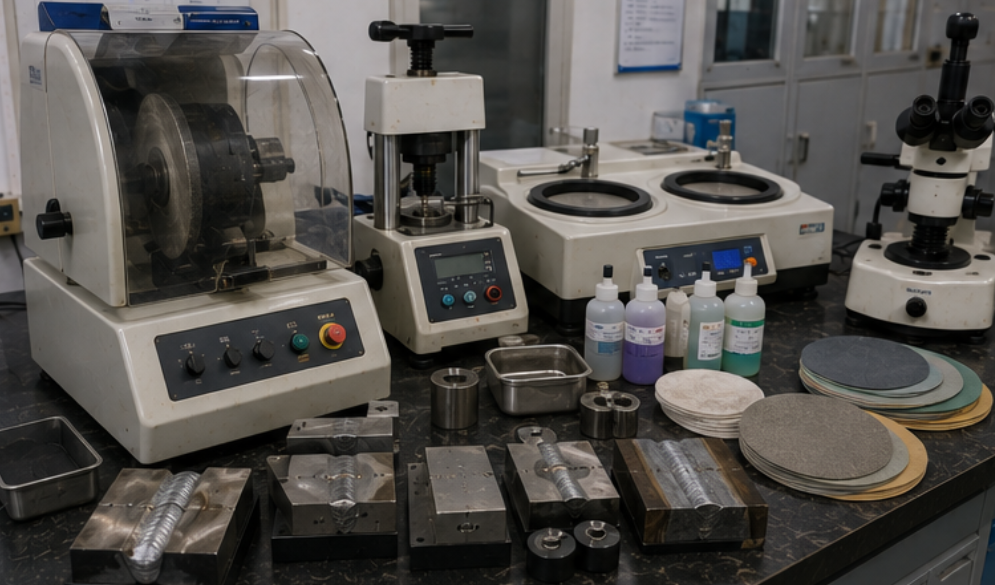
| Preparation Step | Purpose | Risk If Ignored |
|---|---|---|
| Metallographic cutting | Cuts through the weld joint without excessive damage | Heat damage may change local hardness |
| Mounting | Supports the weld cross-section and keeps it flat | Sample may tilt or edge may not be protected |
| Grinding and polishing | Creates a clear surface for indentation measurement | Scratches make Vickers diagonals hard to read |
| Microscope inspection | Identifies weld metal, HAZ, and base metal zones | Test points may be placed in the wrong zone |
4. Plan The Vickers Test Path Across The Weld
The test path should be planned before testing. For welded parts, the goal is often to compare hardness changes across weld metal, HAZ, and base metal. This may require a line of Vickers or Micro Vickers indentations across the cross-section, with consistent spacing and clear zone identification.
If the test points are too far apart, the lab may miss a narrow hard or soft zone. If they are too close, indentations may interfere with each other. The spacing should follow the customer standard, welding procedure qualification requirement, or internal QC specification.
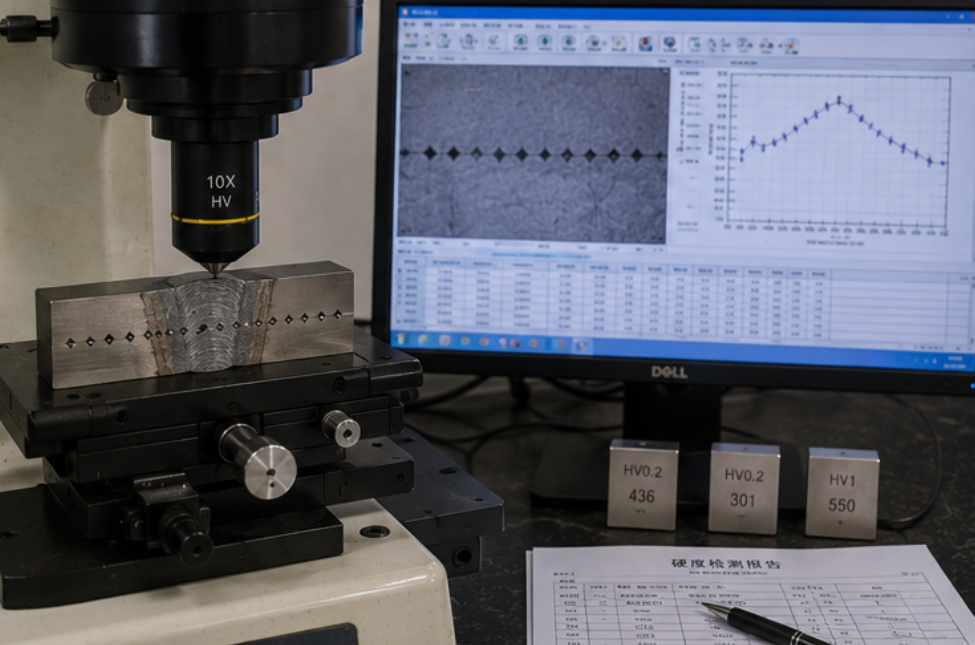
A good weld hardness test path should define:
Number of test points in weld metal, HAZ, and base metal.
Distance between each indentation.
Distance from weld surface or fusion line when required.
Test force and hardness scale.
Whether one or multiple rows are required.
How abnormal hard or soft points should be handled.
5. Verify Calibration Blocks And Indenter Condition
Before testing welded parts, QC labs should verify the hardness tester with suitable calibration blocks. The calibration block should match the method, scale, and hardness range used for the weld inspection. Vickers or Micro Vickers blocks should be selected according to the working range and test load.
Indenter condition is also important. A damaged Vickers diamond indenter can create irregular indentation shapes and unstable values. Calibration and indenter checks should be recorded before important delivery inspection, customer reports, or welding procedure qualification work.
| QC Item | Why It Matters | Recommended Practice |
|---|---|---|
| HV / Micro HV blocks | Verifies tester accuracy before weld testing | Use blocks close to the expected weld hardness range |
| Vickers indenter | Affects indentation geometry and final value | Inspect indentation shape and replace damaged indenters |
| Stage and sample holder | Controls test point positioning and repeatability | Use stable holder or XY stage for cross-section testing |
| Verification record | Supports customer review and audit traceability | Record block value, result, date, operator, and machine ID |
6. Prepare A Clear Delivery Inspection Report
A welded part hardness report should be easy for customers to understand. It should not only list hardness values, but also show where the values were measured. For cross-section testing, the report should identify weld metal, HAZ, and base metal. If the customer requires a hardness map or test path, the report should include the point layout.
Automatic Vickers or Micro Vickers software can help save indentation images, test point coordinates, hardness values, and exported reports. This improves traceability and reduces manual reporting errors.
A useful welded part hardness report should include:
Part name, material grade, drawing number, and batch number.
Welding process, welding position, and post-weld heat treatment condition if required.
Testing method, scale, test force, and standard.
Test point layout across weld metal, HAZ, and base metal.
Hardness values and acceptance range.
Calibration block record and machine ID.
Indentation images or microscope images if required.
PDF or Excel report export for delivery documentation.
Key Questions Before Choosing A Weld Hardness Testing Solution
Before requesting a quotation, QC labs and welded part suppliers should provide clear information about the welded part, material, welding process, test standard, and report needs. This helps recommend the right tester and sample preparation equipment.
What welded parts need testing: plates, pipes, pressure parts, frames, flanges, shafts, molds, or structural components?
What base material and weld filler material are used?
What welding process is used?
Is post-weld heat treatment performed?
Which hardness scale is required: HV, Micro HV, HRC, HBW, or another scale?
Do you need surface testing or cross-section testing?
How many test points are required in weld metal, HAZ, and base metal?
Do you already have cutting, mounting, grinding, polishing, and microscope equipment?
Do customers require test point layout, indentation images, or exported reports?
What daily testing volume and report frequency are expected?
Conclusion: Weld Hardness Testing Should Focus On Zones, Not One Random Value
Hardness testing for welded parts should check the real risk areas: weld metal, heat-affected zone, and base metal. A single value from a random location may not prove that the welded part is safe, stable, and ready for delivery.
A complete weld hardness testing solution may include Vickers or Micro Vickers hardness tester, metallographic cutting machine, mounting system, grinding and polishing machine, microscope, calibration blocks, sample holder, XY stage, and report software.
If your QC lab inspects welded parts before delivery, share your material, welding process, test standard, test point layout, and report requirements before ordering equipment. A complete recommendation can help reduce delivery risk and improve customer confidence.
FAQ
Which hardness method is commonly used for welded parts?
Vickers and Micro Vickers testing are commonly used because they can compare hardness across weld metal, heat-affected zone, and base metal on prepared cross-sections.
Why is HAZ hardness important?
The heat-affected zone may become too hard, brittle, softened, or uneven after welding, so it should be checked before delivery.
Do welded samples need polishing before hardness testing?
For Vickers or Micro Vickers cross-section testing, cutting, mounting, grinding, and polishing are usually required to obtain reliable indentation measurement.
What should be included in a welded part hardness report?
The report should include material, welding process, test method, scale, force, test point layout, hardness values, acceptance range, calibration record, and inspection date.
Need A Hardness Testing Solution For Welded Parts?
Share your welded part type, material, welding process, test standard, sample size, test point layout, and report requirements. We can help recommend suitable Vickers hardness testers, Micro Vickers testers, sample preparation equipment, calibration blocks, and complete QC lab solutions.