


What Information Is Needed Before Quoting A Hardness Testing Machine
What Information Is Needed Before Quoting A Hardness Testing Machine
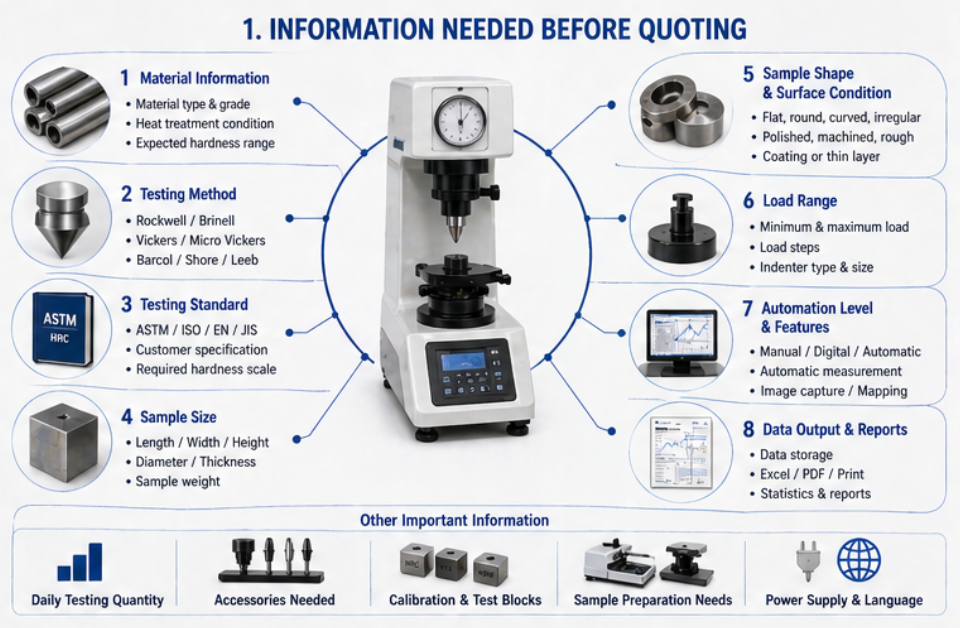
To recommend and quote the right hardness testing machine, suppliers need more than a simple request for price. Material type, hardness method, sample size, load range, testing standard, automation level, data requirements, and laboratory workflow all affect the final machine configuration. Preparing the right information before quotation helps buyers receive a more accurate, practical, and cost-effective proposal.
Material Detail
Material type, hardness range, surface condition, and sample thickness directly affect tester selection.
Testing Method
Rockwell, Brinell, Vickers, Micro Vickers, Barcol, or universal testing methods require different configurations.
Workflow Needs
Daily testing volume, automation level, report export, and sample preparation decide the real system value.
1. Why Quotation Information Matters
A hardness testing machine is not a one-size-fits-all product. Different materials, sample shapes, testing methods, standards, load ranges, and reporting needs require different machine configurations. If the supplier only receives a short message such as “Please quote a hardness tester,” the quotation may be too general, incomplete, or unsuitable for the real application.
For industrial buyers, providing complete technical information before quotation helps reduce communication time, avoid wrong model selection, and compare suppliers more effectively. It also helps the supplier recommend suitable accessories such as indenters, test blocks, fixtures, software, sample preparation equipment, and calibration tools.
A good quotation should not only include price. It should explain which hardness method is recommended, which load range is supported, what sample size can be tested, what accessories are included, whether data reports are available, and how the machine fits the buyer’s quality control workflow.
2. Material Type And Application
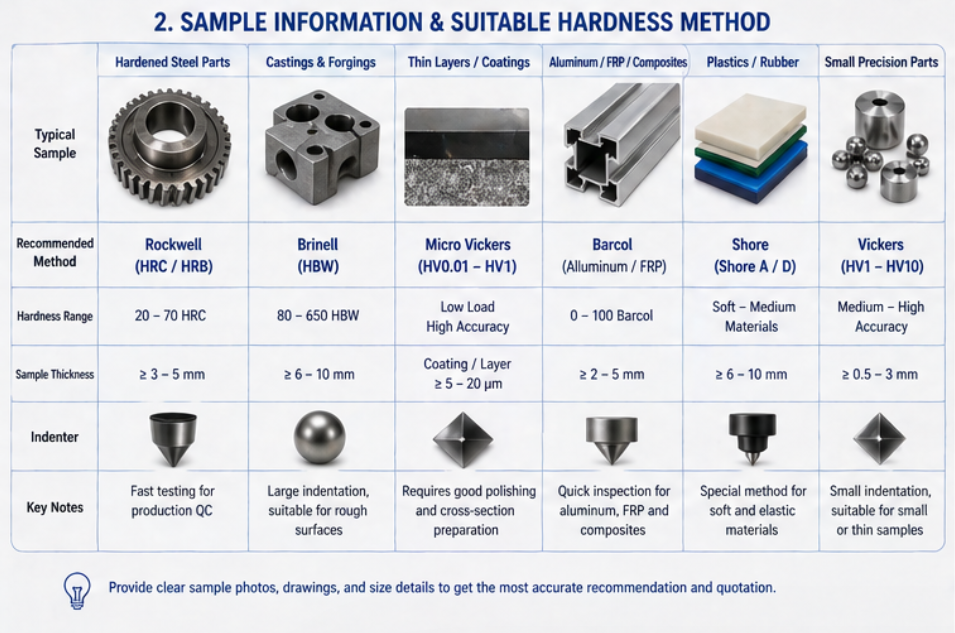
The first information needed is the material to be tested. Hardness testers are selected according to how the material responds to indentation. Hardened steel, aluminum alloy, copper alloy, cast iron, plastic, composite, coating, and thin surface layer may require different testing methods.
Buyers should also explain the application. For example, a heat treatment workshop may need fast Rockwell testing for production control. A laboratory testing coatings may need Micro Vickers testing. A foundry may need Brinell testing for castings. An aluminum profile factory may need a Barcol tester for quick inspection. Without knowing the application, it is difficult to recommend the correct machine.
| Material / Application | Common Testing Method | Quotation Information Needed |
|---|---|---|
| Hardened steel / heat-treated parts | Rockwell / Vickers | Hardness range, scale, sample size, testing volume |
| Castings and forgings | Brinell | Sample weight, thickness, force requirement, indentation measurement method |
| Thin layers and coatings | Micro Vickers | Layer thickness, load range, polishing requirement, automatic measurement need |
| Aluminum profiles / FRP / composites | Barcol | Expected hardness range, sample thickness, mechanical or digital model preference |
3. Required Hardness Testing Method Or Standard
If the buyer already knows the required testing method, this information should be provided clearly. Common methods include Rockwell, Brinell, Vickers, Micro Vickers, Barcol, Shore, Leeb, and universal hardness testing. Each method requires different indenters, loads, measurement principles, accessories, and sample preparation conditions.
If the buyer does not know which method is suitable, the supplier can recommend a method based on material, sample thickness, expected hardness, surface condition, and testing purpose. However, if a customer specification, industry standard, or internal QC procedure already requires a specific method, that method should be stated before quotation.
Testing standards are also important. Different markets and industries may require specific standards or scales. The supplier needs this information to confirm whether the machine configuration, calibration blocks, indenters, and software output can meet the buyer’s requirements.
Useful method information includes:
Required hardness method: Rockwell, Brinell, Vickers, Micro Vickers, Barcol, Shore, Leeb, or universal testing.
Required scale, such as HRC, HRB, HV, HBW, or Barcol value.
Required test standard or customer specification.
Expected hardness range of the material.
Whether results need to be converted between hardness scales.
Whether calibration documents or standard test blocks are required.
4. Sample Size, Shape, Thickness, And Weight
Sample dimensions are essential for quotation. A small polished sample, a mounted cross-section, a large casting, a plastic block, and a long aluminum profile cannot be handled by the same machine structure. The supplier needs to know sample size and weight to confirm test height, throat depth, stage size, fixture requirements, and whether a bench-type, floor-standing, portable, or customized tester is needed.
Thickness is especially important because hardness testing creates an indentation. If the sample is too thin, the indentation may be affected by the back side, support surface, or substrate. For coatings and surface layers, the load must be selected carefully so the indentation measures the target layer rather than the base material.
| Sample Information | Why It Matters | Example To Provide |
|---|---|---|
| Sample size | Affects stage size and test space | Length × width × height or diameter |
| Sample thickness | Determines suitable load and method | 2 mm sheet, 10 mm coating cross-section, 50 mm block |
| Sample shape | May require special fixtures or support | Flat, round, curved, irregular, mounted, or large component |
| Sample weight | Important for large castings and forgings | Small lab sample, 20 kg part, oversized casting |
5. Load Range, Indenter, And Accessories
Load range is one of the key specifications in hardness testing. The supplier needs to know the expected hardness range, material thickness, and required testing method to recommend the correct load configuration. For Micro Vickers testing, low-load precision is important. For Brinell testing, higher force capacity and ball indenter size are important. For Rockwell testing, the correct scale and major load must be supported.
Accessories also affect the quotation. A basic machine may not include every indenter, test block, fixture, objective lens, camera, printer, or software module. Buyers should clarify whether they need standard accessories only or a complete testing package.
| Configuration Item | Common Options | Why It Affects Price |
|---|---|---|
| Load range | Micro-load, standard load, high-force load | Different force systems and accuracy requirements |
| Indenter | Diamond cone, Vickers diamond, Brinell ball, Barcol indenter | Different methods require different indenters and spares |
| Test blocks | Rockwell, Vickers, Brinell, Barcol calibration blocks | Needed for verification and QC confidence |
| Fixtures | Flat stage, V anvil, small-part fixture, large sample support | Sample shape may require special positioning |
6. Manual, Digital, Automatic, Or Full Laboratory Solution?
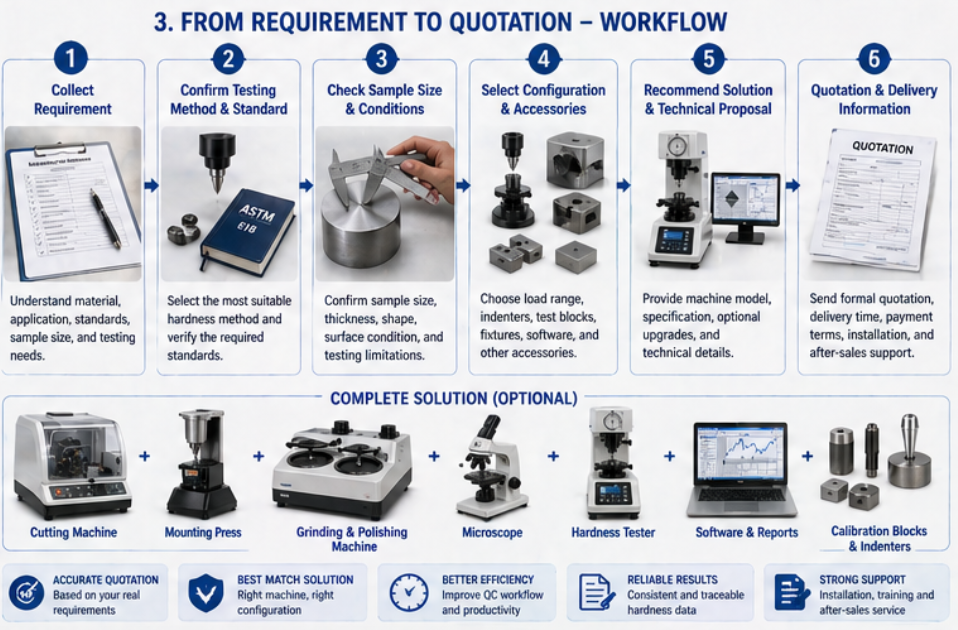
The automation level has a major impact on quotation. A manual hardness tester is usually suitable for basic inspection and lower testing volume. A digital tester improves readability and operation convenience. An automatic vision hardness tester can reduce manual measurement error, improve repeatability, and support report export. A complete laboratory solution may include sample preparation equipment, hardness tester, microscope, software, and calibration tools.
Buyers should explain how many samples are tested per day, how many operators use the machine, whether reports are required, and whether test images need to be saved. These details help the supplier decide whether a simple machine is enough or whether automatic measurement and data management are necessary.
Automation information to provide:
Daily sample quantity and test point quantity.
Whether different operators will use the machine.
Whether automatic measurement is required.
Whether software, data storage, image capture, or report export is needed.
Whether hardness mapping, case depth analysis, or batch statistics are required.
Whether the buyer needs a standalone tester or a complete QC lab solution.
7. Sample Preparation Requirement
Some hardness tests require careful sample preparation. Vickers and Micro Vickers testing usually need a clean, flat, polished surface. Coating cross-sections, weld sections, and case depth analysis may require cutting, mounting, grinding, and polishing equipment. Rockwell and Brinell testing may be faster, but the sample still needs proper support and a clean representative test area.
If the buyer does not already have sample preparation equipment, this should be mentioned before quotation. In many cases, a complete solution including metallographic cutting machine, mounting press, grinding and polishing machine, hardness tester, and software is more practical than buying a hardness tester alone.
8. Data Output, Reports, And Quality Documentation
Many industrial buyers need more than a hardness value. They may need test images, sample IDs, operator records, statistics, Excel export, PDF reports, printer output, or customer documentation. These requirements affect software selection and quotation.
For production QC, digital record keeping can reduce manual errors and improve traceability. For laboratories serving customers, formal reports and saved indentation images can improve credibility. For factories with repeated batch testing, statistics and data export can help compare production quality over time.
Report requirements may include:
Hardness value display and automatic calculation.
Image capture for Vickers, Micro Vickers, or Brinell indentation.
Sample ID and batch number management.
Average, maximum, minimum, and standard deviation statistics.
Excel, PDF, image, or printer output.
Customer report format or internal QC document format.
9. A Practical Quotation Checklist For Buyers
To receive a more accurate quotation, buyers can prepare the following information before contacting the supplier. Even if some details are uncertain, providing as much information as possible will help the supplier recommend a suitable model faster.
Material type and material grade.
Testing purpose: production QC, incoming inspection, laboratory analysis, heat treatment check, coating test, or customer report.
Required hardness method: Rockwell, Brinell, Vickers, Micro Vickers, Barcol, Shore, Leeb, or universal testing.
Required hardness scale and testing standard.
Expected hardness range.
Sample size, thickness, shape, and weight.
Surface condition: polished, machined, rough, coated, curved, mounted, or irregular.
Daily sample quantity and test point quantity.
Manual, digital, automatic, or automatic vision measurement preference.
Need for data storage, report export, printer, image capture, or software analysis.
Required accessories: indenters, test blocks, fixtures, objective lenses, camera, software, or sample stage.
Need for metallographic cutting, mounting, grinding, and polishing equipment.
Destination country, voltage, language, packaging, delivery time, and after-sales support requirement.
Conclusion: Better Information Leads To A Better Quotation
A good hardness testing machine quotation should be based on the buyer’s real material, sample condition, testing method, workflow, and documentation needs. Without this information, the quotation may be too vague or the recommended machine may not fit the application.
Before requesting a quote, buyers should prepare details about material type, hardness range, sample size, test standard, load range, automation level, accessories, and report requirements. If sample preparation is needed, that should also be included in the discussion.
With clear technical information, suppliers can recommend a more suitable machine configuration, reduce unnecessary cost, and help the buyer build a more reliable quality control process.
FAQ
Can I get a quotation without knowing the hardness testing method?
Yes, but you should provide material type, sample size, expected hardness, surface condition, and testing purpose. The supplier can then recommend a suitable method.
Why does sample size affect hardness tester quotation?
Sample size affects test height, throat depth, stage size, fixture requirements, and whether a bench-type, floor-standing, or portable tester is suitable.
Do accessories need to be quoted separately?
It depends on the machine package. Buyers should confirm whether indenters, test blocks, fixtures, software, printer, camera, and spare parts are included.
When is a complete laboratory solution needed?
A complete solution is useful when the buyer also needs sample cutting, mounting, grinding, polishing, microscope observation, hardness testing, and report output in one workflow.
Request A Hardness Testing Machine Quote
Share your material type, sample size, hardness method, testing standard, load range, automation requirement, and report needs. We can help recommend a suitable hardness testing machine or complete laboratory solution for your quality control process.