


What Buyers Should Check Before Ordering A Barcol Hardness Tester
What Buyers Should Check Before Ordering A Barcol Hardness Tester
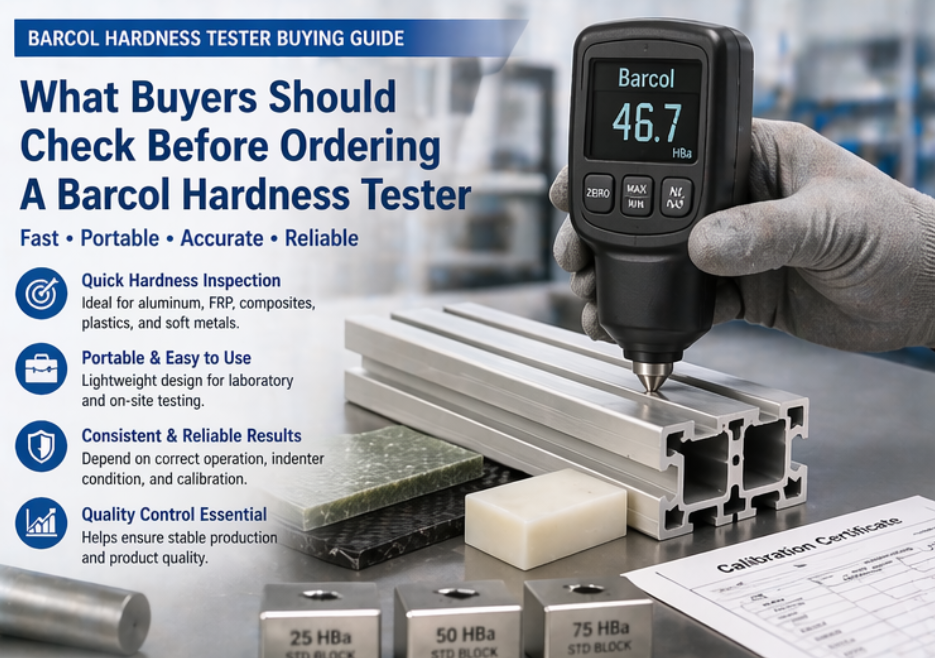
A Barcol hardness tester is commonly used for fast hardness inspection of aluminum, aluminum alloys, fiberglass reinforced plastics, composites, plastics, rubber-like materials, and soft metals. Before ordering, buyers should check the testing material, hardness range, indenter condition, calibration method, sample thickness, digital function, and whether the tester is suitable for laboratory or on-site quality control.
Fast Portable Testing
Barcol testers are compact and practical for quick inspection in workshops, warehouses, laboratories, and production lines.
Material Compatibility
Commonly used for aluminum, FRP, composites, plastics, soft metals, and semi-rigid material hardness comparison.
Calibration Matters
Reliable results depend on proper calibration blocks, indenter condition, sample support, and consistent operation.
A Barcol hardness tester is a portable indentation hardness tester used to evaluate the hardness of relatively soft materials. It is widely used in aluminum profile inspection, aluminum alloy processing, fiberglass reinforced plastic products, composite materials, plastics, rubber-like materials, and other non-ferrous or semi-rigid materials. Compared with large bench-type hardness testing machines, a Barcol tester is easier to carry and more convenient for fast production inspection. In industrial quality control, Barcol testing is often used as a quick comparative method. For example, aluminum extrusion factories may use it to check aging or heat treatment consistency. FRP product manufacturers may use it to evaluate curing quality. Composite material producers may use it to compare surface hardness across batches. It is not always intended to replace full laboratory hardness testing, but it is very practical for routine inspection and process control. Before ordering a Barcol hardness tester, buyers should first confirm whether Barcol testing is suitable for the material and standard they need. The right tester should match the material hardness range, sample thickness, testing environment, calibration requirement, and daily inspection workflow. The most important question is: what material will be tested? A Barcol hardness tester is commonly used for aluminum, aluminum alloys, soft metals, plastics, fiberglass reinforced plastics, and composite materials. However, different materials may require different expectations for hardness range, surface preparation, sample thickness, and testing method. For aluminum and aluminum alloys, Barcol testing is often used to check whether the material hardness is consistent after heat treatment, aging, or extrusion. For FRP and composite materials, it is often used to evaluate curing degree and surface hardness. For plastics, the result may be affected by material formulation, temperature, thickness, and surface flatness.1. Understand What A Barcol Hardness Tester Is Used For
2. Confirm The Material Type Before Choosing A Model
Material Type Common Testing Purpose Buyer Checkpoint Aluminum profiles Check aging, heat treatment, and batch consistency Confirm hardness range and sample surface condition Aluminum castings Fast hardness comparison for non-ferrous parts Check sample thickness and test position stability FRP and composites Evaluate curing quality and surface hardness Check material thickness, surface flatness, and repeatability Plastics and soft materials Compare hardness across production batches Confirm material suitability and testing standard
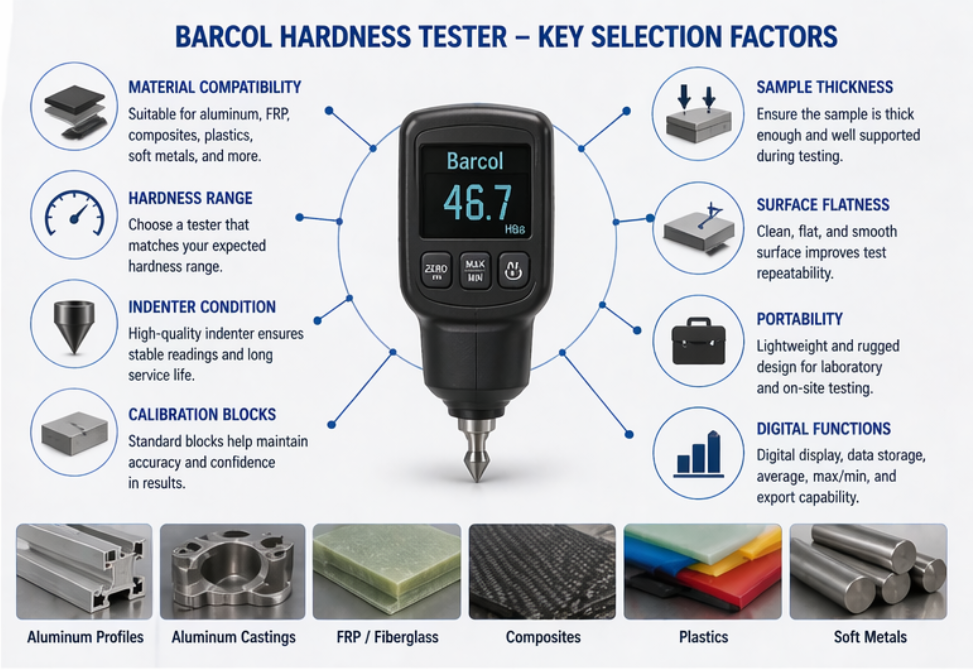
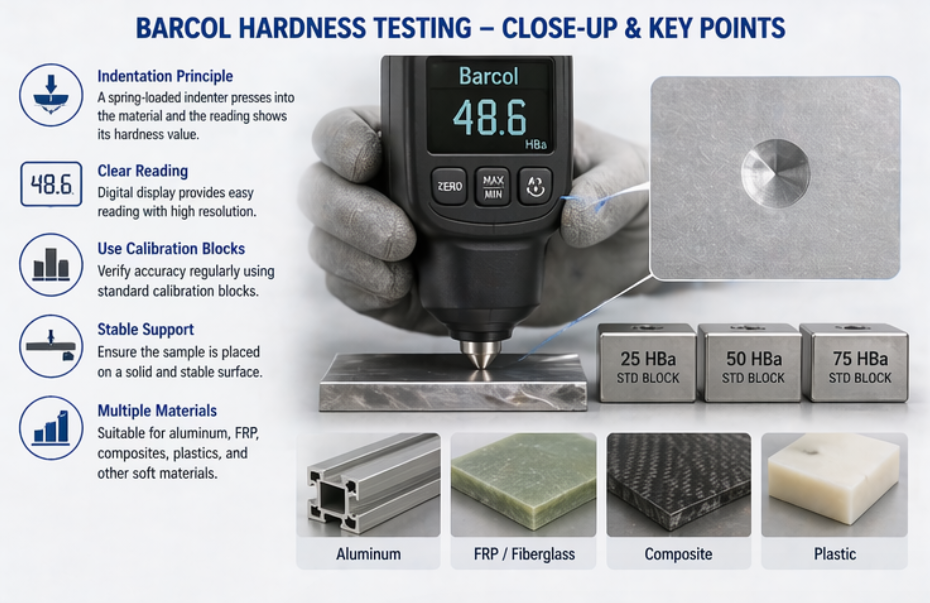
Barcol hardness testers are designed for a specific measurement range. Before ordering, buyers should compare the expected material hardness with the instrument range. If the material is too soft or too hard for the tester, the reading may be unstable, inaccurate, or outside the useful range. Measurement resolution is also important. For production inspection, a stable reading is often more useful than a visually impressive display. Buyers should check whether the tester provides consistent results on standard test blocks and whether the reading scale is suitable for the material. A digital Barcol hardness tester may provide easier reading, data storage, and statistical functions, while a mechanical type may be simple and economical for basic inspection. If the tester will be used for customer quality reports, incoming inspection, or batch comparison, buyers should consider a digital model with repeatable readings, calibration support, and clear data output. The indenter is a critical part of a Barcol hardness tester. A worn, damaged, contaminated, or incorrect indenter can directly affect test results. When comparing models, buyers should ask whether the indenter is replaceable, whether spare indenters are available, and what maintenance is required. Calibration blocks are equally important. A Barcol tester should be checked regularly with standard blocks to confirm that the reading remains within the expected range. If calibration is ignored, the tester may continue to display numbers, but those numbers may no longer represent accurate hardness values. Barcol testing may look simple, but sample condition still has a strong influence on the result. The test surface should be clean, stable, and flat enough for consistent contact. If the sample is too thin, flexible, curved, soft, or poorly supported, the reading may be affected by sample bending or uneven contact. For aluminum profiles, the test position should be selected carefully so the surface is representative and thick enough. For FRP or composite panels, the sample should be supported firmly to avoid flexing during indentation. For plastics, temperature and material recovery may also affect repeatability. Buyers should not only ask whether the tester can measure the material, but also whether their real sample shape and thickness are suitable for Barcol testing. Thick enough to support the indentation. Stable and not easily bent during testing. Clean and free from dirt, oil, coating defects, or loose particles. Flat enough for consistent contact with the tester. Representative of the actual product or production batch.3. Check Hardness Range And Measurement Resolution
4. Pay Attention To The Indenter And Calibration Blocks
Item To Check Why It Matters Recommended Question Indenter condition Affects indentation depth and reading stability Is the indenter replaceable and available as a spare part? Calibration blocks Help verify tester accuracy before use Are standard blocks included with the tester? Zero adjustment Ensures correct starting condition How is the tester adjusted before measurement? Calibration interval Maintains long-term reliability What calibration or verification process is recommended? 5. Check Sample Thickness, Surface Flatness, And Support
A suitable sample should be:
Barcol hardness testers are available in mechanical and digital types. A mechanical Barcol tester is simple, portable, and cost-effective. It is suitable for basic on-site inspection and quick hardness comparison. A digital Barcol hardness tester is easier to read and may support data storage, averaging, statistics, and report output depending on the model. For small workshops or occasional testing, a mechanical type may be enough. For laboratories, aluminum profile factories, composite product manufacturers, and quality departments that need batch records, a digital tester may provide better long-term value. One important advantage of a Barcol hardness tester is portability. Many users need to test large aluminum profiles, composite panels, tanks, pipes, molded FRP products, or finished components that cannot be easily moved to a laboratory. In these cases, a handheld Barcol tester can provide fast inspection directly at the production site or warehouse. For on-site testing, buyers should check the tester weight, grip comfort, reading method, battery life for digital models, protective case, calibration blocks, and whether the instrument can be used reliably by different operators. If the tester will be used outdoors or in a workshop environment, durability and protection are also important. Portability should not mean sacrificing accuracy. The tester should still be verified regularly and used on properly supported sample surfaces. Before requesting a Barcol hardness tester quotation, buyers should prepare clear application information. This helps confirm whether the selected model is suitable and whether accessories or digital functions are needed. What material will be tested: aluminum, FRP, composite, plastic, or soft metal? What is the expected hardness range? Is the sample flat, curved, thin, flexible, or irregular? What is the sample thickness? Will the tester be used in a laboratory, workshop, warehouse, or production line? Do you need mechanical reading or digital display? Do you need data storage, averaging, statistics, or report output? Are calibration blocks included? Is the indenter replaceable? Do you need spare indenters, carrying case, or operation training?6. Mechanical Or Digital Barcol Hardness Tester?
Tester Type Best For Main Advantage Buyer Consideration Mechanical Barcol Tester Basic inspection and quick field testing Simple, portable, economical Requires careful reading and regular checking Digital Barcol Tester Batch QC and documented inspection Clear display, data functions, easier operation Check battery life, data output, and calibration support 7. Consider On-Site Testing And Portability
8. Key Questions Before Requesting A Quote
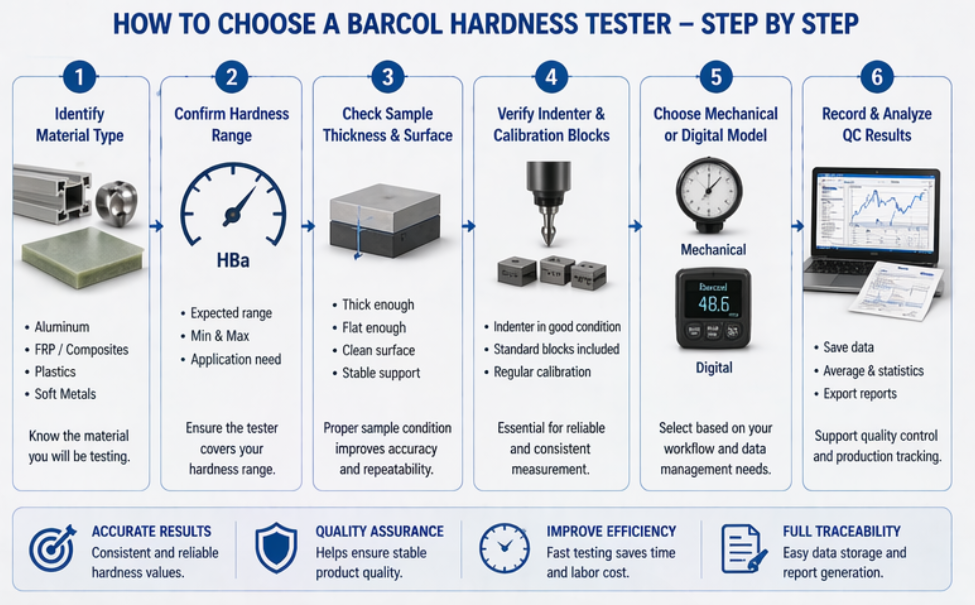
Ordering a Barcol hardness tester is not only about selecting a portable hardness instrument. Buyers should confirm whether the tester matches the material type, hardness range, sample thickness, surface condition, calibration requirement, and inspection workflow. For aluminum profiles and soft metals, Barcol testing can support fast production hardness comparison. For FRP and composite materials, it can help evaluate curing and surface hardness consistency. For plastics and semi-rigid materials, buyers should pay special attention to sample support, material behavior, and testing standard. A suitable Barcol hardness tester should be easy to use, reliable to verify, compatible with the sample, and supported with proper calibration blocks, spare indenters, and technical guidance. Providing clear sample information before ordering will help avoid mismatch and make the quotation more accurate. It is commonly used for aluminum, aluminum alloys, FRP, composites, plastics, soft metals, and other relatively soft or semi-rigid materials. Yes. It is often used for quick hardness inspection of aluminum profiles, especially for checking aging, heat treatment, and production consistency. A mechanical model is suitable for simple field checks. A digital model is better when clear readings, data storage, averaging, and quality records are required. Calibration blocks help verify that the tester is reading correctly. Regular checking improves confidence in hardness comparison and quality control results.Conclusion: Choose A Barcol Tester Based On Material, Range, And Real Use Conditions
FAQ
What materials can a Barcol hardness tester measure?
Is a Barcol tester suitable for aluminum profiles?
Should I choose a mechanical or digital Barcol tester?
Why are calibration blocks important?
Need Help Choosing A Barcol Hardness Tester?
Share your material type, sample thickness, expected hardness range, testing environment, and data recording needs. We can help recommend a suitable Barcol hardness testing solution for aluminum, FRP, composites, plastics, and soft metal inspection.