


Manual vs Digital vs Automatic Hardness Testers: Which One Should Buyers Choose
Manual vs Digital vs Automatic Hardness Testers: Which One Should Buyers Choose?
Manual, digital, and automatic hardness testers can all be used for industrial quality control, but they are designed for different testing volumes, accuracy requirements, operator skill levels, and reporting needs. Buyers should compare not only the machine price, but also repeatability, testing efficiency, data traceability, sample type, and long-term laboratory workflow.
Manual Tester
Suitable for basic testing, lower budgets, occasional inspection, and laboratories with experienced operators.
Digital Tester
A practical choice for routine QC, clear result display, easier operation, and better data handling.
Automatic Tester
Best for higher testing volume, repeatability, automatic measurement, batch inspection, and traceable reports.
1. Why The Automation Level Matters
When buying a hardness tester, many buyers first ask about the testing method, such as Rockwell, Brinell, Vickers, Micro Vickers, Barcol, Shore, or Leeb. This is important, but it is not the only decision. The automation level of the machine also affects accuracy, efficiency, operator workload, data recording, and long-term quality control reliability.
A manual hardness tester may be enough for occasional testing or a small workshop. A digital hardness tester is often better for routine production inspection because it provides clearer readings and easier operation. An automatic hardness tester can improve repeatability and efficiency when the laboratory needs to test many samples, measure small indentations, store images, generate reports, or reduce operator differences.
The best choice is not always the most expensive machine. The right choice depends on your material, hardness method, daily testing volume, sample preparation process, operator skill level, and documentation requirements.
2. Quick Comparison: Manual, Digital, And Automatic Hardness Testers
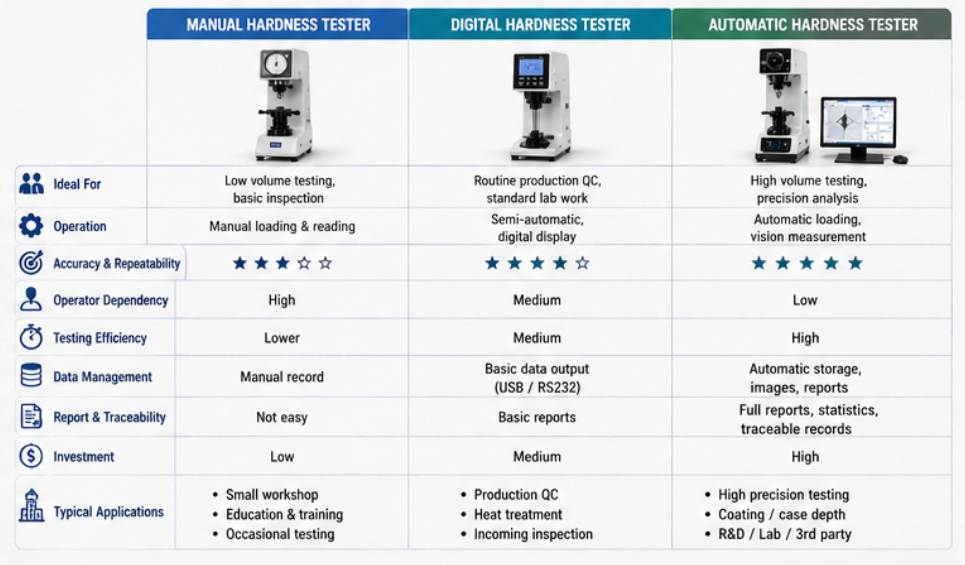
The easiest way to compare the three options is to look at their real use cases. Manual models focus on basic function and lower cost. Digital models improve usability and reading convenience. Automatic models are designed for higher consistency, faster workflow, and stronger data traceability.
| Tester Type | Best For | Main Advantage | Main Limitation |
|---|---|---|---|
| Manual Hardness Tester | Low-volume testing and basic QC | Lower purchase cost | More dependent on operator skill |
| Digital Hardness Tester | Routine production inspection | Clear display and easier operation | Automation functions may still be limited |
| Automatic Hardness Tester | High-volume QC and laboratory reporting | Better repeatability, efficiency, and traceability | Higher initial investment |
3. When Should Buyers Choose A Manual Hardness Tester?
A manual hardness tester is usually suitable for basic testing needs, limited budgets, and lower daily sample volumes. It can be used in small workshops, educational laboratories, maintenance departments, and quality control rooms where testing frequency is not very high.
Manual models are often selected because they are simple, durable, and cost-effective. However, the result may depend more on the operator’s experience. For Vickers or Brinell testing, manual indentation measurement may create differences between operators. For Rockwell testing, manual operation still requires proper loading, sample positioning, and reading discipline.
Buyers should choose a manual tester only when the testing workload is low, the operator is trained, and formal data traceability is not the main requirement.
Manual hardness testers are suitable when:
The budget is limited.
Testing volume is low or occasional.
The operator has enough experience.
Simple pass/fail inspection is enough.
Data export and formal reports are not required.
4. When Should Buyers Choose A Digital Hardness Tester?
A digital hardness tester is often the most practical choice for many industrial buyers. It keeps the machine relatively easy to use while improving reading clarity, calculation convenience, and operation consistency. For routine production inspection, digital models can reduce manual reading errors and help operators work faster.
Digital Rockwell hardness testers are widely used in heat treatment workshops, metal processing plants, and production QC labs. Digital Brinell testers may include image-assisted indentation measurement. Digital Vickers or Micro Vickers testers may provide screen display, software calculation, and easier report generation compared with manual optical reading.
Buyers should consider a digital tester when the machine will be used frequently, when multiple operators need consistent operation, or when basic data output is required.
Digital hardness testers are suitable when:
The lab needs routine daily inspection.
Operators need clearer readings and easier setup.
Basic data storage or output is useful.
The buyer wants better consistency than manual reading.
The application does not require full automation or mapping.
5. When Should Buyers Choose An Automatic Hardness Tester?
An automatic hardness tester is recommended when repeatability, efficiency, and traceability are important. Automatic systems can reduce manual operation, standardize testing procedures, and improve result consistency across different operators and shifts.
For Vickers and Micro Vickers testing, automatic vision measurement is especially useful because the result depends on accurate indentation diagonal measurement. For Brinell testing, automatic image measurement can improve indentation diameter reading. For high-volume production QC, automatic loading, test pattern setting, software recording, and report export can save time and reduce human error.
Automatic hardness testers are commonly used in automotive parts inspection, heat treatment quality control, coating analysis, case depth testing, tool steel inspection, research laboratories, and third-party testing centers.
Automatic hardness testers are suitable when:
Testing volume is high.
Multiple test points are required.
Indentation measurement needs high consistency.
Batch data, images, and reports must be stored.
The lab needs hardness mapping or case depth analysis.
Results must be traceable for customers or audits.
6. Which Option Fits Different Testing Methods?
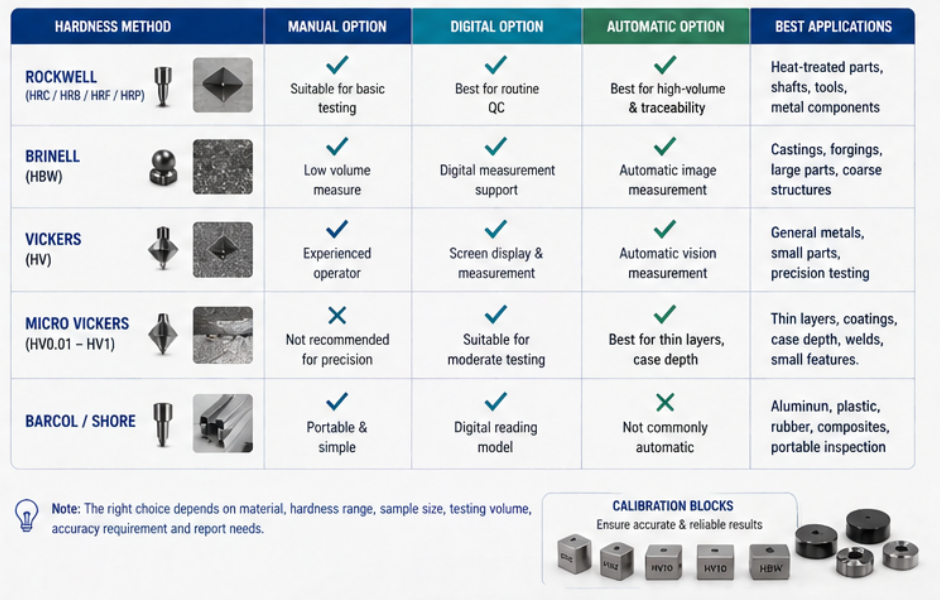
The best automation level also depends on the hardness testing method. Rockwell testing is already fast and direct-reading, so a digital model may be enough for many factories. Vickers and Micro Vickers testing benefit more from automatic vision measurement because the indentation must be measured optically. Brinell testing benefits from digital or automatic image measurement when large indentation diameter reading must be consistent.
| Testing Method | Manual Option | Digital Option | Automatic Option |
|---|---|---|---|
| Rockwell | Basic testing | Routine production QC | High-volume inspection and data records |
| Brinell | Low-volume optical reading | Better diameter measurement support | Image recognition and report output |
| Vickers | Experienced operator needed | Software-assisted measurement | Automatic diagonal measurement and image storage |
| Micro Vickers | Not ideal for high precision workload | Suitable for moderate lab testing | Best for thin layers, mapping, and case depth analysis |
7. Do Not Compare Price Alone
A manual tester may have the lowest purchase price, but it may require more operator time and create more variation. A digital tester may cost more, but it can improve daily operation and reduce reading mistakes. An automatic tester has a higher initial investment, but it may save labor, improve repeatability, and support customer-ready reports.
Buyers should compare total value instead of only machine price. If a laboratory tests many samples every day, the cost of slow operation, repeated tests, manual record errors, and inconsistent results can be higher than the difference between a manual and automatic system.
The right question is not “Which machine is cheapest?” but “Which machine fits our testing workload, accuracy requirement, and reporting process?”
8. Key Questions Before Requesting A Quote
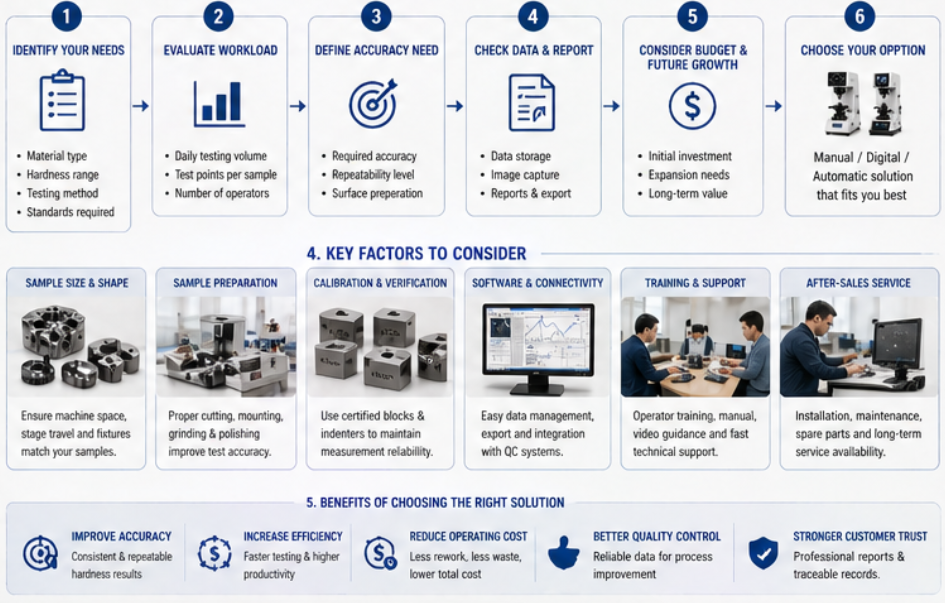
Before selecting manual, digital, or automatic hardness testing equipment, buyers should prepare clear testing information. This helps the supplier recommend a practical configuration instead of simply quoting the lowest or most advanced model.
What material will be tested?
Which hardness method is required: Rockwell, Brinell, Vickers, Micro Vickers, Barcol, Shore, or Leeb?
What is the expected hardness range?
What are the sample size, thickness, shape, and weight?
How many samples and test points will be tested per day?
Will different operators use the machine?
Do you need image capture or automatic indentation measurement?
Do you need software, data storage, statistics, or report export?
Do you need sample preparation equipment before testing?
What is your target budget and expected future testing demand?
Conclusion: Choose Based On Workload, Accuracy, And Traceability
Manual, digital, and automatic hardness testers all have suitable applications. Manual models are cost-effective for basic and low-volume testing. Digital models are practical for routine industrial quality control. Automatic models are better for high-volume testing, automatic indentation measurement, repeatability, data management, and formal reporting.
Buyers should choose the automation level according to real testing needs, not only purchase budget. If the lab only performs occasional testing, a manual or digital model may be enough. If the lab needs to test many samples, reduce operator variation, or provide traceable reports, an automatic hardness tester may provide stronger long-term value.
Before ordering, prepare your material type, testing method, sample size, daily workload, reporting needs, and future expansion plan. This allows the supplier to recommend a hardness testing solution that fits both current QC tasks and long-term laboratory development.
FAQ
Is a manual hardness tester still worth buying?
Yes. A manual tester can be suitable for basic testing, low-volume inspection, education, maintenance, or buyers with limited budget and trained operators.
Why choose a digital hardness tester?
A digital tester provides clearer readings, easier operation, better consistency, and may support basic data output, making it practical for routine production QC.
When is an automatic hardness tester necessary?
It is recommended for high testing volume, automatic indentation measurement, hardness mapping, case depth analysis, batch inspection, and traceable quality reports.
Which type is best for a new QC laboratory?
For a new QC lab, the best choice depends on materials, standards, workload, sample preparation needs, and reporting requirements. Many labs choose digital or automatic systems for better long-term efficiency.
Need Help Choosing Manual, Digital, Or Automatic Hardness Testers?
Share your material type, testing method, sample size, daily testing volume, automation preference, and report requirements. We can help recommend a suitable hardness testing solution for your quality control laboratory.