


Hardness Testing For Tool Steel And Mold Components What Buyers Should Prepare
Hardness Testing For Tool Steel And Mold Components: What Buyers Should Prepare
Tool steel and mold components require reliable hardness testing before machining, heat treatment approval, surface treatment, final assembly, and delivery. Buyers should prepare material grade, heat treatment condition, expected hardness range, test location, sample size, testing method, calibration requirements, and report needs before requesting a hardness testing solution.
Tool Steel Grade
Different tool steels require different hardness ranges and heat treatment verification methods.
Heat Treatment Check
Quenching, tempering, nitriding, and coating processes should be verified before final use.
Correct Test Location
Core area, working surface, cavity edge, insert, and treated layer may need different checks.
Traceable Reports
Reports should include hardness value, method, scale, test position, calibration, and batch records.
Why Tool Steel And Mold Components Need Careful Hardness Testing
Tool steel and mold components are used in high-load, high-wear, high-temperature, and precision manufacturing environments. Injection molds, die-casting molds, stamping dies, cutting tools, mold inserts, punches, guide parts, cavities, cores, and sliders must maintain the right hardness to resist wear, deformation, cracking, and premature failure.
If the hardness is too low, the mold surface may wear quickly, edges may collapse, and dimensional accuracy may become unstable. If the hardness is too high, the component may become brittle, crack during operation, or fail after repeated thermal cycling. For this reason, hardness testing should be part of incoming material inspection, heat treatment approval, process control, and final delivery inspection.
Buyers should not only ask for a hardness tester by model name. They should prepare tool steel grade, mold component type, required hardness range, heat treatment process, test position, sample size, and report requirements. These details help the supplier recommend the correct Rockwell, Vickers, Micro Vickers, or complete hardness testing solution.
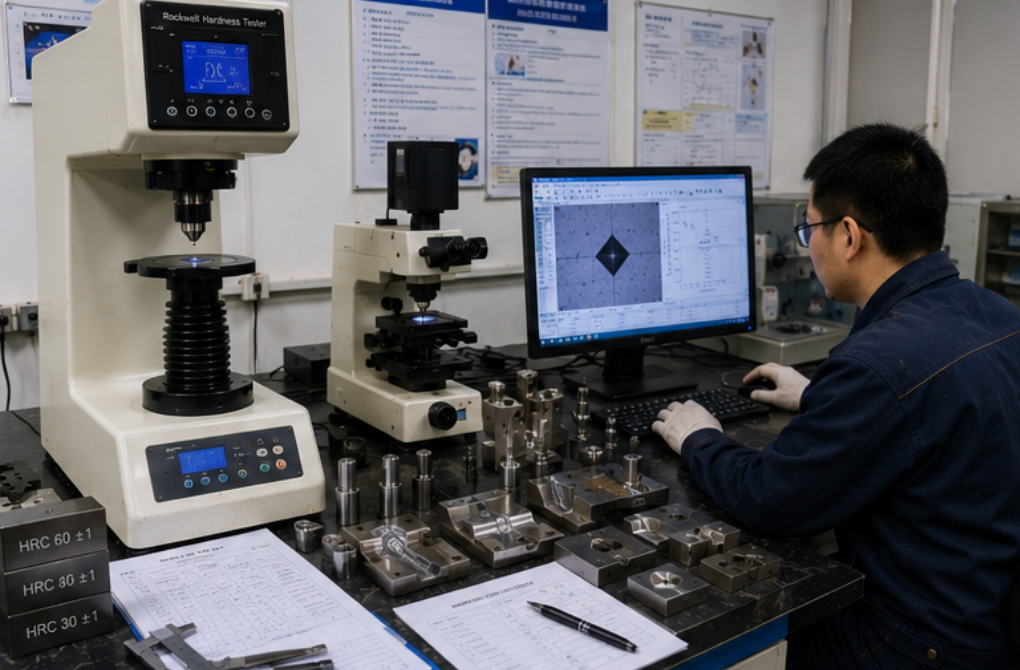
1. Prepare Tool Steel Grade And Heat Treatment Condition
The first information buyers should prepare is the material grade and heat treatment condition. Pre-hardened mold steel, cold work tool steel, hot work tool steel, high-speed steel, plastic mold steel, and die steel may have very different hardness requirements. A hardness tester should match the expected hardness range and the required testing scale.
Heat treatment condition is equally important. A mold insert after quenching and tempering may need HRC verification. A nitrided mold surface may require Micro Vickers testing. A coated or polished mold surface may need careful test location control to avoid damaging a functional area.
| Information To Prepare | Why It Matters | Example |
|---|---|---|
| Tool steel grade | Determines expected hardness and suitable method | D2, H13, P20, S7, M2, SKD11, SKD61, 1.2344 |
| Heat treatment condition | Affects surface hardness, core hardness, and brittleness risk | Pre-hardened, annealed, quenched, tempered, nitrided |
| Mold component type | Defines test location and support requirement | Insert, punch, cavity, core, slider, guide pin, die block |
| Expected hardness range | Helps select calibration blocks and testing scale | HRC 28–34, HRC 48–52, HRC 58–62, HV layer profile |
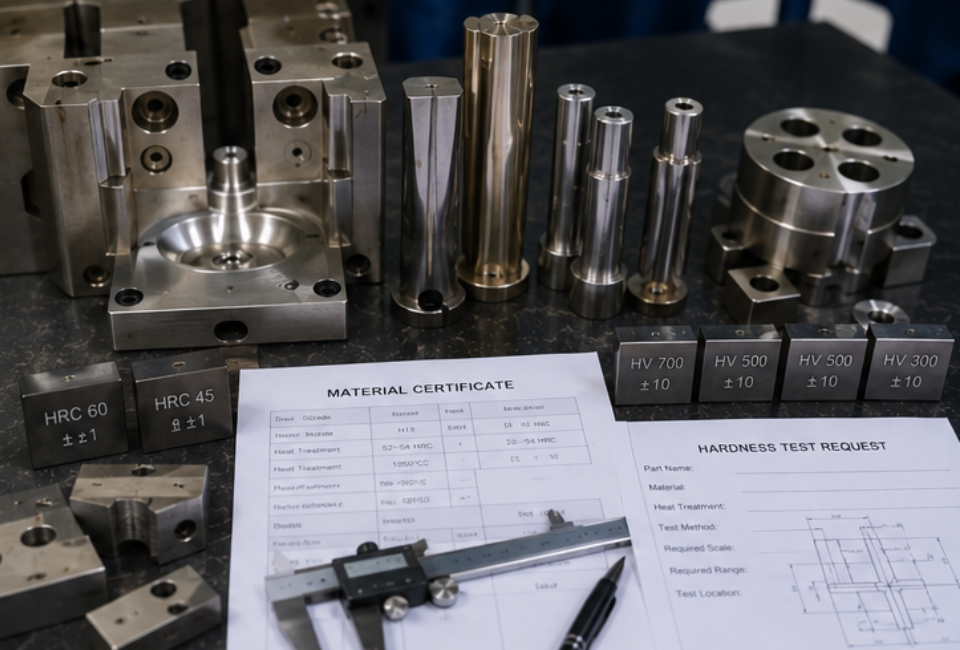
2. Confirm Surface Hardness, Core Hardness Or Layer Hardness Needs
Tool steel and mold components may require different types of hardness checks. Some buyers only need surface hardness to confirm heat treatment approval. Some need core hardness to confirm internal toughness. Some need Micro Vickers testing to check nitrided layers, coatings, welded repair areas, or surface-treated zones.
For mold components, test location can be sensitive. Testing on a functional cavity surface may not be acceptable if the indentation damages the mold. In such cases, buyers should define whether testing is done on a test coupon, non-critical area, cross-section, or spare sample from the same heat treatment batch.
Buyers should clarify whether they need:
Surface hardness after quenching and tempering.
Core hardness for thicker mold blocks or die components.
Nitrided layer hardness and layer depth.
Coating or surface treatment hardness.
Hardness comparison after weld repair or EDM process.
Final delivery hardness report for customer approval.
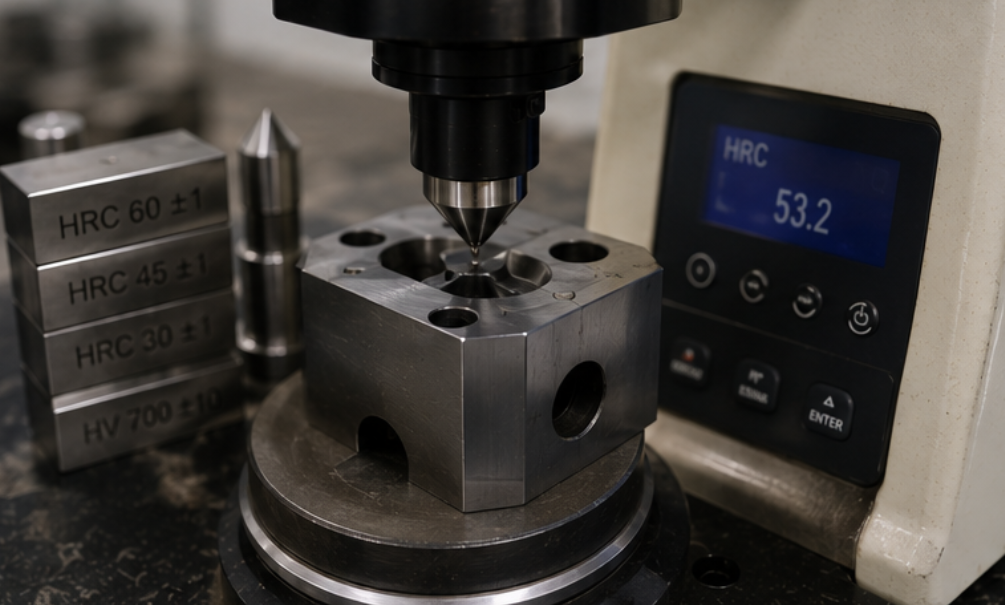
3. Choose Rockwell Testing For Fast HRC Checks
Rockwell hardness testing is commonly used for tool steel and mold components because it is fast, direct-reading, and practical for routine HRC inspection. It is suitable for many quenched and tempered tool steels, pre-hardened mold steels, die blocks, punches, inserts, and larger components when the surface is clean and the sample support is stable.
However, Rockwell testing requires enough material thickness, a suitable test surface, and correct support. Small inserts, thin edges, curved areas, polished cavity surfaces, and narrow components may not be suitable for direct Rockwell testing. In these cases, Vickers or Micro Vickers testing may be more appropriate.
| Application | Recommended Method | Buyer Checkpoint |
|---|---|---|
| Pre-hardened mold steel blocks | Rockwell HRC | Check block size, thickness, surface finish, and HRC range |
| Quenched and tempered die components | Rockwell HRC / Vickers HV | Confirm acceptance range and test location |
| Small mold inserts or thin parts | Vickers / Micro Vickers | Avoid excessive indentation size or backing influence |
| Nitrided or coated mold surfaces | Micro Vickers | Use suitable low load and polished cross-section if layer depth is required |
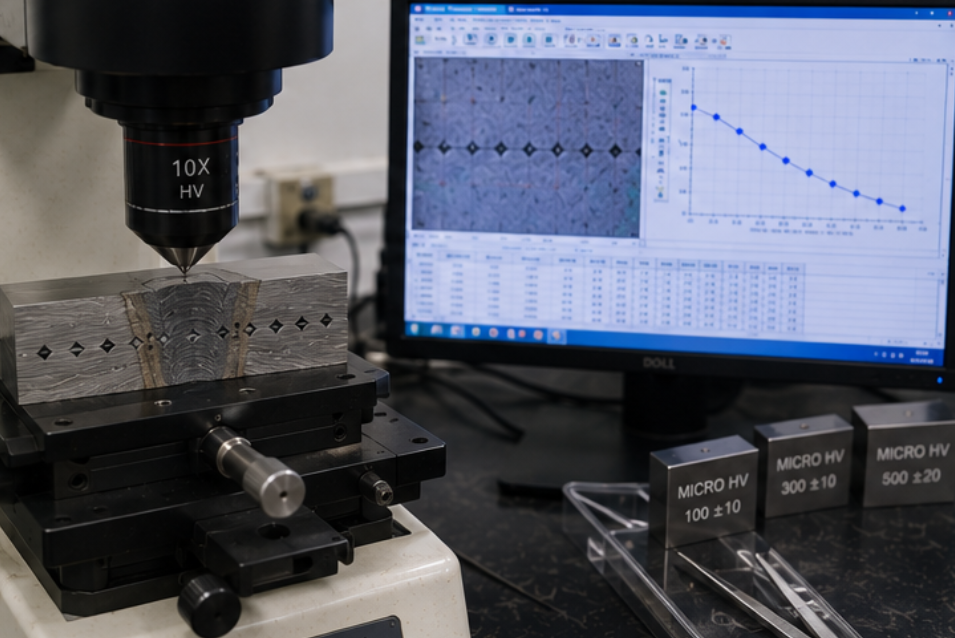
4. Use Micro Vickers Testing For Nitrided Layers, Coatings And Small Areas
Many mold components are nitrided, coated, polished, repaired, or surface-treated. In these cases, a large indentation may not provide useful information and may damage the working surface. Micro Vickers testing uses a smaller indentation and lower test force, making it suitable for thin layers, small areas, cross-sections, and detailed hardness profiles.
For nitrided tool steel or surface-treated mold components, the buyer may need to check both surface layer hardness and effective layer depth. This usually requires cutting a representative sample, mounting it, polishing the cross-section, and testing multiple Micro Vickers points from the surface inward.
Micro Vickers testing is useful for:
Nitrided tool steel surfaces and layer depth analysis.
Coated mold components and thin surface layers.
Small mold inserts, pins, punches, and precision components.
Weld-repaired or locally treated areas.
Cross-section hardness profile testing.
Customer reports requiring indentation images and profile curves.
5. Prepare Sample Size, Test Location And Surface Condition
Before requesting a hardness testing solution, buyers should prepare actual sample information. Mold components can be large, heavy, polished, curved, thin, or irregular. The tester must have enough test height, throat depth, load capacity, and fixture support for the real part.
Surface condition also matters. Oxide scale, EDM recast layer, coating, polishing condition, oil, rust, or rough grinding marks may affect hardness results. If the test surface is a functional mold cavity, the buyer should confirm whether indentation damage is allowed or whether a test coupon should be used.
| Preparation Item | Why It Matters | What Buyers Should Send |
|---|---|---|
| Sample size | Determines machine capacity and test space | Length, width, height, diameter, weight, drawings or photos |
| Test location | Prevents testing the wrong area or damaging functional surfaces | Mark cavity, insert, core, edge, surface, or cross-section area |
| Surface condition | Affects indentation accuracy and reading stability | Polished, ground, EDM, nitrided, coated, rough, or machined |
| Report requirement | Determines software and documentation configuration | PDF, Excel, images, hardness profile, calibration record |
6. Calibration Blocks, Indenters And Report Traceability
Tool steel hardness testing should be verified with calibration blocks that match the expected hardness range. HRC calibration blocks are often used for Rockwell testing. HV or Micro HV blocks are used for Vickers and Micro Vickers testing. The indenter condition should also be checked because damaged indenters can cause unstable or incorrect readings.
For mold components supplied to demanding customers, report traceability is important. The report should show material grade, heat treatment condition, test method, scale, test location, hardness value, calibration record, operator, and inspection date. For Micro Vickers testing, indentation images and hardness profile curves may also be required.
A useful report should include:
Tool steel grade and mold component name.
Heat treatment or surface treatment condition.
Testing method, scale, load, and standard.
Test location and sample identification.
Hardness values and acceptance range.
Calibration block value and verification record.
Operator, date, machine ID, and report number.
Indentation images or hardness profile curves if required.
Key Questions Before Requesting A Tool Steel Hardness Testing Solution
Before requesting a quotation, buyers should prepare practical sample and inspection information. This helps the supplier recommend the right machine, accessories, sample preparation equipment, and report functions.
What tool steel grade or mold steel grade will be tested?
Is the material annealed, pre-hardened, quenched, tempered, nitrided, coated, or repaired?
What mold components need testing: insert, cavity, core, punch, die block, slider, guide pin, or plate?
Which hardness scale is required: HRC, HRB, HV, Micro HV, HBW, or another scale?
What hardness range is expected?
Where should the hardness test be performed?
Is indentation allowed on the working surface, or is a test coupon required?
What are the sample size, weight, surface condition, and shape?
Do you need sample preparation equipment for cross-section testing?
Do customers require PDF reports, indentation images, calibration records, or hardness profile curves?
Conclusion: Buyers Should Prepare More Than A Hardness Range
Hardness testing for tool steel and mold components should be planned around real application risks. Buyers should prepare material grade, heat treatment condition, component type, test location, sample size, surface condition, hardness scale, and report requirements before choosing equipment.
Rockwell testing is practical for fast HRC checks on many tool steels and mold blocks. Vickers and Micro Vickers testing are better for small areas, nitrided layers, coatings, repaired zones, and cross-section profiles. Sample preparation equipment may also be needed when layer depth or cross-section analysis is required.
If your factory tests tool steel, mold inserts, die components, punches, cavities, cores, or nitrided mold parts, a complete hardness testing solution can help improve heat treatment control, customer approval, and long-term mold reliability.
FAQ
Which hardness tester is commonly used for tool steel?
Rockwell hardness testers are commonly used for fast HRC checks on tool steel, while Vickers or Micro Vickers testers are used for smaller areas and surface layers.
Can hardness testing damage mold components?
Yes, hardness testing creates an indentation. For working mold surfaces, buyers should confirm whether testing is allowed on the part or whether a test coupon should be used.
When is Micro Vickers testing needed for mold components?
Micro Vickers testing is useful for nitrided layers, coatings, small inserts, weld-repaired areas, thin layers, and cross-section hardness profiles.
What should buyers send before asking for a quotation?
Buyers should send material grade, heat treatment condition, sample size, hardness scale, test location, expected hardness range, and report requirements.
Need A Hardness Testing Solution For Tool Steel Or Mold Components?
Share your tool steel grade, mold component type, heat treatment process, hardness scale, sample size, test location, and report needs. We can help recommend suitable Rockwell testers, Vickers testers, Micro Vickers testers, calibration blocks, fixtures, sample preparation equipment, and complete QC solutions.
Hardness Testing For Tool Steel And Mold Components What Buyers Should Prepare Procurement Notes
For a quality control laboratory, choosing a hardness tester or metallographic instrument is not only a model comparison. Buyers need to confirm sample material, hardness scale, test load, indentation reading method, software report format, calibration requirement, fixture configuration and after sales support. A clear specification helps the supplier recommend a practical system instead of only quoting a low price.
The related product route should start from testing instrument product range, ValuePro hardness tester, precision quality inspection solutions, factory capability, testing instrument cases, contact the measurement team. These pages help visitors move from the article to real hardness tester, metallographic preparation and precision inspection product categories. This also strengthens internal linking around the same measurement and quality control topic.
Information Buyers Should Prepare Before Quotation
- List the main materials, such as steel, aluminum, copper alloy, casting, forging, coating or heat treated parts.
- Confirm the required scale, including Rockwell, Brinell, Vickers, Micro Vickers, Leeb, Barcol, Shore or other testing method.
- Prepare sample size, surface condition, expected hardness range, batch quantity and whether automated report export is needed.
- Ask for fixture options, calibration blocks, indentation images, software language, report format and training support.
- Confirm spare parts, installation conditions, warranty process and future calibration service before placing an order.
Product And Service Pages For Further Review
Visitors comparing a full laboratory setup can continue with Rockwell hardness testers, Brinell hardness testers, Vickers hardness testers, microhardness testers, Barcol hardness testers, surface roughness measurement solutions. These links cover equipment selection, sample preparation, calibration and factory capability. For buyers who need project support, metallographic products, metallographic grinder polisher series, metallographic cutting machine series provide the next step for cases and inquiry communication.
Quality Checks Before Acceptance
Before accepting a hardness testing system, the buyer should verify load accuracy, optical reading, software report output, sample fixture fit, repeatability, calibration block value and operator workflow. For metallographic preparation equipment, the checklist should include cutting stability, grinding and polishing consistency, mounting quality, consumable availability and safety protection.
| Review Item | Why It Matters |
|---|---|
| Testing scale and load | Ensures the machine matches the material and standard method. |
| Software and report | Improves traceability and helps the lab share results with customers. |
| Calibration and fixtures | Reduces measurement error and improves repeatability. |
Search And Inquiry Value
This article now connects buyer questions with real product pages, technical terms and purchasing steps. It is designed to attract visitors who search for hardness tester selection, metallographic equipment, calibration instruments and industrial QC laboratory setup, then guide them to the correct inquiry path.