-
05-03 2026
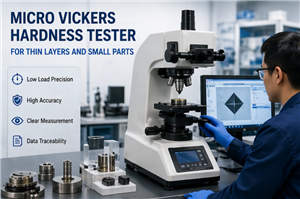
How To Select A Micro Vickers Hardness Tester For Thin Layers And Small Parts
Selecting a Micro Vickers hardness tester for thin layers and small parts requires more than comparing basic specifications. Buyers should evaluate the material, layer thickness, low-load range, optical quality, measurement software, automation level, sample preparation process, and reporting requirements. For occasional laboratory testing, a digital Micro Vickers tester may be sufficient. For case depth analysis, coatings, batch inspection, or high-repeatability QC, an automatic vision Micro Vickers system can provide better consistency, faster operation, and stronger data traceability. The best tester is the one that fits your sample condition, testing standard, daily workload, and quality documentation requirements. Before requesting a quote, prepare your material details and testing purpose so the equipment configuration can be matched accurately.
-
04-27 2026
What Makes A Microhardness Tester Suitable For Thin Coatings And Precision Materials
A microhardness tester becomes suitable for thin coatings and precision materials when it combines stable low-load control, strong indentation visibility, precise positioning, and realistic application support. Buyers should judge the whole measurement system, not only the load range, if they want dependable results in demanding micro-scale work.
-
01-17 2026
The Role of Microhardness Testers in Semiconductor and Electronics Quality Control
In the high-stakes world of semiconductors and electronics, where failure is not an option, microhardness testers provide the critical, data-driven insights needed to guarantee material integrity, validate complex processes, and solve elusive failures. They are not merely testing instruments but essential enablers of quality, reliability, and miniaturization, ensuring that the tiny components powering our modern world meet the most stringent performance standards.