


How To Reduce Rework In Heat Treatment QC With Better Hardness Testing Workflow
How To Reduce Rework In Heat Treatment QC With Better Hardness Testing Workflow
Rework in heat treatment QC often comes from unstable hardness results, wrong test locations, incomplete case depth checks, poor sample preparation, missing calibration records, and late inspection. A better hardness testing workflow helps factories detect problems earlier, reduce rejected batches, control heat treatment variation, and provide clearer reports before delivery.
Early Detection
Check incoming material and trial batches before large-scale heat treatment.
Stable Testing
Use correct methods, calibration blocks, fixtures, and sample preparation to reduce variation.
Case Depth Control
Micro Vickers profiles help verify carburized, nitrided, and induction-hardened layers.
Report Traceability
Clear records help reduce customer disputes and support batch release decisions.
Why Rework Happens In Heat Treatment QC
Heat treatment rework is expensive because it usually appears after time, energy, labor, and production capacity have already been used. A batch may need re-quenching, re-tempering, re-inspection, sorting, or even scrapping if hardness results do not meet the required range. For gears, shafts, bearings, fasteners, molds, tools, castings, forgings, and automotive parts, this can delay delivery and create customer complaints.
Many rework problems are not caused by one single machine failure. They often come from weak quality control workflow: incoming material was not checked, test locations were unclear, calibration was not verified, sample support was unstable, case depth was not measured, or the final report was incomplete. When the problem is found too late, the cost is much higher.
A better hardness testing workflow helps factories identify abnormal material and heat treatment variation earlier. It also improves repeatability, reduces operator disputes, and makes customer approval easier with traceable hardness records.
1. Start With Incoming Material Hardness Verification
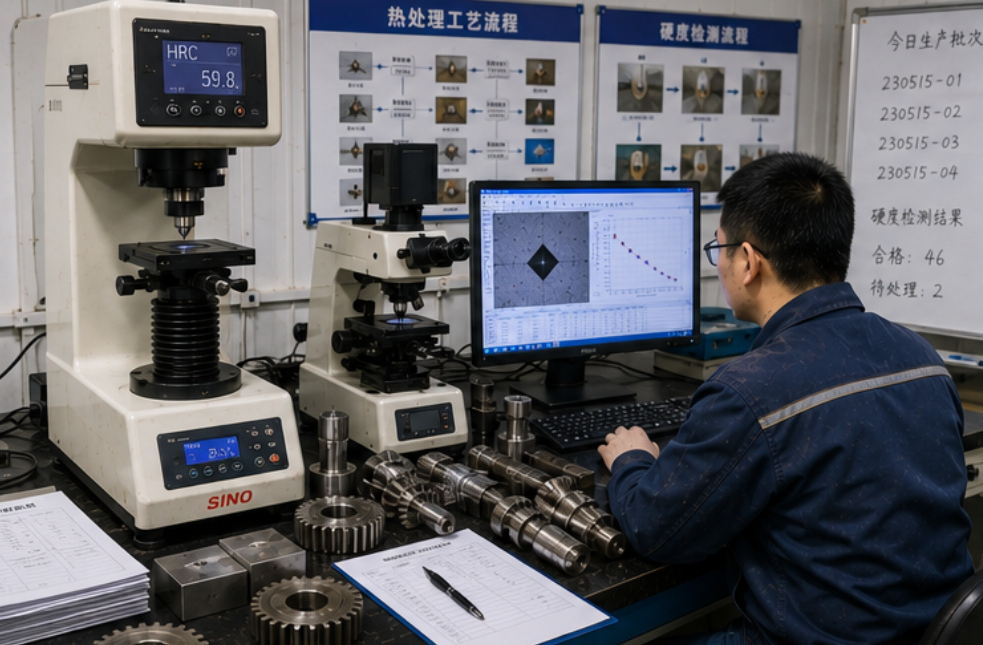
Rework can start before heat treatment if the incoming material condition is wrong. Steel bars, forgings, castings, pre-hardened materials, and semi-finished blanks may arrive with hardness that does not match the expected condition. If this is not found early, the heat treatment process may produce unstable or unexpected final results.
Incoming hardness inspection helps confirm whether the material is ready for machining, forming, or heat treatment. For high-risk parts, the QC team should check material certificate, heat number, supplier batch, surface condition, and hardness value before releasing the material into production.
| Inspection Stage | What To Check | How It Reduces Rework |
|---|---|---|
| Incoming material | Material grade, heat number, certificate, hardness range | Prevents wrong material condition from entering heat treatment |
| Pre-hardened material | HRC / HBW / HV value before machining | Avoids machining or finishing parts with incorrect hardness |
| Forgings and castings | Representative Brinell hardness and batch consistency | Finds abnormal supplier batches before further processing |
| Trial samples | Hardness response after trial heat treatment | Helps adjust process before treating the full batch |
2. Define The Correct Hardness Method And Test Location
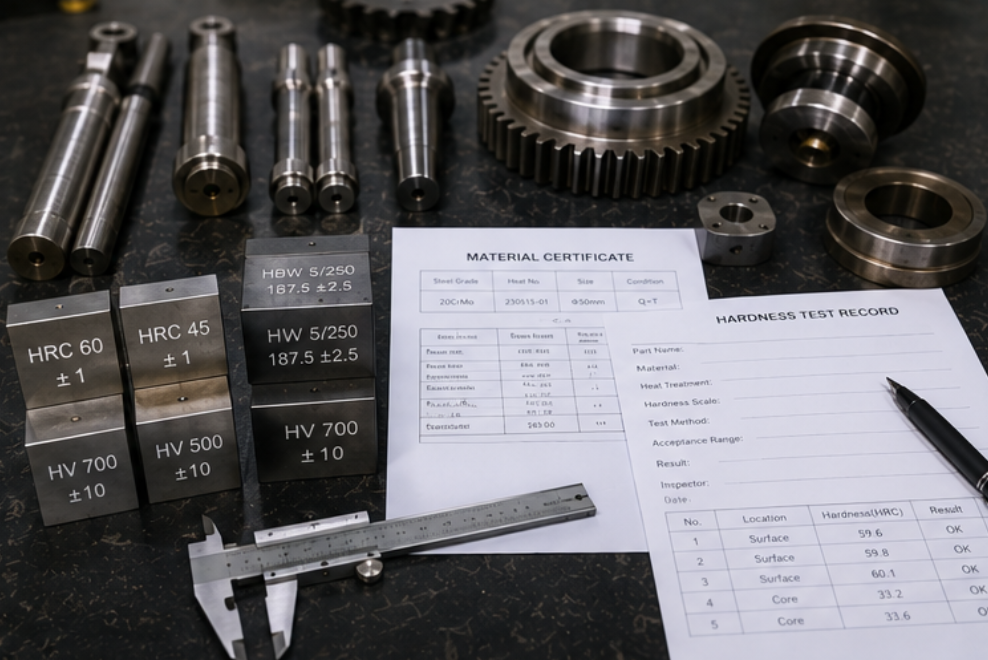
Rework often happens when the hardness value is measured, but not at the right location or by the right method. Heat-treated parts may have different hardness at the surface, core, tooth flank, shaft track, bearing raceway, weld zone, or cross-section. Testing an easy location may not prove that the functional area is qualified.
Before batch inspection, the QC team should define the method, scale, test force, test location, sampling quantity, and acceptance range. This should be based on drawings, customer standards, heat treatment requirements, or internal process control plans.
A clear hardness inspection plan should define:
Required method: Rockwell, Brinell, Vickers, or Micro Vickers.
Required scale: HRC, HRB, HBW, HV, Micro HV, or others.
Exact test location on the part.
Surface hardness, core hardness, or case depth requirement.
Sampling quantity and retest rules.
Acceptance range and batch release decision.
3. Verify The Hardness Tester Before Batch Testing
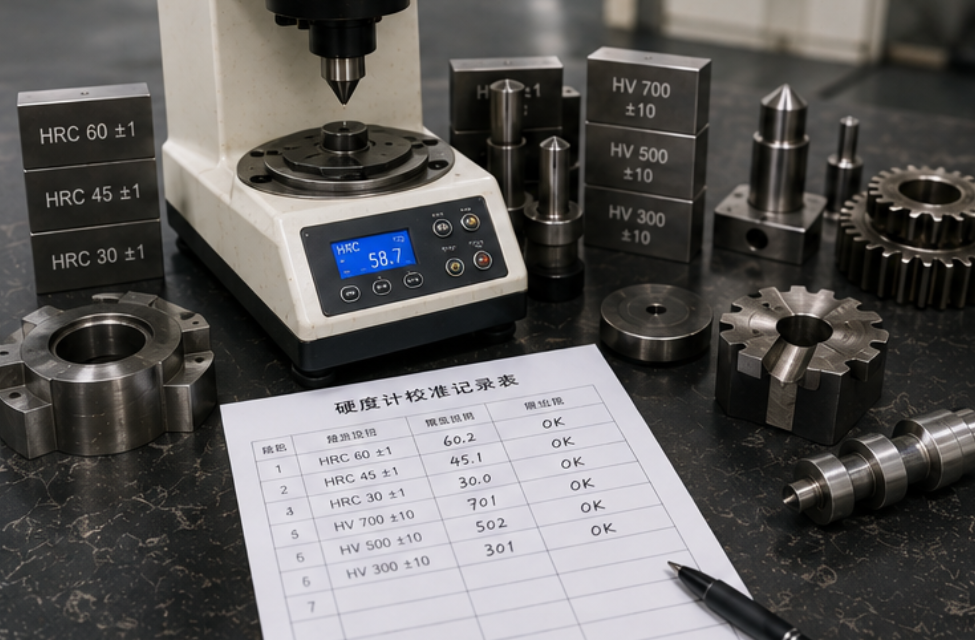
If the hardness tester is not verified before testing, abnormal results may be discovered too late. The machine should be checked with suitable calibration blocks before important batch inspection. The calibration block should match the method, scale, and working hardness range.
Indenters, anvils, and fixtures should also be inspected. A worn indenter, damaged anvil, unstable support, or wrong fixture can create inconsistent hardness values and unnecessary retesting. Proper verification reduces false failures and false approvals.
| Control Item | Common Problem | Recommended Practice |
|---|---|---|
| Calibration blocks | Block value does not match the working range | Use HRC, HBW, HV, or Micro HV blocks close to the tested parts |
| Indenters | Worn or damaged indenter causes unstable readings | Inspect and replace indenters when results drift |
| Fixtures and anvils | Sample moves, tilts, or rolls during loading | Use flat anvils, V anvils, ring supports, or custom fixtures |
| Verification records | No proof that the tester was checked before inspection | Record block value, tester ID, date, operator, and result |
4. Add Case Depth Testing For Surface-Hardened Parts
For carburized, nitrided, carbonitrided, and induction-hardened parts, surface hardness alone cannot confirm the full heat treatment result. A batch may pass surface hardness inspection but still fail because the effective case depth is too shallow, too deep, or inconsistent.
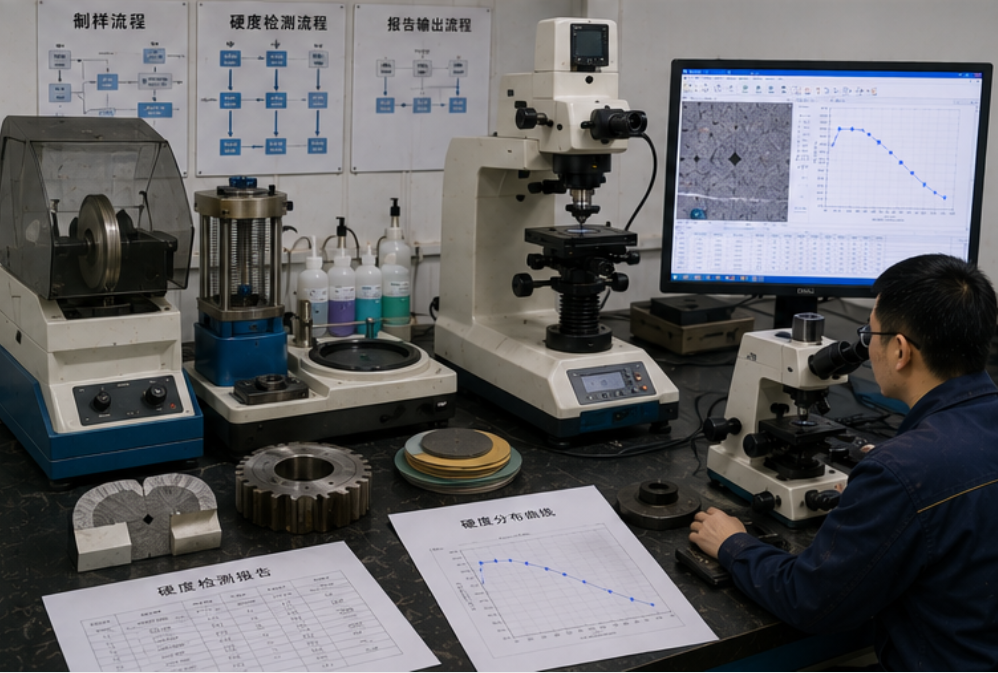
Micro Vickers testing is commonly used to build a hardness profile from the surface toward the core. This helps verify effective case depth, hardened layer consistency, and heat treatment process stability. It is especially important for gears, shafts, bearings, molds, tools, and precision components.
Case depth testing workflow usually includes:
Cutting the part through the required inspection area.
Mounting the sample to protect edges and support the cross-section.
Grinding and polishing to obtain a flat, clear surface.
Microscope inspection before hardness testing.
Micro Vickers test points from surface to core.
Hardness profile curve and effective case depth report.
5. Improve Sample Preparation To Avoid False Rework
Poor sample preparation can create false hardness problems. Cutting heat may change local hardness. Poor mounting may cause edge rounding. Rough grinding or polishing scratches may make Vickers indentation edges unclear. If the sample preparation process is unstable, the factory may retest or rework parts unnecessarily.
For Vickers, Micro Vickers, case depth, weld section, coating, and thin layer testing, sample preparation should be controlled as part of the QC workflow. A reliable lab should have suitable cutting, mounting, grinding, polishing, cleaning, and microscope inspection equipment.
| Sample Preparation Issue | QC Risk | Better Workflow |
|---|---|---|
| Overheating during cutting | Local hardness changes before testing | Use low-damage cutting and proper coolant |
| Poor edge retention | Case depth or coating layer result becomes unreliable | Use proper mounting method and controlled polishing |
| Surface scratches | Indentation edges are difficult to measure | Improve grinding and polishing sequence |
| Wrong cross-section location | Test result does not represent the required area | Mark the test location before cutting |
6. Use Reports To Close The QC Loop
A hardness test result should not stay as an isolated number. It should be connected to material batch, heat treatment batch, furnace record, operator, test method, test location, calibration status, and final release decision. This helps the factory understand whether rework comes from material variation, heat treatment process, testing error, or sample preparation.
Digital hardness testing systems and automatic vision software can help save indentation images, hardness values, profile curves, calibration records, and PDF or Excel reports. This makes it easier to review abnormal batches and communicate with customers.
A rework-reduction report should include:
Part name, material grade, drawing number, and batch number.
Heat treatment process and furnace batch record.
Testing method, scale, force, and test location.
Hardness values and acceptance range.
Calibration block record and tester ID.
Case depth curve if surface hardening is involved.
Operator, inspection date, and release decision.
Abnormal result handling and retest record.
Recommended Equipment For A Better Heat Treatment QC Workflow
The right equipment configuration depends on the parts and inspection level. A basic heat treatment shop may only need a Rockwell tester and calibration blocks. A more complete QC lab should also include Micro Vickers testing, sample preparation equipment, microscope, fixtures, and report software.
| QC Requirement | Recommended Equipment | Purpose |
|---|---|---|
| Routine HRC inspection | Digital Rockwell hardness tester, HRC blocks, fixtures | Fast heat treatment batch check |
| Castings and forgings | Brinell hardness tester, HBW blocks, digital measurement | Representative hardness control for large parts |
| Case depth testing | Micro Vickers tester, XY stage, profile software | Verify hardened layer depth and hardness gradient |
| Cross-section analysis | Cutting machine, mounting system, grinding-polishing machine, microscope | Prepare reliable samples for Vickers and Micro Vickers testing |
Key Questions Before Improving Your Heat Treatment QC Workflow
Before upgrading equipment or rewriting procedures, factories should review which rework problems happen most often. This helps identify whether the issue comes from material, heat treatment process, testing method, sample preparation, or reporting.
Which parts are most often reworked after heat treatment?
Which process is involved: quenching, tempering, carburizing, nitriding, carbonitriding, or induction hardening?
Do failed batches fail surface hardness, core hardness, or case depth?
Are test locations clearly defined on drawings or inspection plans?
Are calibration blocks matched to the working hardness range?
Are sample fixtures stable enough for real part shapes?
Is sample preparation causing false hardness variation?
How many samples and test points are checked per batch?
Do reports include enough information for customer review?
Do you need Rockwell, Brinell, Vickers, Micro Vickers, sample preparation equipment, or automatic vision software?
Conclusion: Better Hardness Testing Workflow Reduces Rework Before It Becomes Expensive
Heat treatment rework is easier to reduce when hardness testing is treated as a complete workflow, not a final number. Factories should control incoming material inspection, method selection, test location, calibration verification, fixtures, sample preparation, case depth testing, and report traceability.
For simple heat treatment QC, a reliable Rockwell tester and calibration blocks may solve many problems. For carburized, nitrided, induction-hardened, welded, coated, or precision parts, Micro Vickers testing, metallographic sample preparation, microscope inspection, and report software may be necessary.
If your factory is losing time on repeated heat treatment rework, unstable hardness readings, customer rejection, or unclear inspection reports, improving the hardness testing workflow can directly reduce cost and improve delivery reliability.
FAQ
How can hardness testing reduce heat treatment rework?
It helps detect abnormal material, wrong heat treatment results, unstable batches, and incomplete case depth before parts move to the next process or delivery.
Is surface hardness enough for heat treatment QC?
Not always. Some parts also require core hardness, effective case depth, or hardness profile testing.
When is Micro Vickers testing needed?
Micro Vickers testing is needed for carburized layers, nitrided layers, induction-hardened zones, coatings, weld sections, and case depth reports.
What records should be kept for heat treatment hardness testing?
Records should include part batch, material grade, heat treatment process, method, scale, test location, hardness values, calibration record, operator, date, and release decision.
Need To Reduce Rework In Heat Treatment QC?
Share your heat-treated parts, material grade, process type, hardness scale, rework problem, testing volume, and report needs. We can help recommend suitable hardness testers, sample preparation equipment, calibration blocks, fixtures, Micro Vickers systems, and complete QC workflow solutions.
How To Reduce Rework In Heat Treatment QC With Better Hardness Testing Workflow Procurement Notes
For a quality control laboratory, choosing a hardness tester or metallographic instrument is not only a model comparison. Buyers need to confirm sample material, hardness scale, test load, indentation reading method, software report format, calibration requirement, fixture configuration and after sales support. A clear specification helps the supplier recommend a practical system instead of only quoting a low price.
The related product route should start from testing instrument product range, ValuePro hardness tester, precision quality inspection solutions, factory capability, testing instrument cases, contact the measurement team. These pages help visitors move from the article to real hardness tester, metallographic preparation and precision inspection product categories. This also strengthens internal linking around the same measurement and quality control topic.
Information Buyers Should Prepare Before Quotation
- List the main materials, such as steel, aluminum, copper alloy, casting, forging, coating or heat treated parts.
- Confirm the required scale, including Rockwell, Brinell, Vickers, Micro Vickers, Leeb, Barcol, Shore or other testing method.
- Prepare sample size, surface condition, expected hardness range, batch quantity and whether automated report export is needed.
- Ask for fixture options, calibration blocks, indentation images, software language, report format and training support.
- Confirm spare parts, installation conditions, warranty process and future calibration service before placing an order.
Product And Service Pages For Further Review
Visitors comparing a full laboratory setup can continue with Rockwell hardness testers, Brinell hardness testers, Vickers hardness testers, microhardness testers, Barcol hardness testers, surface roughness measurement solutions. These links cover equipment selection, sample preparation, calibration and factory capability. For buyers who need project support, metallographic products, metallographic grinder polisher series, metallographic cutting machine series provide the next step for cases and inquiry communication.
Quality Checks Before Acceptance
Before accepting a hardness testing system, the buyer should verify load accuracy, optical reading, software report output, sample fixture fit, repeatability, calibration block value and operator workflow. For metallographic preparation equipment, the checklist should include cutting stability, grinding and polishing consistency, mounting quality, consumable availability and safety protection.
| Review Item | Why It Matters |
|---|---|
| Testing scale and load | Ensures the machine matches the material and standard method. |
| Software and report | Improves traceability and helps the lab share results with customers. |
| Calibration and fixtures | Reduces measurement error and improves repeatability. |
Search And Inquiry Value
This article now connects buyer questions with real product pages, technical terms and purchasing steps. It is designed to attract visitors who search for hardness tester selection, metallographic equipment, calibration instruments and industrial QC laboratory setup, then guide them to the correct inquiry path.