


What Should Be Included In A Hardness Testing Report For Industrial Buyers
What Should Be Included In A Hardness Testing Report For Industrial Buyers
A professional hardness testing report should include part information, material grade, batch number, testing method, hardness scale, test force, test location, sample preparation condition, calibration record, hardness values, acceptance range, result judgment, operator information, inspection date, and supporting images when required.
Part Information
Report should show part name, material, drawing number, batch number, and heat treatment condition.
Testing Method
Rockwell, Brinell, Vickers, Micro Vickers, Shore, Barcol, or Leeb method must be clearly stated.
Calibration Record
Calibration block value, tester ID, verification result, and inspection date support traceability.
Final Judgment
The report should clearly show whether the tested batch passed, failed, or needs retesting.
Why A Hardness Testing Report Matters For Industrial Buyers
Industrial buyers do not only need a hardness value. They need to know whether the value was measured correctly, whether the right method was used, whether the test location matches the drawing, whether the tester was verified, and whether the result meets the agreed acceptance range.
This is especially important for heat-treated parts, gears, shafts, bearings, fasteners, castings, forgings, welded parts, aluminum and copper alloy parts, tool steel, mold components, coatings, and precision machined parts. A weak report may cause customer doubts even when the hardness value itself looks correct.
A complete hardness testing report helps suppliers prove quality before shipment, reduce disputes, support customer audits, and improve long-term trust. For factories selling to industrial buyers, report quality can directly affect whether the buyer accepts the batch or asks for retesting.
1. Basic Part And Batch Information
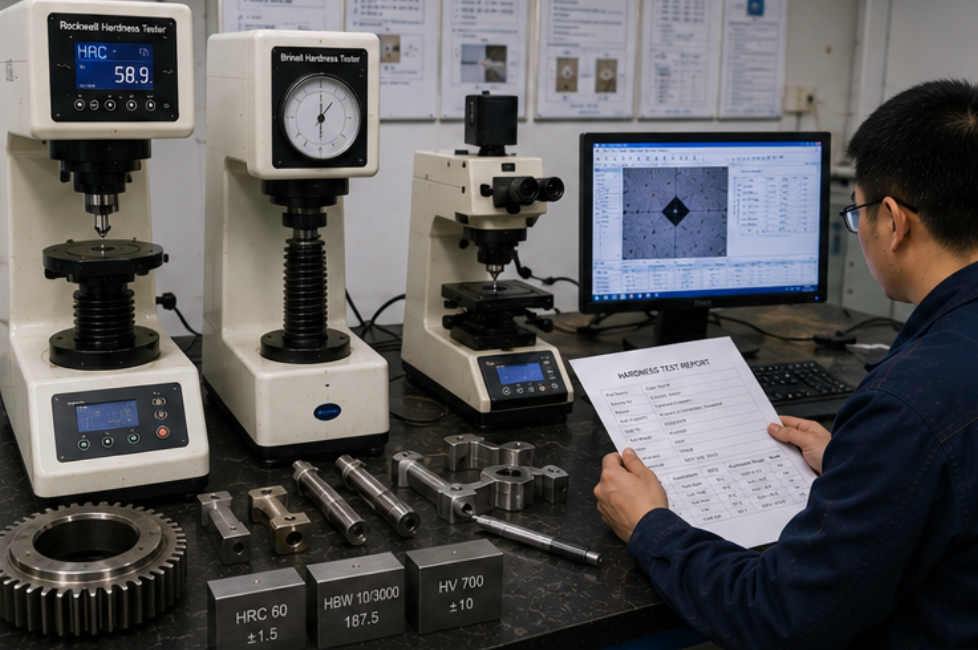
The report should first identify what was tested. Without clear part and batch information, the hardness result cannot be connected to the actual shipment, production lot, material batch, or customer order. This is a common reason why reports are rejected during customer review.
For industrial buyers, the report should show the part name, drawing number, material grade, batch number, heat number, purchase order, supplier name, and inspection date when required. If the part has been heat-treated or surface-treated, this process condition should also be listed.
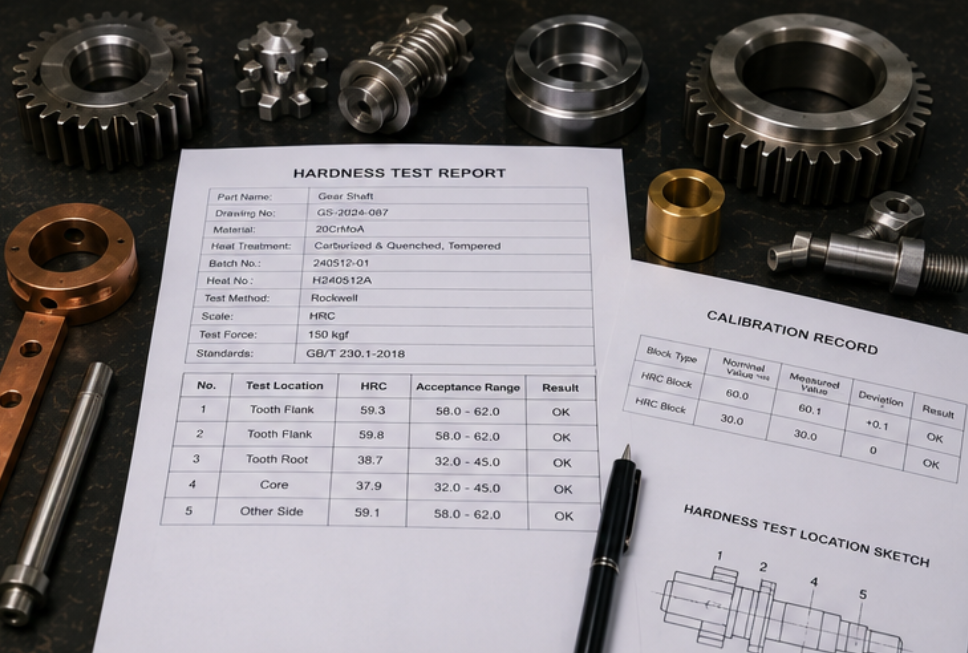
| Report Item | Why It Matters | Example |
|---|---|---|
| Part name and drawing number | Links result to the correct product | Gear shaft, bearing ring, mold insert, fastener, welded bracket |
| Material grade | Confirms the correct material was tested | 4140 steel, H13, D2, aluminum alloy, brass, bronze |
| Batch number or heat number | Supports traceability during shipment or audit | Heat No., lot No., furnace batch, production order |
| Process condition | Explains why hardness is being verified | Quenched, tempered, carburized, nitrided, welded, coated |
2. Testing Method, Scale, Force And Standard
A hardness report must clearly state the testing method and scale. Rockwell HRC, Rockwell HRB, Brinell HBW, Vickers HV, Micro Vickers, Shore, Barcol, and Leeb values are not interchangeable without customer approval. If the report only says “hardness passed,” the buyer cannot confirm whether the correct method was used.
For Vickers, Micro Vickers, and Brinell testing, the test force or test condition should be included. For example, a Micro Vickers report should show the load used. A Brinell report should show ball diameter and test force when applicable. If the customer has a required standard, it should also be listed.
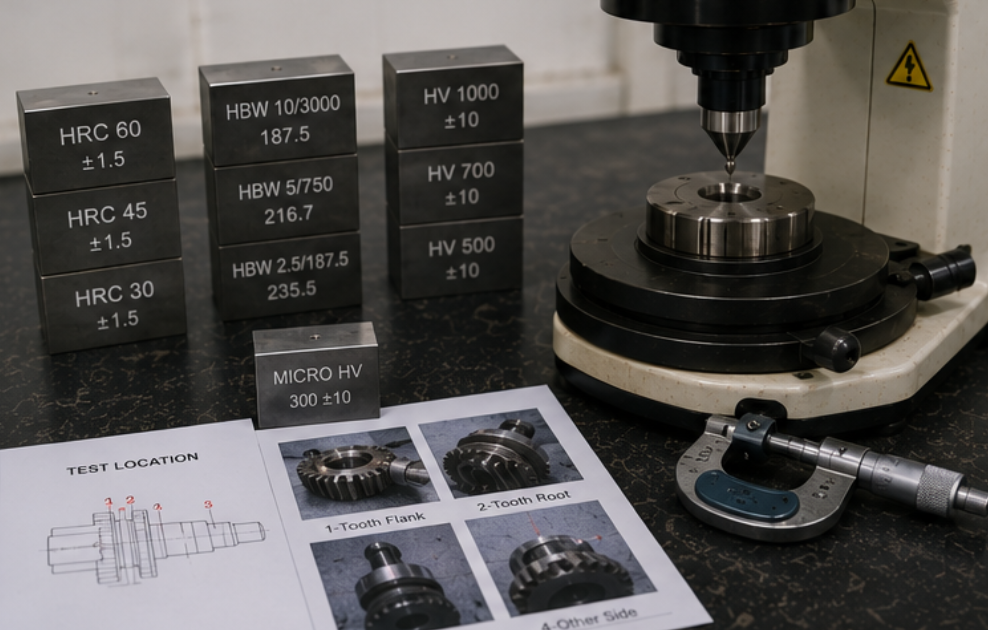
This section should include:
Testing method: Rockwell, Brinell, Vickers, Micro Vickers, Shore, Barcol, or Leeb.
Hardness scale: HRC, HRB, HBW, HV, Micro HV, Shore A/D, Barcol, or others.
Test force or load when applicable.
Indenter type when required.
Testing standard or customer specification.
Whether hardness conversion was used and whether it is accepted by the buyer.
3. Test Location And Sample Preparation Condition
Hardness values can change from one area to another. A gear tooth surface, shaft track, bearing raceway, weld HAZ, core area, coating layer, casting body, and mold insert surface may all have different hardness. Therefore, the report should clearly state where the test was performed.
If the sample was cut, mounted, ground, polished, or etched before testing, the report should mention the sample preparation condition. This is especially important for Micro Vickers testing, case depth analysis, weld cross-sections, coating hardness, and metallographic samples.
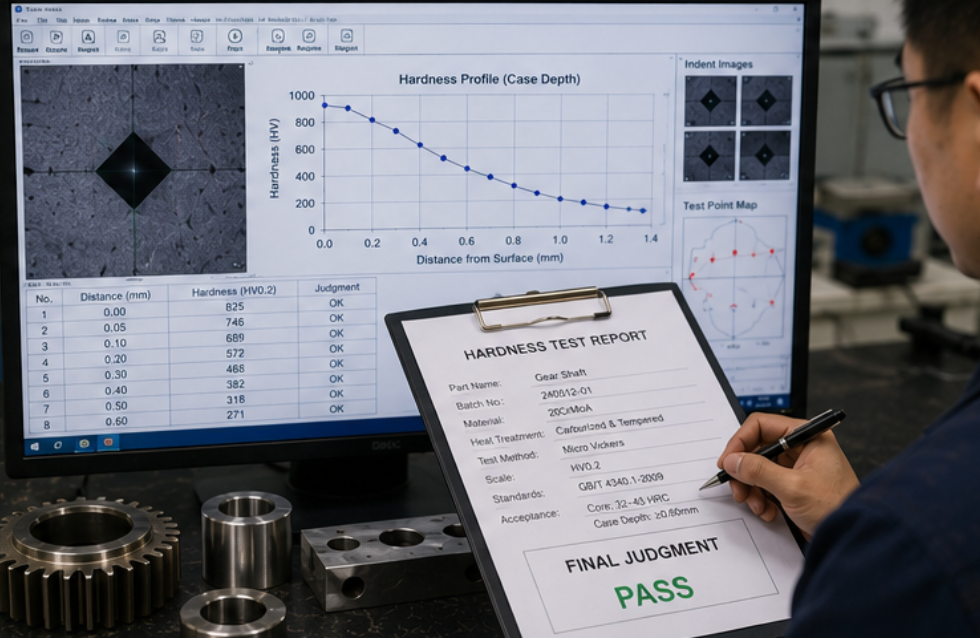
| Test Location | Why It Matters | Report Example |
|---|---|---|
| Gear tooth surface | Confirms wear-resistant functional area | Tooth flank surface, HRC 59.8 |
| Core area | Confirms toughness and internal support | Core section, HV 330 |
| Weld metal / HAZ / base metal | Confirms weld zone hardness distribution | Weld center, HAZ, base metal path |
| Coating or hardened layer | Checks surface treatment or case depth | Micro HV profile from surface to core |
4. Calibration Verification And Equipment Information
Industrial buyers often want to know whether the tester was verified before inspection. A hardness value is more credible when the report includes calibration block information, verification results, tester ID, indenter condition, and inspection date.
The calibration block should match the testing method, scale, and working hardness range. For example, HRC testing should be verified with suitable HRC blocks. Brinell testing should use HBW blocks. Vickers or Micro Vickers testing should use HV or Micro HV blocks.
| Calibration Item | Why It Matters | What To Record |
|---|---|---|
| Calibration block | Verifies tester accuracy before inspection | Block value, scale, serial number, certificate status |
| Verification result | Shows whether the tester was within acceptable range | Measured value, allowable tolerance, pass/fail result |
| Tester and indenter | Supports equipment traceability | Tester model, machine ID, indenter type, inspection status |
| Operator and date | Supports audit and dispute review | Operator name, inspection date, report number |
5. Hardness Values, Acceptance Range And Final Judgment
The report should not only list hardness values. It should also show the required acceptance range and final judgment. Industrial buyers need to see whether each tested point passed, failed, or needs retesting.
For batch inspection, the report should include sample quantity, test points per sample, minimum value, maximum value, average value, and abnormal results if applicable. If one value is close to the limit, the report should state whether retesting was performed.
Result section should include:
Hardness values for each test point.
Required acceptance range.
Pass, fail, hold, or retest judgment.
Minimum, maximum, and average values when needed.
Sampling quantity and batch size.
Abnormal result handling record.
Inspector approval or QC release decision.
6. Images, Curves And Supporting Data For Advanced Reports
For simple Rockwell testing, a numeric report may be enough. But for Vickers, Micro Vickers, Brinell, coating hardness, weld hardness, and case depth testing, images and curves can make the report much stronger.
Automatic vision hardness testing systems can save indentation images, test point coordinates, hardness profile curves, Brinell indentation images, and exported PDF or Excel reports. These records are useful for customer audits, technical disputes, and long-term quality improvement.
| Advanced Data | Useful For | Report Benefit |
|---|---|---|
| Indentation images | Vickers, Micro Vickers, Brinell testing | Provides visual proof of measurement quality |
| Hardness profile curve | Case depth, carburized layers, nitrided layers | Shows hardness change from surface to core |
| Test point map | Welds, gears, coatings, precision parts | Shows exactly where values were measured |
| Exported PDF / Excel data | Customer audits and batch records | Improves consistency and reduces manual mistakes |
Hardness Testing Report Checklist For Buyers
Industrial buyers can use the checklist below when reviewing a supplier’s hardness testing report. A complete report should make the inspection result easy to trace, verify, and approve.
Part name, drawing number, material grade, and batch number.
Heat treatment, surface treatment, welding, or coating condition.
Testing method, hardness scale, test force, and standard.
Test location and sample preparation condition.
Calibration block value, verification result, machine ID, and indenter information.
Hardness values for each test point.
Acceptance range and final pass/fail judgment.
Sampling quantity and retest record if applicable.
Operator, inspection date, approval status, and report number.
Indentation images, test point map, hardness profile curve, or exported data when required.
Conclusion: A Good Report Proves The Process, Not Just The Number
A professional hardness testing report should prove more than a single hardness value. It should show what was tested, where it was tested, how it was tested, whether the tester was verified, what result was obtained, and whether the batch meets the required acceptance range.
For industrial buyers, this level of detail helps reduce inspection disputes, customer rejection, repeated testing, and unclear quality responsibility. For suppliers, a clear report improves trust and makes it easier to win repeat orders from demanding customers.
If your factory needs better hardness testing reports, the solution may include digital hardness testers, automatic vision measurement, calibration blocks, report software, sample preparation equipment, and a more complete QC workflow.
FAQ
Is a hardness value alone enough for industrial buyers?
Usually not. Buyers often need method, scale, test location, calibration record, acceptance range, and final judgment to verify the result.
Should calibration records be included in the report?
Yes. Calibration records show that the hardness tester was verified before inspection and support traceability.
When are indentation images needed?
Indentation images are useful for Vickers, Micro Vickers, Brinell, case depth, weld hardness, coating hardness, and customer audit reports.
What makes a hardness testing report traceable?
Traceability comes from part ID, batch number, material grade, machine ID, calibration record, operator, test date, test location, and report number.
Need A Better Hardness Testing Report System?
Share your testing method, sample type, report format, customer requirements, calibration needs, and daily testing volume. We can help recommend suitable hardness testers, automatic vision systems, calibration blocks, sample preparation equipment, and report software for industrial QC.
What Should Be Included In A Hardness Testing Report For Industrial Buyers Procurement Notes
For a quality control laboratory, choosing a hardness tester or metallographic instrument is not only a model comparison. Buyers need to confirm sample material, hardness scale, test load, indentation reading method, software report format, calibration requirement, fixture configuration and after sales support. A clear specification helps the supplier recommend a practical system instead of only quoting a low price.
The related product route should start from testing instrument product range, ValuePro hardness tester, precision quality inspection solutions, factory capability, testing instrument cases, contact the measurement team. These pages help visitors move from the article to real hardness tester, metallographic preparation and precision inspection product categories. This also strengthens internal linking around the same measurement and quality control topic.
Information Buyers Should Prepare Before Quotation
- List the main materials, such as steel, aluminum, copper alloy, casting, forging, coating or heat treated parts.
- Confirm the required scale, including Rockwell, Brinell, Vickers, Micro Vickers, Leeb, Barcol, Shore or other testing method.
- Prepare sample size, surface condition, expected hardness range, batch quantity and whether automated report export is needed.
- Ask for fixture options, calibration blocks, indentation images, software language, report format and training support.
- Confirm spare parts, installation conditions, warranty process and future calibration service before placing an order.
Product And Service Pages For Further Review
Visitors comparing a full laboratory setup can continue with Rockwell hardness testers, Brinell hardness testers, Vickers hardness testers, microhardness testers, Barcol hardness testers, surface roughness measurement solutions. These links cover equipment selection, sample preparation, calibration and factory capability. For buyers who need project support, metallographic products, metallographic grinder polisher series, metallographic cutting machine series provide the next step for cases and inquiry communication.
Quality Checks Before Acceptance
Before accepting a hardness testing system, the buyer should verify load accuracy, optical reading, software report output, sample fixture fit, repeatability, calibration block value and operator workflow. For metallographic preparation equipment, the checklist should include cutting stability, grinding and polishing consistency, mounting quality, consumable availability and safety protection.
| Review Item | Why It Matters |
|---|---|
| Testing scale and load | Ensures the machine matches the material and standard method. |
| Software and report | Improves traceability and helps the lab share results with customers. |
| Calibration and fixtures | Reduces measurement error and improves repeatability. |
Search And Inquiry Value
This article now connects buyer questions with real product pages, technical terms and purchasing steps. It is designed to attract visitors who search for hardness tester selection, metallographic equipment, calibration instruments and industrial QC laboratory setup, then guide them to the correct inquiry path.