What Buyers Should Check Before Ordering A Barcol Hardness Tester
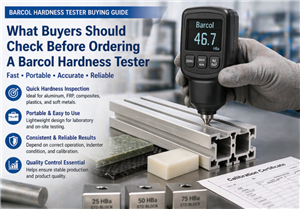
Ordering a Barcol hardness tester is not only about selecting a portable hardness instrument. Buyers should confirm whether the tester matches the material type, hardness range, sample thickness, surface condition, calibration requirement, and inspection workflow.
For aluminum profiles and soft metals, Barcol testing can support fast production hardness comparison. For FRP and composite materials, it can help evaluate curing and surface hardness consistency. For plastics and semi-rigid materials, buyers should pay special attention to sample support, material behavior, and testing standard.
A suitable Barcol hardness tester should be easy to use, reliable to verify, compatible with the sample, and supported with proper calibration blocks, spare indenters, and technical guidance. Providing clear sample information before ordering will help avoid mismatch and make the quotation more accurate.